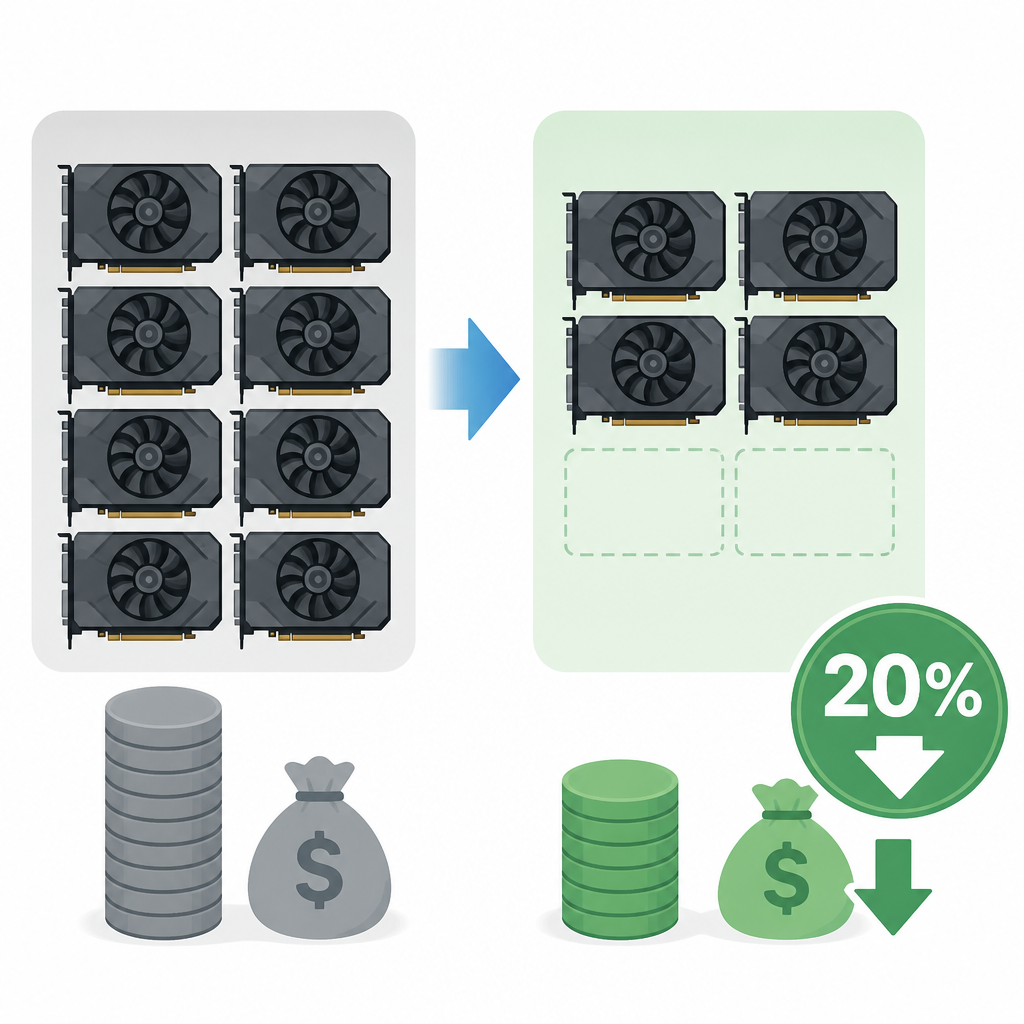
GPT-5.6 Sol cuts GPU costs 20%
GPT-5.6 Sol rewrote production GPU kernels with Codex, Triton, Gluon, and FpSan, cutting OpenAI inference costs 20%.

OpenAI moved from hand-tuned kernels to Sol rewriting them and cut inference costs 20%.
I've been around enough model and infra stacks to know when something feels off. You wire up the agent, give it tools, point it at a repo, and it happily nods along like a junior engineer who wants to please you. Great for vibes. Terrible for production. The real problem is not whether the model can write code. It's whether it can touch the ugly, brittle, performance-sensitive parts of a system without turning the whole thing into a support ticket.
That is why this OpenAI write-up got my attention. It is not another “look, the model made a toy app” story. It is about production GPU kernel code, the stuff that actually moves money around. And the part that matters is not just that Sol rewrote code. It is that OpenAI says the result lowered inference cost by 20%. That is the kind of number that makes infra people stop scrolling.
I pulled this apart from the original post on Zhihu, which summarizes OpenAI’s internal setup: Sol using Codex to rewrite production kernels in Triton and Gluon, then checking the output with FpSan. The key detail here is that this is production code, not a lab demo. That changes everything.
OpenAI did not ask the model to write pretty code; it asked for cheaper code
Get the latest AI news in your inbox
Weekly picks of model releases, tools, and deep dives — no spam, unsubscribe anytime.
No spam. Unsubscribe at any time.
GPT-5.6 Sol used Codex to rewrite OpenAI production GPU kernel code in Triton and Gluon, and the result reduced inference cost by 20%.
What this actually means is simple: the goal was not “can the model code?” The goal was “can the model improve the economics of a live system?” That is a much nastier task. Kernel code is where tiny mistakes become big latency spikes, weird correctness bugs, or a bill that makes your finance team stare at the ceiling.

I like this framing because it strips away the usual agent theater. No one cares if the model can produce a neat little function with good variable names. Production infra teams care about throughput, memory access patterns, fusion opportunities, and whether the change survives load. If the model can make the system 20% cheaper, then the discussion changes from novelty to operations.
How to apply it: stop evaluating coding agents on “can it finish a toy task?” Start evaluating them on one constrained cost target. Pick a path in your stack that burns real money, then define success as a measurable reduction in compute, latency, or memory. If you cannot name the metric, you are still in demo land.
- Choose one hot path, not a broad refactor.
- Define a concrete economic target: cost, latency, or memory.
- Require a before/after benchmark, not a code sample.
Triton and Gluon matter because they are already the language of the fight
OpenAI says Sol worked in Triton and Gluon, both open-source GPU programming tools it maintains. That matters more than people think. If you want an agent to modify performance-critical code, you do not start by throwing it into raw CUDA and hoping it survives. You give it a higher-level surface where the patterns are more legible and the search space is less insane.
What this actually means is that the model was not asked to invent the whole abstraction stack from scratch. It was asked to operate inside OpenAI’s own preferred GPU toolchain. That makes the task both more realistic and more contained. The model can optimize within a language that already encodes some of the dangerous choices. That is a much better shape for automation.
I have seen teams try to automate low-level performance work by letting a model edit whatever language the repo already uses. That usually ends with five half-correct variants and one broken edge case. The smarter move is to narrow the space. Put the agent in a DSL or framework that expresses the right kind of intent, then let humans review the output like adults.
How to apply it: if your stack has a performance layer, create a narrower interface for model edits. That could be a DSL, a wrapper API, or a codegen template. The point is to reduce the number of ways the model can be wrong.
- Prefer structured kernels over free-form edits.
- Expose only the knobs that matter for performance.
- Keep the generated surface small enough to audit.
FpSan is the boring part, and that is exactly why it matters
OpenAI also used FpSan, an open-source verification tool, to check that Sol’s kernel code was correct. I respect this a lot more than a flashy agent demo. Anyone can generate code. Fewer people can prove it is not quietly wrong. And with numerical code, “quietly wrong” is the worst kind of wrong because it often passes casual tests before it ruins your week.
What this actually means is that OpenAI did not trust the model’s output on faith. It wrapped the output in a verification layer. That is the right instinct. If you are letting an agent touch low-level compute, the agent is not the final authority. The verifier is. The model proposes; the checker disposes.
I ran into this exact pattern when reviewing auto-generated optimization code for a pipeline. The first pass looked great in benchmarks until we hit a weird input distribution. The lesson was brutal but useful: speed wins are fake until correctness is pinned down. Verification is not optional decoration. It is the thing that makes the whole workflow usable.
How to apply it: pair every agentic code path with a checker. That might be property tests, symbolic checks, differential testing, or a domain-specific verifier like FpSan. If you cannot verify it automatically, keep the agent far away from production-critical code.
This is not “AI writes code”; it is “AI enters the performance loop”
The headline here is easy to misread. This is not about replacing engineers. It is about moving the model into a tighter feedback loop where it can search for better implementations faster than a human can. That is a very different claim. It is also a much more believable one.
What this actually means is that the model is being used like an optimization engine. Humans still define the target, the constraints, and the guardrails. The model explores the space of implementations. That is how I would want to use it anyway, because performance work is usually a miserable mix of pattern recognition, benchmarking, and tedious micro-iteration.
I have spent too many hours staring at kernel diffs that only matter because one memory access got reordered or one fusion opportunity disappeared. A model that can propose ten variants while I am still reading the first one is actually useful. But only if the system around it is strict. Loose agent loops just create expensive noise.
How to apply it: use the model for search, not authority. Give it a benchmark harness, a correctness gate, and a narrow optimization target. Then compare variants like you would compare any other performance patch.
The real lesson is that the guardrails are part of the product
People love to talk about the model output and ignore the scaffolding. That is backward. In this story, the important pieces are not just Sol, Codex, or the rewritten kernels. The important pieces are the surrounding tools that made the rewrite safe enough to ship: Triton, Gluon, and FpSan.
What this actually means is that agentic coding in production is never just the model. It is the model plus the language surface plus verification plus benchmarks plus human review. If any of those are missing, the whole thing turns into a science fair project with a pager attached.
This is where a lot of teams get lazy. They buy into the fantasy that a strong model can skip engineering discipline. It cannot. It just changes which discipline matters. You still need tests, invariants, and a review process. You probably need even more of them because the model can now produce plausible nonsense at scale.
How to apply it: document the guardrails before you let the agent write anything. Make the safety layer explicit in your workflow, not an afterthought. If the model is going to touch production, the surrounding process should be stricter than your normal PR flow, not looser.
- Define what the model may edit.
- Define what must be auto-checked.
- Define who signs off on the final patch.
Why this matters to teams shipping real systems
If you build infra, compilers, runtimes, or anything else where performance is money, this is the part worth paying attention to. The takeaway is not “AI can code now.” It is “AI can participate in highly constrained optimization work if the environment is shaped correctly.” That is a much more practical claim.
What this actually means is that the winning workflow is probably not a giant autonomous agent wandering through your repo. It is a set of narrow, high-trust lanes where the model can propose improvements, prove them against a checker, and hand them back for review. That is boring. It is also how production software gets better.
I am skeptical of broad autonomy in codebases because the failure modes are too expensive. But I am very interested in tightly scoped optimization loops. That is where the model’s speed actually helps. It can generate more candidates than I can, and if the verifier is strong enough, I do not have to trust the vibes.
How to apply it: identify one area where the model could save compute or developer time without needing broad repo access. Build the smallest possible loop around it. If it works, expand carefully. If it does not, you have lost a week, not a quarter.
The template you can copy
# Agentic performance-optimization workflow for production code

## Goal
Use an LLM-based coding agent to propose performance improvements for a hot path,
then verify correctness and benchmark the result before any merge.

## Scope
- Only allow edits in one directory or module.
- Only allow changes to performance-sensitive code.
- Do not allow the agent to modify tests, release scripts, or deployment config.

## Inputs
- A single target file or kernel.
- A benchmark harness with a baseline run.
- A correctness specification.
- A constrained implementation surface, such as a DSL or codegen wrapper.

## Workflow
1. Run the baseline benchmark and record latency, throughput, memory, and cost.
2. Ask the agent to propose one optimization at a time.
3. Require the agent to explain the expected effect before code is generated.
4. Generate the patch inside the constrained surface.
5. Run an automatic verifier:
   - property tests
   - differential tests
   - numerical checks
   - domain-specific validation like FpSan-style checks
6. Re-run the benchmark against the baseline.
7. Reject any patch that fails correctness, regresses readability beyond the agreed limit, or does not improve the target metric.
8. Human review the final diff.

## Review checklist
- Does the patch preserve correctness for edge cases?
- Does the patch reduce the target metric in a repeatable way?
- Is the change understandable enough to maintain?
- Did the agent stay inside the allowed scope?
- Can we reproduce the benchmark result?

## Output format for the agent
- Proposed change
- Expected performance effect
- Risks
- Patch
- Verification plan

## Merge rule
Only merge if the verifier passes and the benchmark shows a real improvement over baseline.

## Example prompt to the agent
You are optimizing a production kernel. Your goal is to reduce inference cost without changing numerical correctness.
Use only the allowed implementation surface.
Return one patch, one explanation, and one verification plan.
Do not expand scope.
Do not rewrite unrelated code.
The original source is this Zhihu post, which summarizes OpenAI’s internal example. My breakdown is derivative, but the workflow template above is mine, built from the pattern in that source and the production constraints I would use in a real team.
// Related Articles
- [TOOLS]
DeepSeek V4 Flash turns Agent work cheap
- [TOOLS]
Astra Turns a Math Post Into a Model Launch
- [TOOLS]
OpenAI’s API changelog adds spend caps, transcribe, and Fast mode
- [TOOLS]
Windsurf’s IntelliJ plugin is a shortcut, not a strategy
- [TOOLS]
SWE-1.7 free preview lands in Devin Desktop
- [TOOLS]
Vibe Island’s changelog shows the right product bets