HANDOFF makes humanoid control more planner-friendly
HANDOFF gives humanoid robots a compact control interface and distills three specialists into one controller.
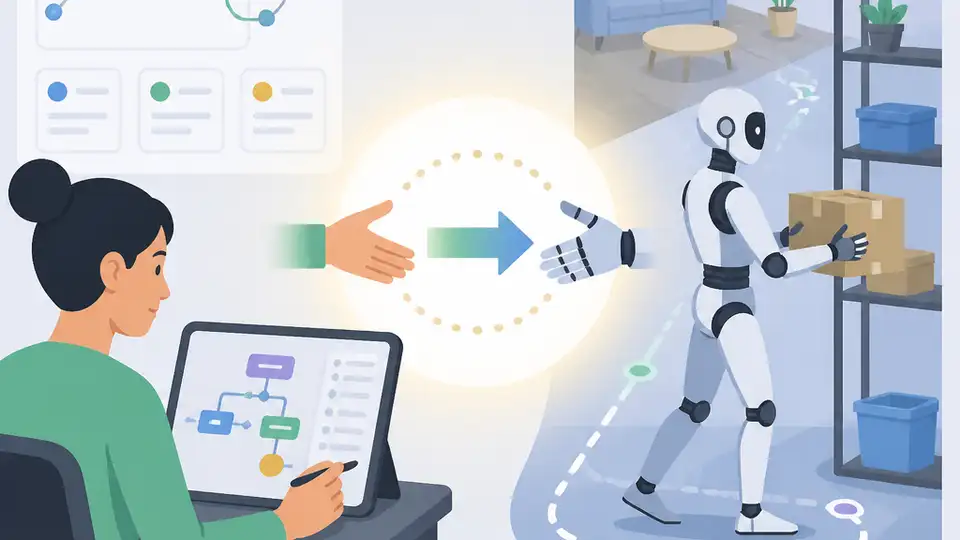
HANDOFF gives humanoid robots a compact control interface and distills three specialists into one controller.
- Research org: Unspecified in arXiv abstract
- Core data: No benchmark numbers in abstract
- Breakthrough: Distills complementary teachers into a context-gated mixture-of-experts student
Humanoid robots are hard to control because the thing that plans the task and the thing that executes whole-body motion often speak very different languages. This paper is about narrowing that gap with an interface that is easier for planners to use, while still being expressive enough for real manipulation and locomotion.
That matters if you care about deploying humanoids outside a lab. The paper’s core claim is practical: if the command space is too dense or too low-level, task planners struggle to produce usable references. HANDOFF is designed to be a middle ground.
What problem HANDOFF is trying to fix
Get the latest AI news in your inbox
Weekly picks of model releases, tools, and deep dives — no spam, unsubscribe anytime.
No spam. Unsubscribe at any time.
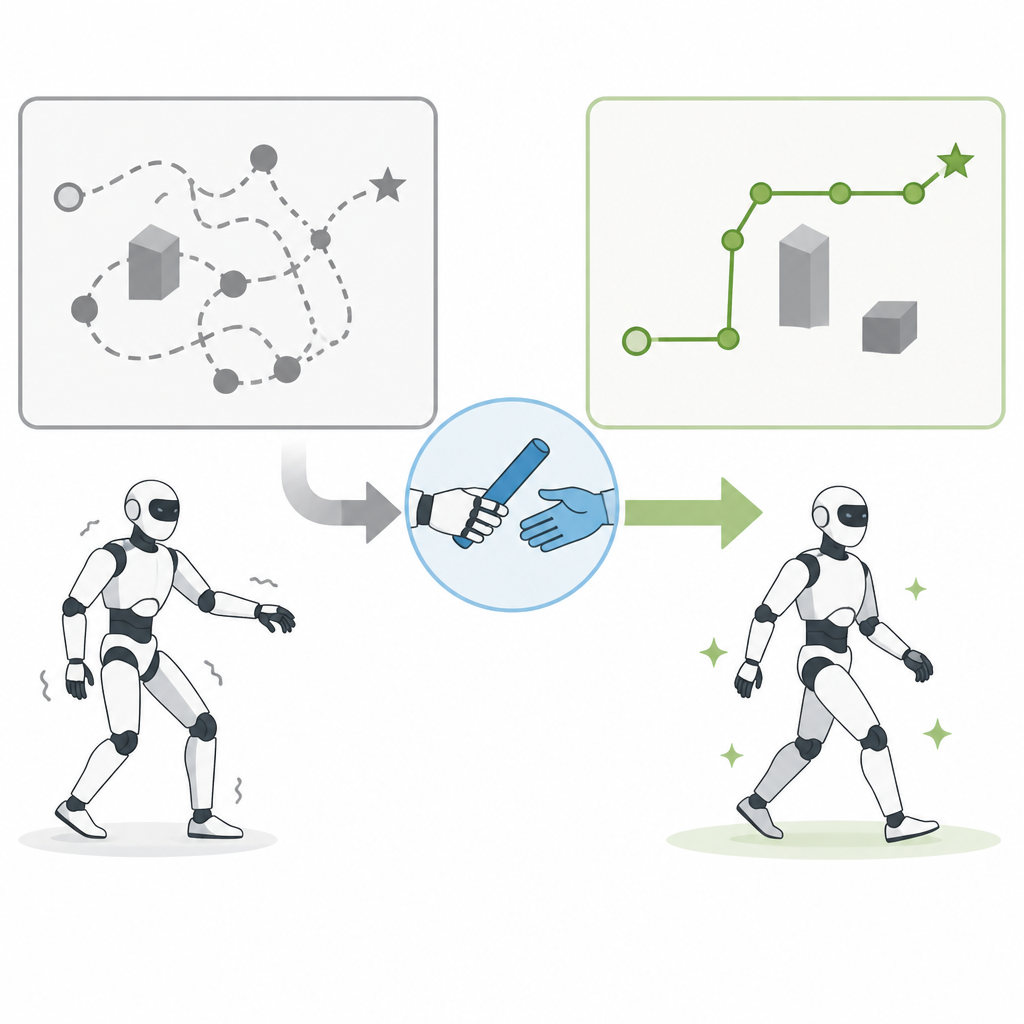
The abstract frames the main bottleneck clearly: existing whole-body controllers usually need dense kinematic or spatial references. Those are fine when a system already knows exactly how to move, but they are awkward when a planner only has task semantics, like “pick up,” “walk over,” or “recover balance.”
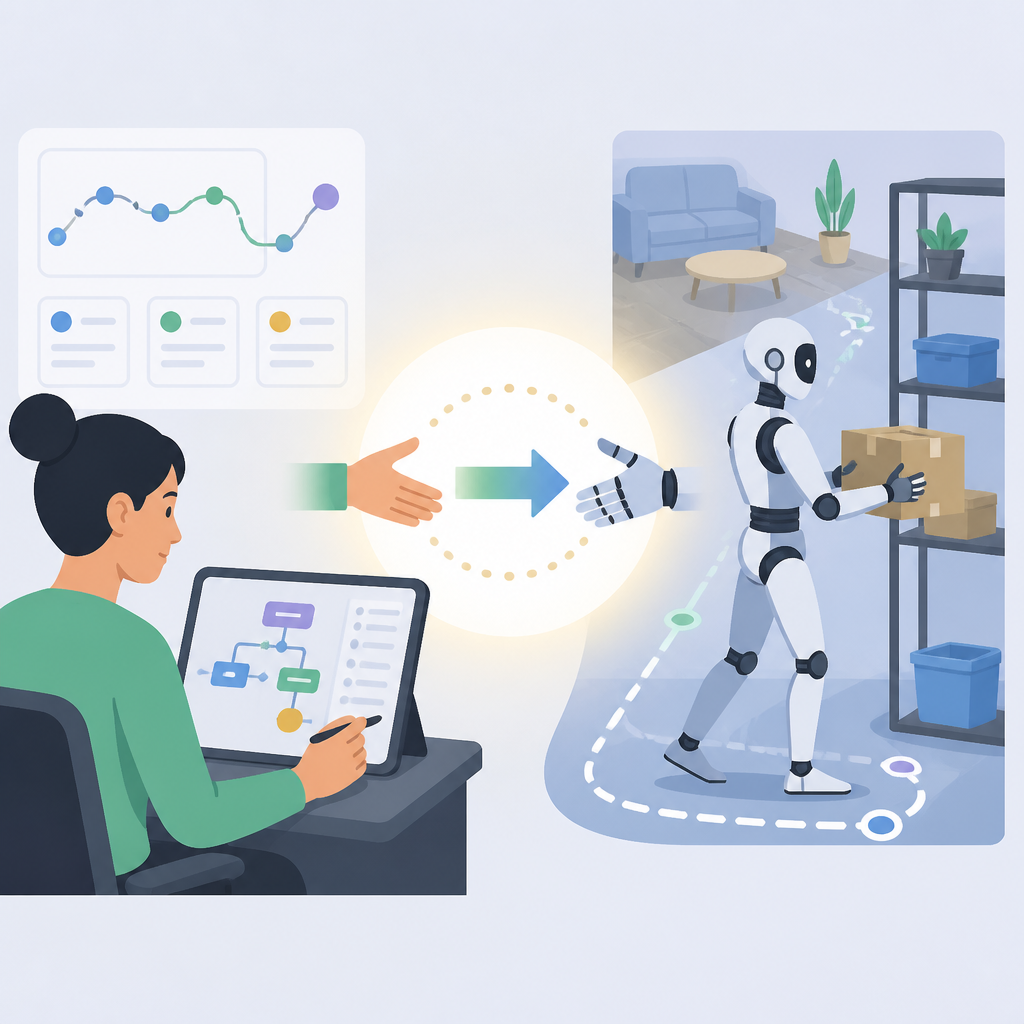
In other words, the interface between planning and control is doing too much work. If the command space is cumbersome, the planner has to synthesize details that are not naturally present in the task description. That creates friction for agentic systems that need to chain perception, language, planning, and control.
HANDOFF is proposed as a compact, explicit interface that is meant to be intuitive, general, modular, and expressive enough for diverse manipulation skills. The paper is not claiming to solve all humanoid control problems; it is trying to make the handoff between high-level intent and whole-body execution less brittle.
How the method works in plain English
The system centers on a single humanoid whole-body controller that follows the new interface. Instead of training that controller from scratch as one monolithic policy, the authors distill it from multiple specialists.
Those specialists are complementary: one focuses on whole-body motion tracking with safety-filtered data, one on locomotion, and one on fall recovery. The student controller is trained with multi-teacher KL distillation, and a context-conditioned gating scheme decides how much each specialist should influence the student for a given situation.
That design choice is the paper’s technical core. A mixture-of-experts student can absorb different behaviors without forcing all of them through one undifferentiated policy. The gating mechanism is what makes the mixture context-aware rather than just a bag of skills.
For engineers, the appeal is straightforward: instead of building separate controllers for tracking, walking, and recovery, HANDOFF aims to unify them under one interface and one executable policy. The paper positions that as a cleaner way to support agentic humanoid behavior.
What the paper actually shows
The abstract reports results on the Unitree G1. HANDOFF matches state-of-the-art velocity tracking, and it offers one of the largest robust manipulation workspaces. Those are the only concrete performance claims given in the source, so there are no benchmark tables or numeric scores to quote here.
The paper also says the system is hardware-feasible. That is important because a lot of humanoid control ideas look good in simulation but get stuck when they meet real sensors, latency, and safety constraints. Here, the authors say they demonstrate multiple natural-language-driven task roll-outs on hardware.
Those roll-outs are powered by a VLM-driven agentic planner, and the abstract emphasizes that they use no task-specific data and no controller fine-tuning. That suggests the controller interface is doing real integration work: the planner can issue task-level instructions without being retrained for each new behavior.
Still, the source is careful in what it does and does not say. It does not provide exact success rates, workspace dimensions, latency numbers, or comparison details in the abstract. If you need hard performance deltas, you would have to read the full paper.
Why developers should care
If you work on robotics software, the interesting part is not just that the controller is strong, but that it is structured for composition. A compact interface between planner and controller makes it easier to plug in new task logic without rewriting the low-level stack every time.
The multi-teacher setup is also a useful pattern. Real humanoid behavior is not one skill; it is a bundle of skills that are often trained under different data regimes and safety constraints. Distillation into a context-gated student is a way to consolidate that complexity without flattening it.
For teams building agentic robots, the paper points toward a more maintainable architecture: language or vision can drive the task, while the controller handles whole-body execution through a stable intermediate representation. That is a better story than forcing a planner to output dense motion references directly.
Limitations and open questions
The biggest limitation is also the most obvious one: the abstract gives only high-level results. It says HANDOFF matches state-of-the-art velocity tracking and has one of the largest robust manipulation workspaces, but it does not give the numbers needed to judge margin, robustness, or statistical significance.
There is also an open question about generality. The paper shows hardware feasibility on the Unitree G1, but the abstract does not say how much of the approach transfers across robot morphologies, sensor suites, or task families. That matters if you are thinking about adoption beyond one platform.
Another practical question is how the context-conditioned gating behaves under novel conditions. Mixture-of-experts systems can be powerful, but they depend on the gating logic making the right call when the robot is outside the training distribution. The abstract does not answer that, so it remains a key thing to inspect in the full paper.
Even with those caveats, HANDOFF is a useful signal for the field. It treats the planner-to-controller boundary as a first-class design problem, not an implementation detail. For humanoids that need to act on real-world commands, that boundary may be where a lot of the complexity lives.
Bottom line
HANDOFF proposes a humanoid control stack that is easier for planners to use, while still being grounded in whole-body motion, locomotion, and recovery skills. The paper’s main contribution is the interface plus the distillation strategy, not a new benchmark suite.
If you are building agentic robotics systems, the takeaway is simple: a better command space can matter as much as a better policy. HANDOFF is an attempt to make that command space compact enough for planning and rich enough for real humanoid behavior.
- It reframes humanoid control around a more planner-friendly interface.
- It consolidates multiple specialist controllers into one context-gated student.
- It demonstrates real-robot task roll-outs without task-specific fine-tuning.
// Related Articles