A Survey of Large Language Models
This survey maps the landscape of large language models and explains the core ideas behind them.

This survey maps the landscape of large language models and explains the core ideas behind them.
- Research org: Unspecified in arXiv abstract
- Core data: No benchmark numbers in abstract
- Breakthrough: Survey of LLM architectures, training, and applications
This paper is a broad survey, not a new model or a benchmark report. For engineers, that matters because surveys are often the fastest way to get oriented before you choose a stack, design an evaluation plan, or decide which LLM techniques are worth deeper reading.
Because the abstract provided here is just the arXiv landing-page text, it does not include the usual technical details you would expect from a full research abstract. There are no benchmark numbers, no dataset descriptions, and no performance claims to compare against other systems.
What problem this paper is trying to fix
Get the latest AI news in your inbox
Weekly picks of model releases, tools, and deep dives — no spam, unsubscribe anytime.
No spam. Unsubscribe at any time.
The main problem with large language models is not a single algorithmic bug; it is the sheer sprawl of the field. LLMs touch model architecture, pretraining, instruction tuning, alignment, prompting, evaluation, and downstream applications, and that makes the literature hard to navigate.

A survey tries to compress that sprawl into a coherent map. Instead of introducing one new method, it helps readers understand how the parts fit together and where the important tradeoffs usually show up.
For developers, that is useful in a very practical way. If you are trying to build with LLMs, you need a mental model of the ecosystem before you can make good decisions about prompting, fine-tuning, deployment, or safety constraints.
How the method works in plain English
Since this is a survey, the “method” is really an organizing framework. The paper’s job is to collect the major ideas around large language models and present them in a structured way rather than proving a new technical trick.
In practice, that usually means grouping the field into themes such as how models are trained, how they are adapted to tasks, and how they are used in real systems. A good survey also points out where the literature is still unsettled, which is often more valuable than a single headline result.
The abstract available here does not spell out the survey’s section structure, so we should not pretend to know its exact taxonomy. What we can say is that the paper is meant to be a guide to the LLM landscape rather than a narrow contribution in one sub-area.
What the paper actually shows
There are no benchmark numbers in the abstract, so there is no empirical result to report from the provided source. That is normal for a survey paper: its value is in synthesis, not in claiming a new state-of-the-art score.
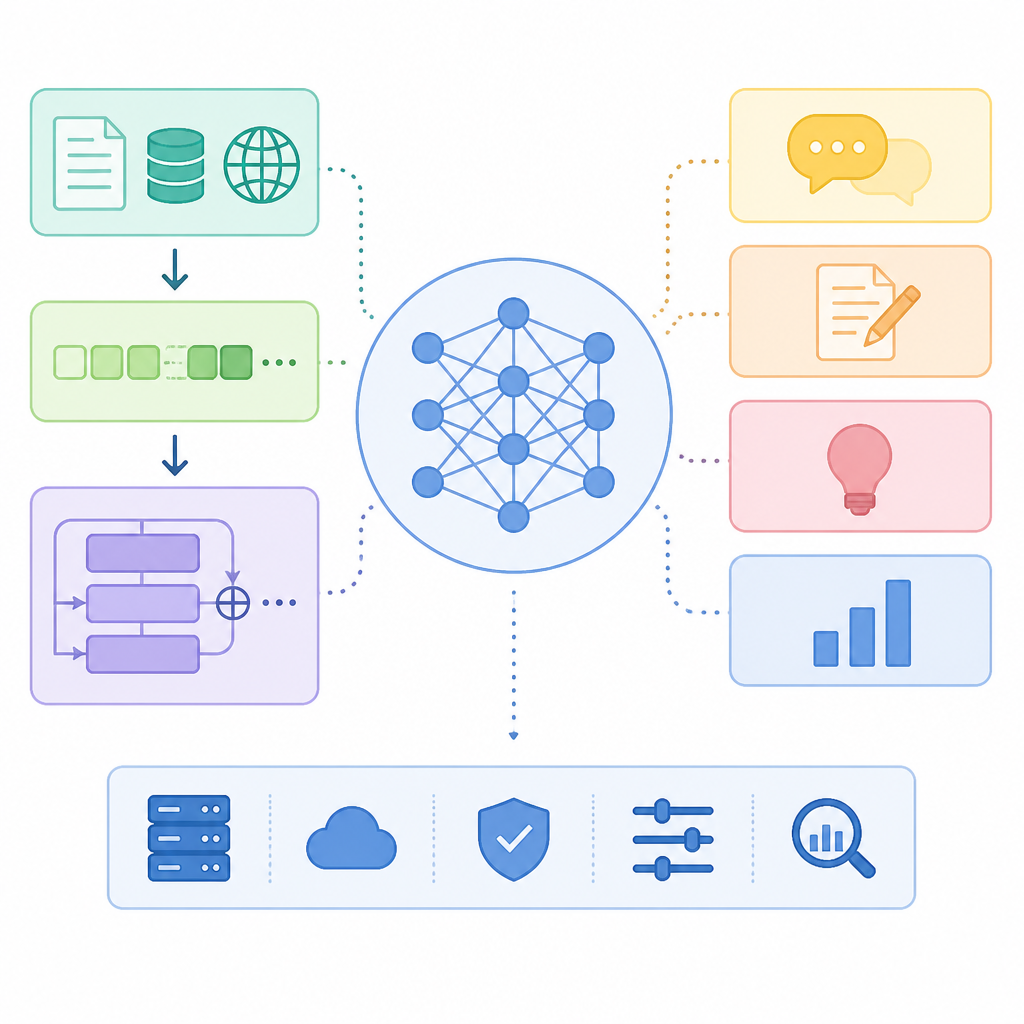
What the paper does show, based on the title and abstract page, is that large language models are now important enough to warrant a dedicated survey. That alone signals a mature and fast-moving area where the basics are no longer enough and practitioners need a higher-level overview.
For readers looking for hard metrics, this abstract does not provide them. If you need evaluation numbers, latency comparisons, or cost data, you would need to inspect the full paper or the sources it cites.
- It is a survey of large language models, not a new model release.
- The abstract page does not include benchmark results or datasets.
- Its value is in organizing the field for readers who need context.
Why developers should care
LLM work is full of accidental complexity. You can waste a lot of time if you treat prompting, fine-tuning, retrieval, and evaluation as isolated topics instead of parts of one system. A survey helps reduce that friction by giving you a common vocabulary and a map of the design space.
That matters whether you are building internal tooling, a customer-facing assistant, or an evaluation harness. The better you understand the field, the easier it is to spot when a problem is about model capability, data quality, prompt design, or deployment constraints.
It also helps with reading other papers. Once you know the major categories in LLM research, new papers become easier to place: is this about pretraining, instruction following, alignment, or application-specific adaptation? That context saves time and makes technical reviews more useful.
Limitations and open questions
The biggest limitation here is that the provided abstract page is extremely sparse. It does not tell us which subtopics the survey emphasizes, what literature cutoff it uses, or how deeply it goes into any one area.
Another limitation is that surveys age quickly in a fast-moving field. A strong survey can still become dated as model families, training recipes, and evaluation practices change. That is especially true for large language models, where the state of the art moves fast.
So the right way to use this paper is as a starting point, not a final authority. It is a map, not the territory.
Bottom line
If you want a single paper that helps you orient yourself in the LLM ecosystem, this survey is the kind of document you would start with. It does not promise a new benchmark or a novel system in the abstract provided here, but it does point to the need for an organized view of a complex field.
For engineers, that can be enough to justify a read. A clear survey can save hours of trial-and-error by showing which ideas are foundational, which are application-specific, and where the open problems still live.
// Related Articles
- [RSCH]
How to test memory in LLM agents
- [RSCH]
How persona steering changes LLM behavior
- [RSCH]
LLM Inference Hardware Needs Memory, Not More FLOPs
- [RSCH]
Agent Skills: the next layer for LLM agents
- [RSCH]
Offline-First LLMs for Low-Connectivity Learning
- [RSCH]
How LLMs are changing US research funding