How to hand off LLM session state
This paper defines what an LLM app must keep when a task continues in a new session.

This paper defines what an LLM app must keep when a task continues in a new session.
- Research org: Unspecified in arXiv abstract
- Core data: No benchmark numbers in abstract
- Breakthrough: Three-part record for exact decisions, repeated evidence, and unrecoverable observations
When an LLM task runs out of context window, the app restarts, or a second agent takes over, the hard part is not just “saving memory.” It is deciding which parts of the earlier interaction are actually necessary for the next step. This paper treats that problem as a formal handover of task-relative in-context learning state.
That matters for any developer building long-running assistants, multi-agent workflows, or systems that have to survive interruptions. The paper’s angle is useful because it separates what must be preserved exactly from what only needs to preserve the downstream prediction behavior.
What problem this paper is trying to fix
Get the latest AI news in your inbox
Weekly picks of model releases, tools, and deep dives — no spam, unsubscribe anytime.
No spam. Unsubscribe at any time.
Most LLM applications eventually hit a boundary: the prompt gets too long, the process restarts, or another agent needs to continue the work. At that point, the system has to decide what to carry forward from the earlier session. If it keeps too little, the next session may lose important task context. If it keeps too much, it wastes memory and may still fail to preserve the behavior that matters.

This paper frames that as a theoretical problem rather than a UI or product problem. The object being transferred is not just text history, but a task-relative in-context learning state. In other words, the question is not “what happened before?” but “what information is sufficient for the model to continue making the right predictions?”
The abstract also draws a distinction that is easy to miss in practice: exact recovery of earlier material is not the same as preserving the target distribution. A handover can be useful even if it does not reconstruct every original token, as long as it preserves the downstream behavior the continuation task depends on.
How the method works in plain English
The paper formulates handover under an exogeneity condition and studies predictive equivalence. That gives a way to characterize the coarsest deterministic handover that is still sufficient. “Coarsest” here means the smallest deterministic summary that does not lose the predictive behavior needed for the continuation.
Once you think in those terms, memory becomes a design constraint with a measurable cost. The paper says predictive equivalence yields a fixed-length bit requirement, which means there is a lower bound on how compact the handover can be if you want to preserve the right task behavior.
The analysis also separates three forces that affect the result: the memory constraint itself, the writer that creates the handover record, and the continuation procedure that consumes it. That separation is important because it shows that a handover is not just a storage problem; it depends on how the record is written and on what query comes next.
One especially practical point is that the paper quantifies the cost of writing before the downstream query is known. That is exactly the situation many systems face in production: you often have to compress or summarize state before you know the next user turn or the next agent step.
What the paper actually proposes
The main design idea is a three-part record. The abstract describes it as a record that stores decisions and constraints exactly, uses task-justified statistics for repeated evidence, and retains original observations whose effect is not preserved by those statistics.
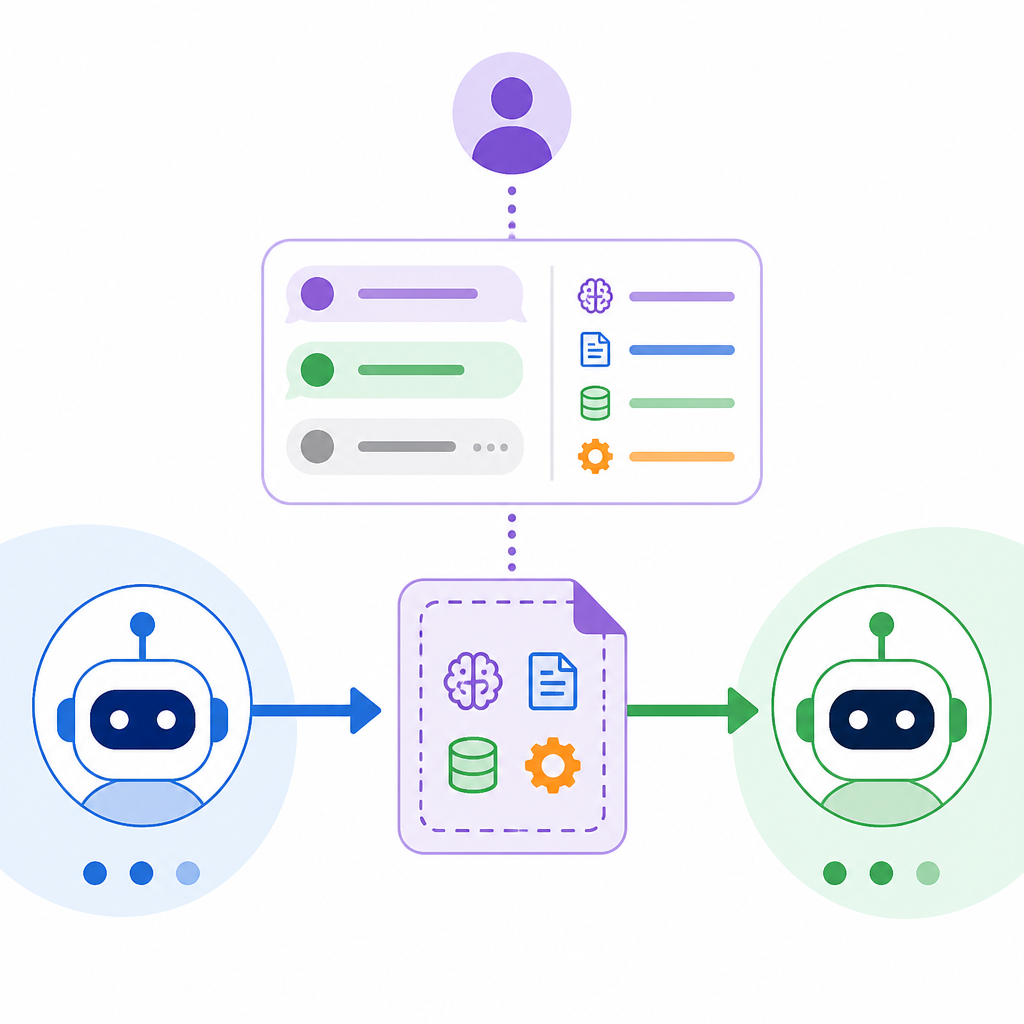
That structure is a useful mental model for engineers. Some facts should be preserved verbatim because they are decisions or constraints. Some information can be compressed into statistics because it repeats and the task justifies that summary. And some observations need to stay in their original form because a statistical summary would lose the effect that matters for the continuation.
In practice, that suggests a handover format that is not just a plain summary and not just a raw transcript. It is a selective record with different retention rules for different kinds of information.
What the paper shows
The abstract does not list benchmark numbers, so there is no empirical leaderboard-style result to report here. Instead, the contribution is theoretical: it gives exact and bounded results for different model classes and continuation settings.
For Gaussian linear regression, the paper says there is an exact finite-dimensional handover and finite-bit perturbation bounds. That is a strong result because it shows the state can be compressed into a finite representation without losing the relevant continuation behavior in that setting.
For nonparametric regression, the paper gives upper and lower bounds that connect memory to squared prediction error. So instead of a single exact compression rule, it describes a tradeoff: more memory can reduce prediction error, and the bounds describe how tight that relationship is.
Those results give the paper its practical value. They move handover from an ad hoc summarization problem to a formal question about sufficiency, compression, and error under continuation.
Why developers should care
If you are building an assistant that has to survive context-window cuts, session resets, or handoffs between agents, this paper gives a vocabulary for deciding what state to preserve. It tells you to think in terms of downstream predictive equivalence, not just transcript length.
That can influence how you design memory layers, checkpointing, and session-resume logic. For example, a system could store exact decisions and constraints separately from recurring evidence and from raw observations that cannot be safely summarized. Even without implementation details in the abstract, the structure is directly relevant to production architecture.
The paper also makes clear that there is a cost to committing to a handover before you know the next query. That is a real systems issue: if you compress too aggressively too early, you may throw away information that turns out to matter for the actual continuation.
Limitations and open questions
Because the source here is only the abstract, the paper does not provide benchmark results, datasets, or engineering evaluations. So while the theory is clear, the abstract does not tell us how the method performs in a real LLM application or how easy it is to implement at scale.
The results are also model- and assumption-dependent. The abstract highlights an exogeneity condition and gives specific results for Gaussian linear regression and nonparametric regression. That means the theory is strongest in the settings it analyzes, and the generalization to real product workloads is still an open question from the abstract alone.
Still, the core takeaway is valuable: session handover should be treated as a formal state-transfer problem, with explicit rules for what must survive and what can be compressed. For anyone shipping long-context or multi-agent LLM systems, that is a much better starting point than “just summarize the chat.”
- Session handover is framed as transferring task-relative in-context learning state.
- The paper distinguishes exact recovery from preserving downstream predictive behavior.
- A three-part record separates exact decisions, reusable statistics, and raw observations.
// Related Articles
- [RSCH]
Marionette splits game world state from appearance
- [RSCH]
Uncertainty-Aware AI Reads Prehistoric Hand Stencils
- [RSCH]
Long-horizon agents need harnesses first, not bigger models
- [RSCH]
Grok 4.6 puts frontier IQ on a budget
- [RSCH]
Anthropic's watermark fails the real dev workflow
- [RSCH]
HumanTracker fixes humanoid motion eval blind spots