Uncertainty-Aware AI Reads Prehistoric Hand Stencils
A deep learning pipeline models stencil uncertainty to estimate sex and flag ambiguous prehistoric hand prints.
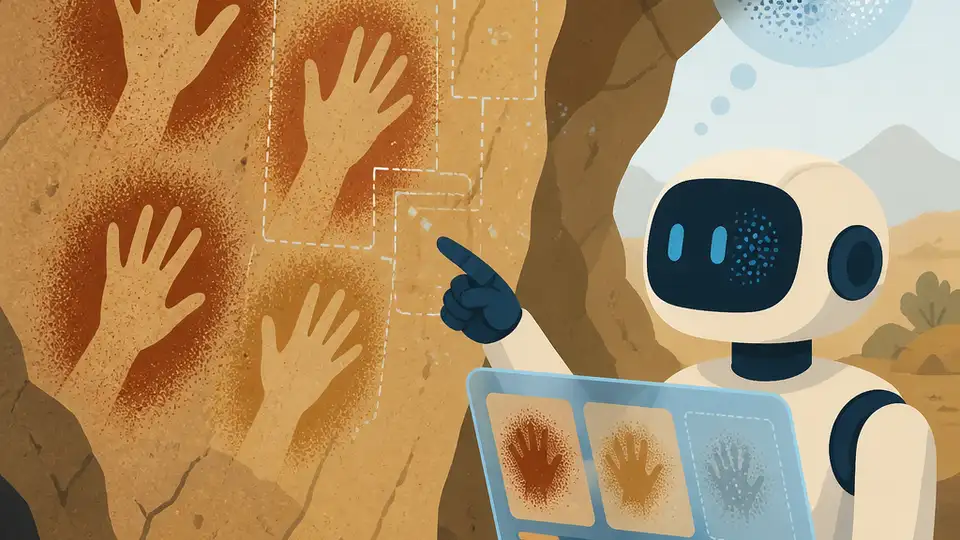
Earlier methods guessed from hand stencils; this framework models uncertainty to estimate sex and flag ambiguity.
- Research org: Unspecified in arXiv abstract
- Core data: 14,036 contemporary hand samples
- Breakthrough: Dual contour extraction plus ensemble uncertainty aggregation
Archaeological sex attribution from prehistoric hand stencils has always been messy: there is no ground truth for the ancient makers, modern reference data may not match prehistoric populations, and image degradation can distort the silhouette you are trying to measure. This paper tackles that problem with a deep learning pipeline that does not pretend the input is clean. Instead, it tries to carry uncertainty through the full workflow and surface it in the final decision.
That matters beyond archaeology. If you build systems that classify imperfect visual data, the useful question is often not just “what is the label?” but “how confident is the model, and where is the input ambiguous?” This study is a concrete example of turning uncertainty from a nuisance into part of the output.
What problem the paper is trying to fix
Get the latest AI news in your inbox
Weekly picks of model releases, tools, and deep dives — no spam, unsubscribe anytime.
No spam. Unsubscribe at any time.
The abstract is clear about the failure modes of traditional morphometric methods. Hand stencil sex attribution suffers from high structural overlap between sexes, weak generalization across populations, and subjective feature engineering. In other words, if the boundary is fuzzy, the population differs from the training set, or the hand shape is hard to summarize with hand-written features, the old approach gets shaky fast.

There is also a deeper issue: prehistoric stencils do not come with labels. That means the pipeline has to make inference under uncertainty, not just classification. The paper’s core idea is to explicitly model that uncertainty rather than hide it behind a single prediction.
For developers, that is a familiar pattern. The same problem shows up in medical imaging, document OCR, industrial inspection, and any computer vision task where the source material is degraded or the labels are not fully trustworthy. The paper is basically saying: if the input is uncertain, your pipeline should be uncertain too.
How the method works in plain English
The framework combines several pieces. First, it uses dual image processing and dual contour extraction, then builds structured silhouette augmentations to create multiple plausible versions of each stencil boundary. The goal is to represent not one “true” outline, but a small set of plausible outlines that reflect boundary uncertainty.
According to the abstract, each stencil is expanded into twelve plausible silhouette realizations. Those are then processed by two ensembles of ten deep neural networks each: one based on EfficientNet-B3 and another on MobileViT-S. The models were trained on 14,036 contemporary hand samples.
The architectural diversity is doing important work here. EfficientNet-B3 and MobileViT-S are different model families, so the ensemble is not relying on a single inductive bias. That gives the pipeline more than one way to interpret the same silhouette, which is useful when the input itself is uncertain.
The paper also adds a triangulated validation scheme. It combines ensemble predictions with unsupervised latent-space mapping using UMAP and k-NN, plus explainable AI spatial attributions using LayerCAM. In plain terms, the model is not only asked to predict a label; its internal structure and attention patterns are checked to see whether the result makes anatomical sense.
What the paper actually shows
On contemporary data, the ensemble models achieve strong classification performance, with accuracies exceeding 88% in older age groups. The abstract does not provide a full benchmark table, class-by-class breakdown, or comparison against specific baselines, so those details are not available here.
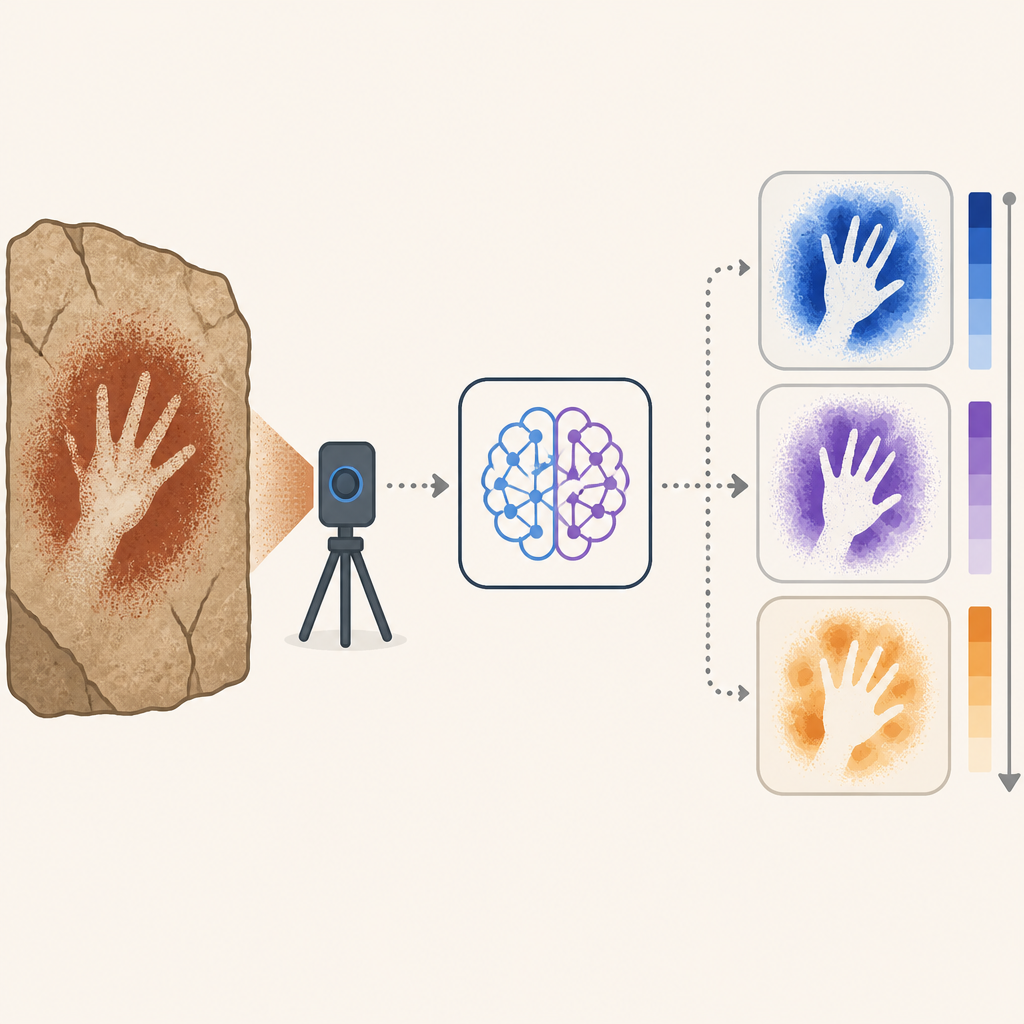
Applied to prehistoric stencils, the framework outputs both sex predictions and confidence measures based on internal agreement. That is a key result: it can separate morphologically stable cases from ambiguous ones instead of forcing every stencil into a hard label.
The authors also report convergence across ensemble predictions, latent-space structure, and interpretability analyses. The takeaway is not that the model magically solves a hard archaeological problem, but that multiple signals can agree enough to make uncertainty measurable and therefore more usable.
That is a practical distinction. A system that says “female” or “male” without context is less useful than one that says “female, but low internal agreement” or “ambiguous.” The latter is much easier to reason about in an analysis pipeline.
Why developers should care
This paper is a reminder that uncertainty-aware design is not just a statistical nicety. If you are building ML systems for noisy real-world data, the architecture should reflect what is unknown, not only what is predicted. The authors do this by adding multiple plausible inputs, multiple models, and multiple validation views.
There is also a systems lesson here: robustness often comes from redundancy plus diversity. Twelve silhouette realizations capture input uncertainty. Two model families reduce dependence on one architecture. UMAP, k-NN, and LayerCAM provide extra checks on whether the predictions line up with the data geometry and anatomy.
For practitioners, the most interesting part may be the output format. The framework does not just classify; it produces confidence measures of internal agreement. That makes it easier to decide when to trust the result, when to treat it as tentative, and when to leave a case unresolved.
Limitations and open questions
The abstract leaves several questions unanswered. It does not give a full benchmark table, the exact evaluation protocol, or a direct comparison against all traditional morphometric baselines. It also does not specify how the prehistoric stencils were curated, how many there were, or how much the image degradation varied.
Another important limitation is domain shift. The models were trained on contemporary hand samples, so the leap to prehistoric stencils still depends on how well the learned features transfer across populations and time. The paper acknowledges this problem rather than pretending it disappears.
There is also the usual interpretability caveat: LayerCAM and latent-space structure can help check whether the model is behaving sensibly, but they do not prove the biological interpretation is correct. They are support tools, not ground truth.
Even with those limits, the paper’s contribution is straightforward and useful: it shows how to build a pipeline that treats uncertainty as a first-class signal. That is a pattern worth borrowing anywhere the input is messy, the labels are incomplete, and a single hard prediction is not enough.
Bottom line
This is not just a classification paper wrapped around an archaeology use case. It is a workflow for making machine learning more honest about ambiguity. The combination of silhouette sampling, ensemble diversity, latent-space validation, and spatial attribution gives the model a way to say not only what it thinks, but how stable that belief is.
For engineers, that is the real lesson: when the data is uncertain, the pipeline should expose uncertainty all the way through the stack.
// Related Articles
- [RSCH]
How to hand off LLM session state
- [RSCH]
Marionette splits game world state from appearance
- [RSCH]
Long-horizon agents need harnesses first, not bigger models
- [RSCH]
Grok 4.6 puts frontier IQ on a budget
- [RSCH]
Anthropic's watermark fails the real dev workflow
- [RSCH]
HumanTracker fixes humanoid motion eval blind spots