Marionette splits game world state from appearance
Marionette predicts explicit game state, renders geometry exactly, and uses diffusion only for appearance.

Marionette predicts explicit game state, renders geometry exactly, and uses diffusion only for appearance.
- Research org: Unspecified in arXiv abstract
- Core data: 31% root-aligned joint error change across 48 held-out segments
- Breakthrough: Two-stage state prediction plus zero-parameter geometry rendering
Interactive game world models usually try to generate everything at once in pixels or latent space. Marionette takes a different route: it separates the parts that should be exact, like geometry and occlusion, from the parts that can be learned, like visual appearance.
That matters because long-horizon generation tends to drift. If pose, collisions, and object relationships are only implicit inside a neural sequence, small mistakes compound. Marionette is built to keep those structured world properties explicit, so the model can stay controllable over time instead of slowly losing track of the scene.
What problem this paper is trying to fix
Get the latest AI news in your inbox
Weekly picks of model releases, tools, and deep dives — no spam, unsubscribe anytime.
No spam. Unsubscribe at any time.
The paper targets interactive game world models with articulated characters. In these systems, the model is expected to predict what happens next while preserving the underlying state of the world. The problem is that many existing approaches autoregress visual observations directly, which forces the model to remember pose, geometry, and occlusion implicitly.
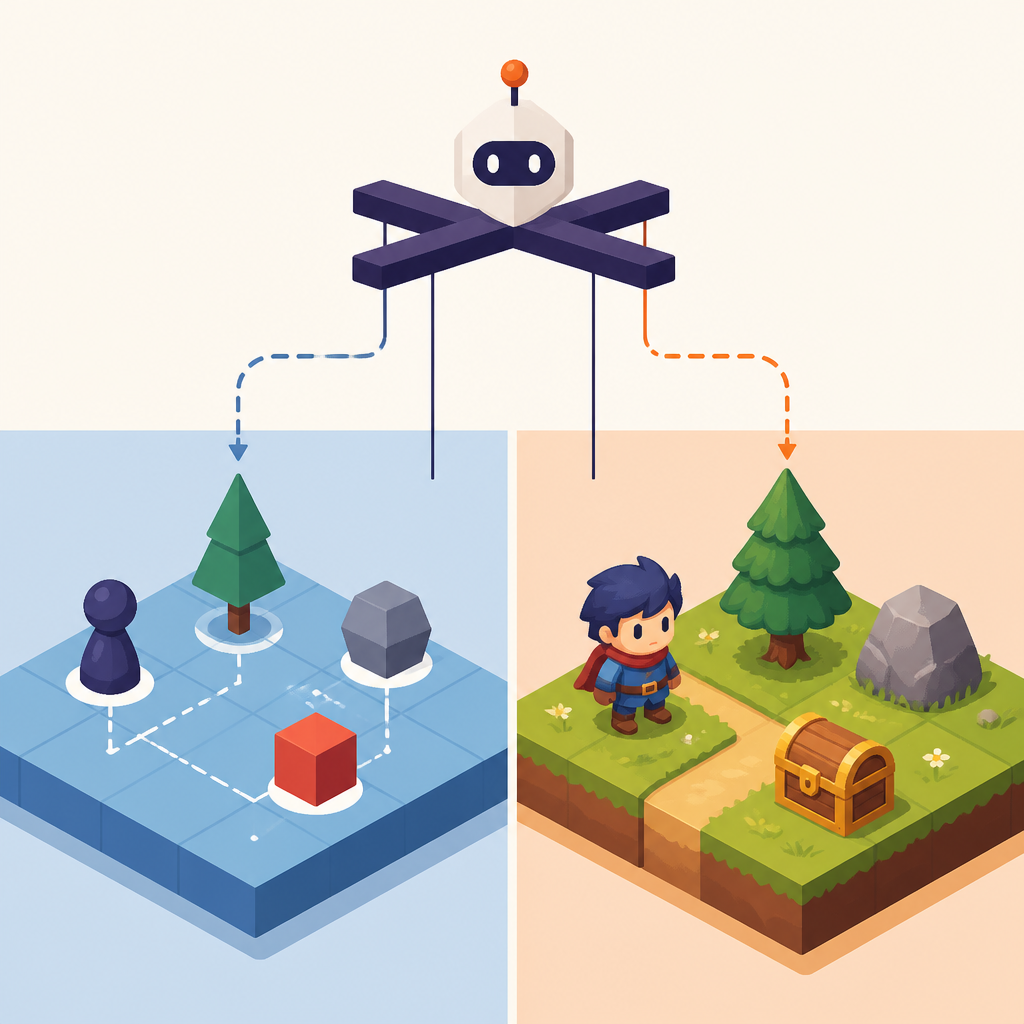
That implicit setup is fragile. Once the model slips on a joint angle, a root trajectory, or an occlusion relationship, the error can propagate through the rest of the rollout. The abstract frames this as a consistency and controllability problem: the longer the rollout, the harder it is to keep the world coherent.
Marionette’s core idea is simple: make the world state explicit, use a renderer for the exact parts, and reserve the neural generator for appearance. In other words, do not ask a video model to rediscover geometry every frame if a graphics bridge can compute it directly.
How Marionette works in plain English
The system has three pieces. First, a two-stage autoregressive dynamics model predicts an explicit 276-dimensional 3D world state. The abstract says this state includes multi-entity articulated skeletons, metric root trajectories, and rotations. That is the part that tracks where things are and how they are posed.
Second, a zero-parameter graphics bridge turns that predicted state into pose-control videos. This bridge computes world-space geometry and occlusion in closed form. The important detail for engineers is that this step is not learned, so the model is not wasting capacity on basic geometric bookkeeping.
Third, a control-conditioned video-diffusion observation model produces the final RGB output. This is where the system paints appearance. The diffusion model does not have to infer the whole world from scratch; it receives structured controls derived from the predicted state.
That division of labor is the main design point. State prediction handles dynamics, the renderer handles geometry, and the diffusion model handles visual realism. The paper is essentially arguing that these three jobs should not be mixed into one opaque autoregressive sequence.
What the paper actually shows
The abstract reports two experimental properties. First, the predicted world state is directly controllable. When the authors force a mismatched action stream, root-aligned joint error changes by 31% across 48 held-out segments. That is evidence that the state representation is not just decorative; it responds to control inputs in a measurable way.

Second, the paper shows that long-horizon behavior can be repaired in the explicit state rather than in the rendered output. Left free, the two generated characters drift to 21.2 meters apart, while recorded sessions stay near 5 meters. In the same free-running setting, a third of frames show ground penetration.
The interesting part is what happens when the authors impose two rules on the explicit state: a terrain collider and a separation cap. Those changes cut penetration by 66% and keep the pair engaged, with no change to the observation model. That suggests the state layer is a useful intervention point for fixing behavior without retraining the appearance model.
The paper also reports a fidelity check for the appearance path. Routing appearance through the predicted state costs no fidelity that the authors can detect, with an FVD of 831 against 799 for recorded pose. The abstract does not provide any other benchmark numbers beyond these, so there is no broader leaderboard context here.
Why developers should care
If you build simulation-heavy systems, game agents, or interactive world models, the lesson is practical: explicit structure makes debugging and control easier. A model that keeps pose, collision, and trajectory in a separate state space is easier to inspect than one that hides everything inside latent tokens.
It also opens up a cleaner intervention surface. Instead of trying to patch weird behavior in the image generator, you can modify the world state directly. In Marionette, the authors show that simple rules in the state layer can fix penetration and keep characters interacting, without touching the observation model.
That is a useful pattern for anyone working on embodied generation or controllable video. If the system needs to obey physics-like constraints, some parts of the pipeline may be better served by deterministic computation than by a neural net.
Limitations and open questions
The abstract is strong on the architecture and the reported effects, but it leaves several practical questions unanswered. It does not say how broad the evaluation is beyond the held-out segments and recorded sessions mentioned in the results. It also does not provide a full benchmark suite, so it is hard to compare Marionette against other world models from the abstract alone.
Another open question is generality. The method is instantiated for interactive games with articulated characters, so the exact setup is specialized. The paper shows that explicit state repair works in that setting, but the abstract does not establish how well the approach transfers to other kinds of scenes, objects, or motion regimes.
There is also an engineering tradeoff hiding in the design. A zero-parameter renderer makes geometry exact, but the overall system still depends on the quality of the predicted world state. If the state is wrong, the renderer will faithfully render the wrong thing. Marionette reduces one class of drift, but it does not eliminate the need for good dynamics prediction.
Still, the paper makes a clear case for hybrid world models. When the task has structured physics, articulated motion, and visual realism all mixed together, splitting those responsibilities can make the system easier to control and easier to repair.
Bottom line
Marionette shows that a game world model can stay more controllable by predicting explicit 3D state, rendering geometry deterministically, and generating only appearance with diffusion. For developers, the big takeaway is that the most reliable way to scale interactive generation may be to stop asking one model to do every job.
- Explicit state makes long-horizon behavior easier to control and patch.
- Deterministic geometry can remove a lot of pressure from the neural generator.
- The reported results are promising, but the abstract does not give broad benchmark coverage.
// Related Articles
- [RSCH]
How to hand off LLM session state
- [RSCH]
Uncertainty-Aware AI Reads Prehistoric Hand Stencils
- [RSCH]
Long-horizon agents need harnesses first, not bigger models
- [RSCH]
Grok 4.6 puts frontier IQ on a budget
- [RSCH]
Anthropic's watermark fails the real dev workflow
- [RSCH]
HumanTracker fixes humanoid motion eval blind spots