Hippo rolls out Devin across insurance engineering
Hippo is deploying Cognition’s Devin across its engineering team to speed work on rate filings, underwriting, distribution, and customer experience.

Hippo has deployed Cognition’s Devin across engineering to speed insurance software work.
Hippo Holdings Inc. said on June 25, 2026 that it has rolled out Devin, Cognition’s AI software engineer, across its engineering team. The move is aimed at speeding software delivery for rate filings, underwriting, distribution, risk management, and customer experience.
| 項目 | 數值 |
|---|---|
| Announcement date | June 25, 2026 |
| Company | Hippo Holdings Inc. (NYSE: HIPO) |
| Product | Devin |
| States Hippo software must work across | 50 |
What changed
Get the latest AI news in your inbox
Weekly picks of model releases, tools, and deep dives — no spam, unsubscribe anytime.
No spam. Unsubscribe at any time.
Hippo said Devin will handle multi-step development tasks such as planning, writing, and testing code across complex systems. The company is using it in engineering work tied to its insurance stack, including Hannah, its AI-powered service representative, partner MGA data ingestion, and distribution initiatives.

The company framed the deployment as an engineering-wide shift, not a limited pilot. Hippo said the tool is meant to reduce manual effort in repetitive but high-precision work, while leaving engineers to focus on product, data, operations, and risk management.
- Devin is now deployed across Hippo engineering, not just in one team.
- Use cases include rate filings, underwriting, partner integrations, and customer experience.
- Hippo says the software helps it build for all 50 state regulatory regimes.
- Cognition says Devin runs secure autonomous cloud agents for trusted engineering work.
Why it matters
Insurance software is slow to build because every state has different rules, and errors can be costly. Hippo is betting that an AI coding agent can shorten development cycles without lowering the bar on compliance or reliability.
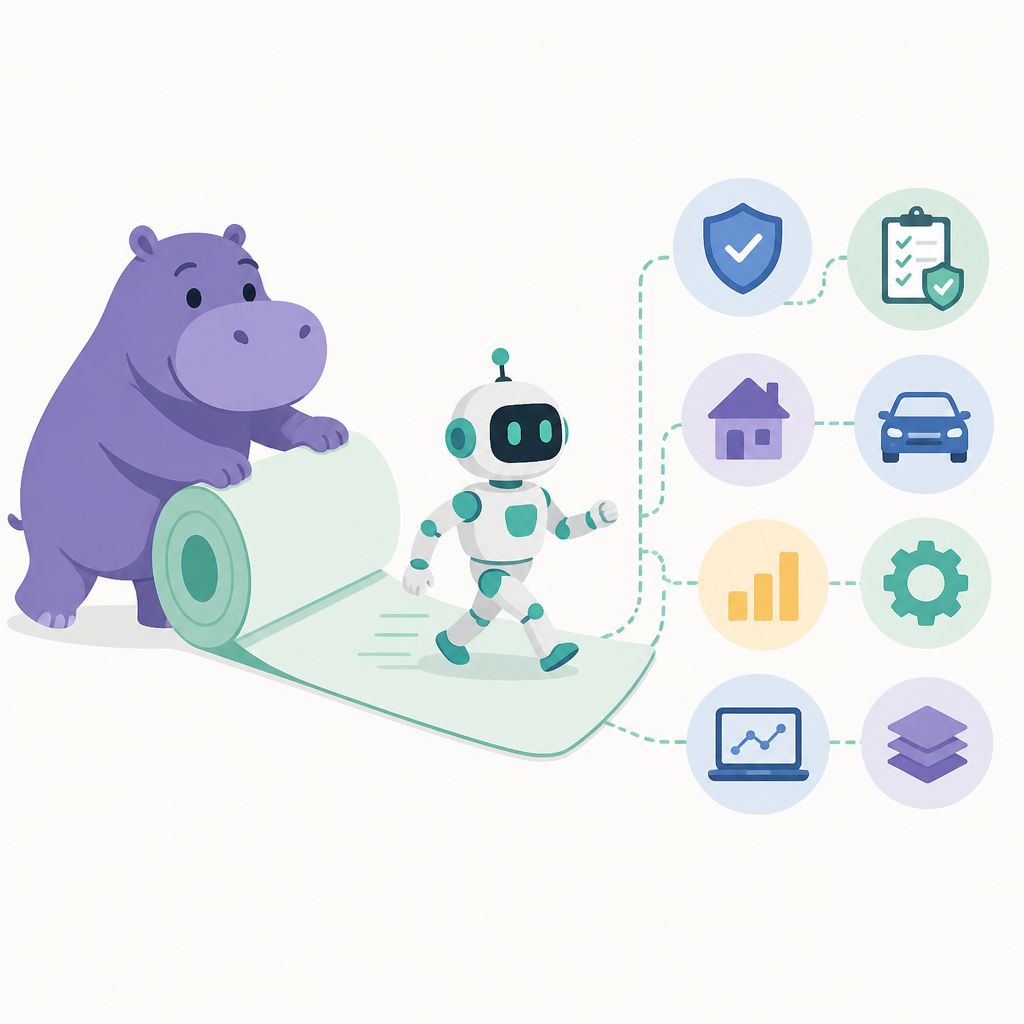
For developers, the practical shift is clear: more routine coding, testing, and edge-case handling can be pushed to an agent, while human engineers spend more time on architecture and judgment calls. For the market, the announcement is another sign that AI coding tools are moving from general software teams into regulated industries with stricter requirements.
Hippo’s pitch is not that AI replaces insurance engineers, but that it absorbs the repetitive work that slows them down. The open question is whether that model can scale across a heavily regulated business without creating new review and governance overhead.
// Related Articles
- [AGENT]
Agent Plugins 1.0.0 turns skills into folders
- [AGENT]
FaithEyes lets you train tool-faithful vision agents
- [AGENT]
Connect Qwen 3.8 Max to CLI Agents
- [AGENT]
Fine-tune a small LLM for legal labeling
- [AGENT]
SALA Boosts Long Context on Edge AI
- [AGENT]
Anthropic’s breach proves AI agents need hard security limits