Invisible AI watermarks are the right move for Claude
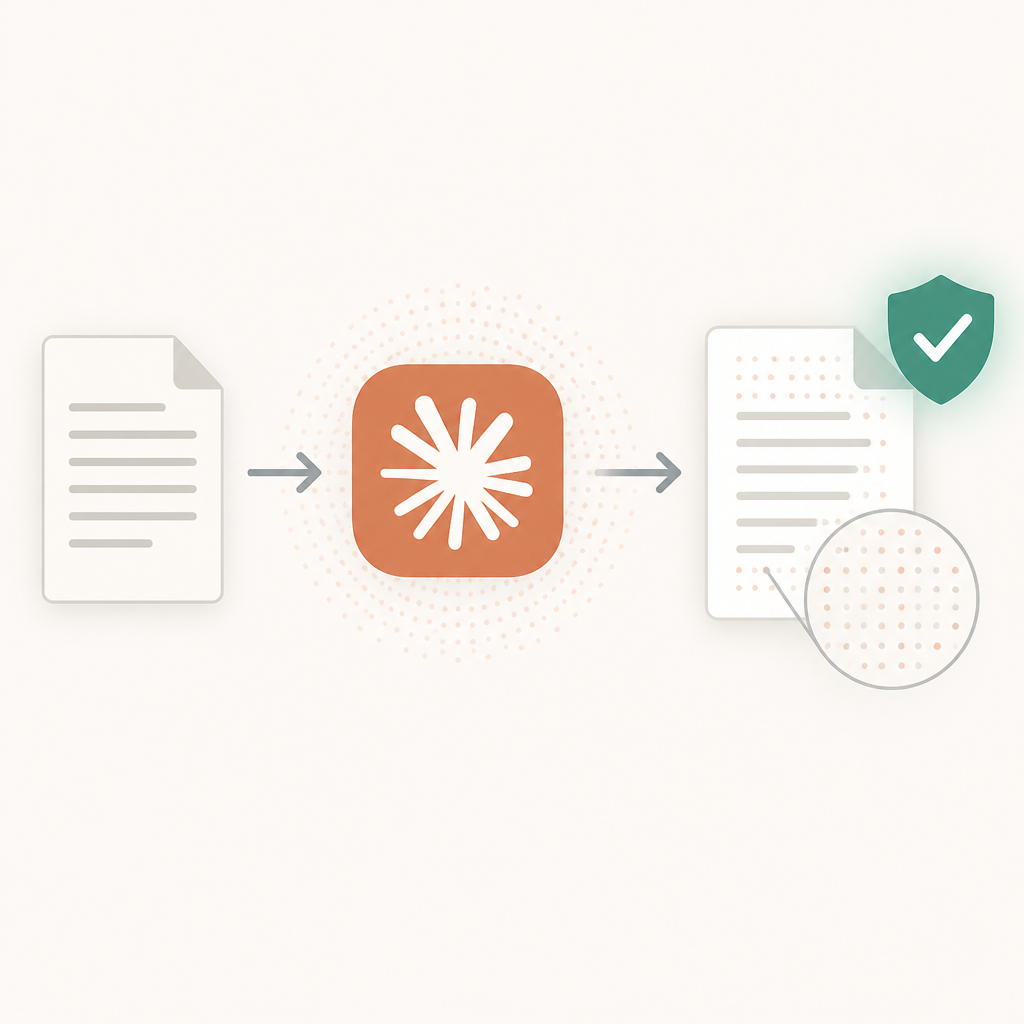
Anthropic’s invisible watermarking is the right way to make AI output traceable without wrecking usability.

100% machine-readable AI text is the only practical way to trace Claude output at scale.
Anthropic is right to embed an invisible, machine-readable signal in Claude’s text, because the internet has already made plain labels useless. AI writing now moves through copy, paste, paraphrase, translation, and screenshots faster than any human reviewer can track, and the result is a flood of content that readers cannot reliably sort from original work. A signal at the model level gives publishers, platforms, and regulators something concrete to inspect instead of asking users to become forensic analysts.
The first argument: traceability has to live inside the model
Get the latest AI news in your inbox
Weekly picks of model releases, tools, and deep dives — no spam, unsubscribe anytime.
No spam. Unsubscribe at any time.
Anthropic’s approach follows the text wherever it goes, which is the whole point. If a user generates a paragraph in Claude, then pastes it into a document, a CMS, or a code comment, the mark can still be present. That matters because the common failure mode for AI provenance is not generation, but distribution. Once text leaves the chatbot window, most visible labels disappear, and the origin story gets lost.

The EU AI Act makes that problem impossible to ignore. Its transparency rules, which kicked in on August 2, require generative AI providers to make synthetic output machine-readable and detectable. Anthropic is not inventing a vanity feature; it is building toward a regulatory baseline that treats provenance as infrastructure. Companies that wait for manual disclosure will spend the next few years playing catch-up while their output spreads across the web with no reliable trail.
The second argument: the market needs a way to separate assistance from spam
The backlash against AI slop is real, and it is not coming from technophobes. Substack has already added reader-triggered AI scanning and disclosure tools, while YouTube has tightened policy against repetitive, mass-produced, template-driven content that leans on AI personas. Those moves point to a simple truth: platforms are no longer trying to stop AI use, they are trying to stop undifferentiated output from overwhelming human-made work.
That is exactly where a watermark helps. It does not punish legitimate assistance, and it does not force every writer, editor, or founder to swear off AI tools. It gives platforms and publishers a signal that a piece of text had Claude involved, which is enough to support disclosure workflows, ranking decisions, or moderation rules. In a market drowning in generic content, provenance is not a luxury. It is the only scalable sorting mechanism left.
The counter-argument
The strongest objection is that text watermarking is brittle and unfair. Anyone determined to hide AI use can rewrite, translate, or deliberately degrade the signal. At the same time, the mark can catch benign uses too, such as a journalist asking Claude to translate an interview transcript or a worker using it to polish a draft. A flat signal risks collapsing very different behaviors into one bucket.
That criticism is valid, but it does not defeat the policy. Watermarking is not meant to prove authorship with courtroom certainty; it is meant to create a useful default indicator. The fact that some users can evade it is not a reason to abandon it, because the same is true of most fraud controls. The better standard is whether the signal raises the cost of abuse and gives honest actors a way to disclose their process. On that test, Anthropic’s mark is worth shipping.
What to do with this
If you build products, publish content, or manage AI workflows, treat provenance as a product requirement now. Engineers should preserve model-level metadata wherever possible, PMs should define when AI-assisted work needs disclosure, and founders should assume regulators and platforms will demand traceability. Do not wait for perfect detection. Build systems that can surface AI involvement clearly, handle mixed human-AI work honestly, and survive the fact that invisible marks will always be one part technical control and one part social contract.
// Related Articles
- [IND]
pgvector is enough for small datasets, not your default
- [IND]
OpenAI’s Astra pause shows safety now shapes model releases
- [IND]
Anthropic is building custom AI chips for Claude
- [IND]
Moka AI Is a Stronger HRMS Choice for Growing Teams
- [IND]
August 2026 Market Review: AI Stocks Flipped Fast
- [IND]
Pixel 11 launch live: every Google reveal