LAPIS-SHRED infers hidden dynamics from tiny windows
LAPIS-SHRED reconstructs or forecasts full spatiotemporal systems from sparse sensors and short windows, using a modular latent-phase pipeline.

Reconstructing a full spatiotemporal system from a few sensors and a short time window is a hard problem for anyone working with complex physical systems. The new paper LAtent Phase Inference from Short time sequences using SHallow REcurrent Decoders (LAPIS-SHRED) tackles that problem with a modular pipeline that can rebuild or forecast hidden dynamics from very limited observations.
That matters because in real deployments, you often do not get clean, dense, long-duration measurements. Sensors fail, coverage is incomplete, and sometimes you only capture a narrow temporal slice. The paper’s pitch is simple: if you can learn the system’s latent structure from simulation, you may still recover the missing trajectory when the real-world observation is sparse and short.
What problem this paper is trying to fix
Get the latest AI news in your inbox
Weekly picks of model releases, tools, and deep dives — no spam, unsubscribe anytime.
No spam. Unsubscribe at any time.
The paper starts from a familiar limitation in scientific machine learning and data-driven modeling: the measurements are incomplete in space, incomplete in time, or both. That makes it difficult to recover the full trajectory of a system, even when the trajectory is exactly what you need for mechanistic understanding, model calibration, or operational decisions.

In plain terms, you can think of it as trying to infer the full movie from a few frames and a tiny snippet of audio. For turbulent flow, combustion, propulsion physics, or satellite-derived environmental fields, the real system evolves over time in ways that are expensive or impossible to observe exhaustively.
The authors frame this as a challenge of reconstructing full spatio-temporal dynamics from sparse sensor observations confined to short temporal windows. Their goal is not just interpolation over missing values, but a way to infer the hidden phase of the system and then extend that inference across unobserved time.
How LAPIS-SHRED works in plain English
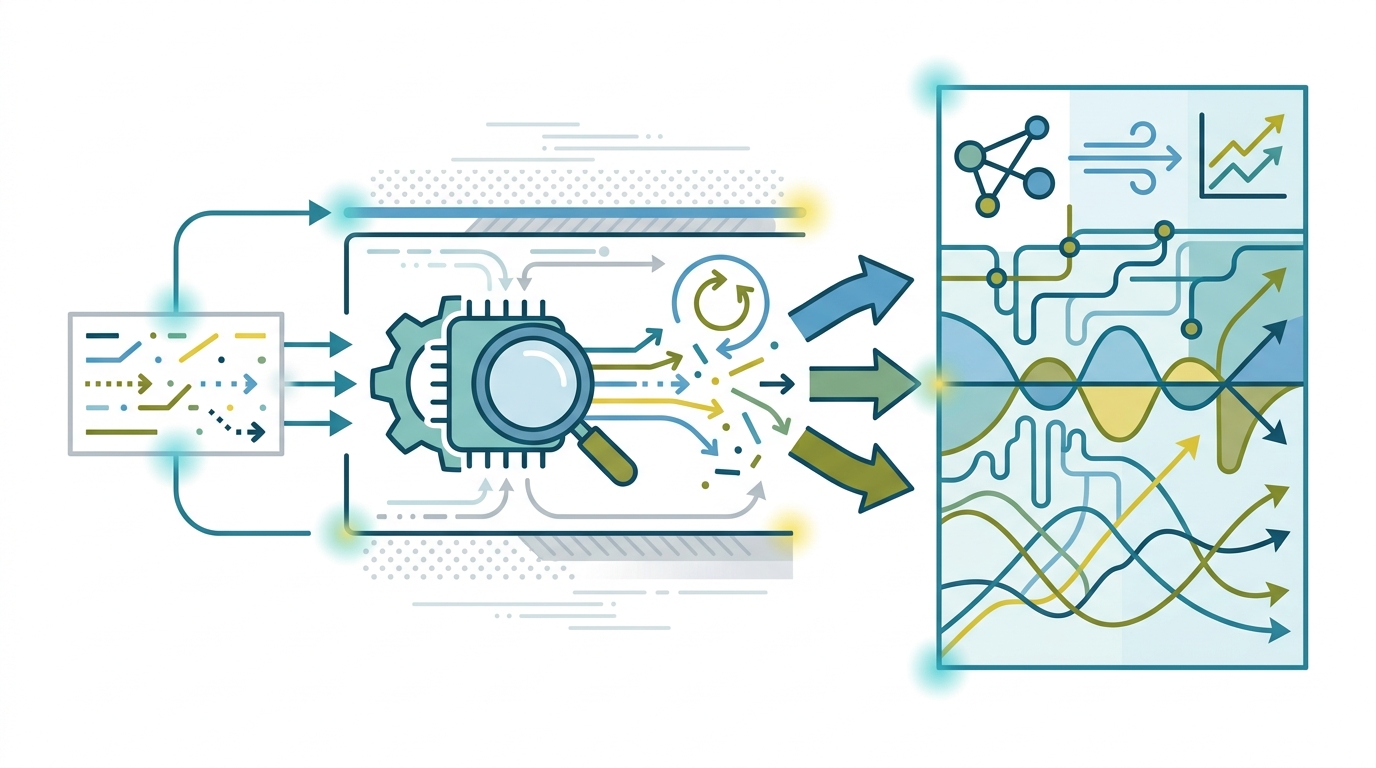
LAPIS-SHRED is built as a three-stage pipeline. The first stage pre-trains a SHRED model entirely on simulation data. In that stage, the model learns to map sensor time histories into a structured latent space. That latent space is the key abstraction: instead of working directly with the full field, the system learns a compact representation of the underlying dynamics.
The second stage trains a temporal sequence model on simulation-derived latent trajectories. Its job is to move latent states forward or backward in time so the model can span regions that were never observed. The paper describes this as latent phase inference from short time sequences, which is a good shorthand for “learn the hidden state from a small window, then propagate it through the missing interval.”
The third stage is deployment. At inference time, the model only receives a short observation window of hyper-sparse sensor measurements from the real system. The SHRED model and the temporal model are then used together, with the trained components frozen, to reconstruct or forecast the complete spatiotemporal trajectory.
That modular design is one of the paper’s main ideas. The authors say the framework supports bidirectional inference, so it can work forward or backward in time. They also say it inherits data assimilation and multiscale reconstruction capabilities from the modular structure, and that it can handle extreme observational constraints, including single-frame terminal inputs.
- Stage 1: pre-train SHRED on simulation data.
- Stage 2: train a temporal sequence model on latent trajectories from simulation.
- Stage 3: use short, sparse real observations to reconstruct or forecast the full system.
What the paper actually shows
The abstract says the authors evaluate LAPIS-SHRED on six experiments spanning complex spatio-temporal physics. The list includes turbulent flows, multiscale propulsion physics, volatile combustion transients, and satellite-derived environmental fields. That gives the method a broad test surface across both engineered and naturally occurring systems.
What the abstract does not give is benchmark numbers. There are no error metrics, no runtime figures, and no side-by-side quantitative comparisons in the provided text. So while the paper claims successful evaluation across six experiments, the abstract alone does not let us measure how much better it is than prior methods or how much compute it needs.
Even without numbers, the scope is informative. The paper is not presenting a one-off toy example. It is trying to show that the same latent-inference pipeline can be applied across different physical regimes where observations are scarce and temporal coverage is narrow.
The strongest concrete claim in the abstract is about operational practicality. The authors describe LAPIS-SHRED as lightweight and modular, which suggests the method is intended for settings where observation is constrained by physical or logistical limitations. That is a useful signal for practitioners, because it points toward systems where sensor density is not under your control.
Why developers and engineers should care
If you build systems around forecasting, monitoring, or state estimation, this paper sits right in the middle of a real deployment pain point: you rarely get the data you wish you had. Methods that assume dense, continuous measurements tend to break down when the observation process is messy. LAPIS-SHRED is interesting because it explicitly designs for sparse sensors and short windows instead of treating them as edge cases.
The modular structure also matters from an engineering standpoint. Separating the latent representation step from the temporal propagation step makes the system easier to reason about than a single monolithic model. It also creates a clearer division between simulation-based pretraining and deployment-time inference, which is a pattern many teams already use in other machine learning workflows.
There is also a practical systems angle in the bidirectional inference claim. If a model can infer hidden state forward or backward from a short window, that opens the door to reconstruction from terminal observations as well as forecasting from initial ones. For real operations, that flexibility can be more valuable than a narrow forward-only predictor.
Limitations and open questions
The abstract is promising, but it leaves several important questions open. First, the method depends on simulation pretraining. That means its usefulness will depend on how well simulation data captures the real system you care about. If the simulator is off, the latent space may not transfer cleanly.
Second, the paper does not provide benchmark numbers in the abstract, so we cannot judge accuracy, robustness, or computational cost from the source text alone. For engineers, those are not minor details. A lightweight architecture is only useful if it holds up under real latency and reliability constraints.
Third, the paper mentions extreme observational constraints, including single-frame terminal inputs, but the abstract does not spell out failure modes. It is still unclear how performance degrades as sensors become even sparser, or how sensitive the method is to noise, missing channels, or mismatch between simulation and reality.
Even with those caveats, LAPIS-SHRED is a useful addition to the toolbox because it reframes the problem around latent phase inference rather than direct reconstruction from raw observations. That is a sensible move when the data window is short and the system is complex. For teams working on scientific ML, remote sensing, or operational monitoring, the paper is worth reading as a design pattern for doing more with less data.
In short: LAPIS-SHRED is trying to turn sparse, short-lived sensor input into a full picture of a dynamic system. The abstract does not prove it is the best option in every setting, but it does outline a practical architecture for a problem that shows up everywhere in real-world science and engineering.
// Related Articles
- [RSCH]
Evaluation Protocols for Fine-Tuned LLMs in 2026
- [RSCH]
DeepSpec should be treated as a data-regeneration pipeline, not a tra…
- [RSCH]
Program-as-Weights turns prompts into reusable tools
- [RSCH]
LACUNA tests whether LLM unlearning really erases
- [RSCH]
Persistent-state AI agents open a new attack surface
- [RSCH]
Language critiques improve imitation learning