Microsoft’s MLOps model maps five maturity levels
Microsoft’s Azure guide defines five MLOps maturity levels, from manual model handling to automated retraining and monitoring.
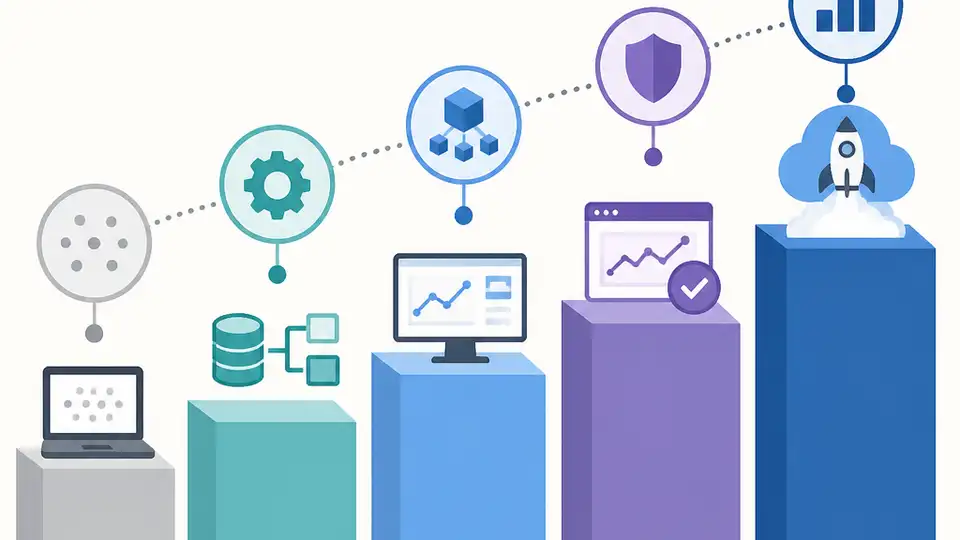
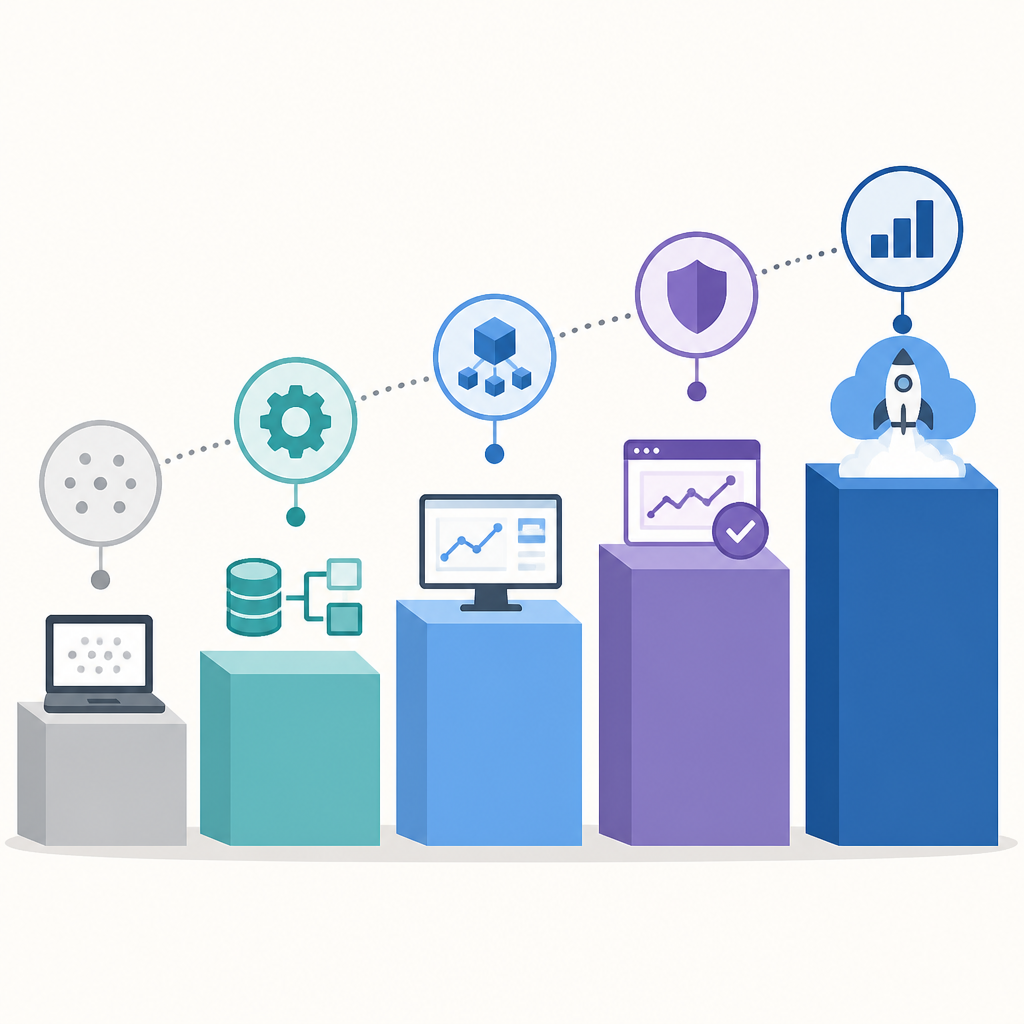
Microsoft’s Azure guide defines five MLOps maturity levels from manual work to automated retraining.
Microsoft’s MLOps maturity model breaks machine learning operations into five levels, and the jump from one level to the next is mostly about repeatability, traceability, and automation. The guide also makes a blunt point: real teams often sit in more than one level at the same time.
| Level | Name | What changes |
|---|---|---|
| 0 | No MLOps | Manual training, manual release, little tracking |
| 1 | DevOps but no MLOps | App code is automated, model work is still handoff-heavy |
| 2 | Automated training | Training is repeatable and traceable, releases stay manual |
| 3 | Automated model deployment | CI/CD, tests, and promotion across workspaces |
| 4 | Full MLOps automated operations | Monitoring can trigger retraining and policy-based promotion |
What Microsoft is really measuring
Get the latest AI news in your inbox
Weekly picks of model releases, tools, and deep dives — no spam, unsubscribe anytime.
No spam. Unsubscribe at any time.
The model is less about a badge and more about operational maturity. Microsoft says it measures people and culture, processes and structures, plus objects and technology. That matters because a team can have polished notebooks and still fail in production if release ownership, monitoring, or feedback loops are weak.
There’s also a practical planning angle here. Microsoft says teams can use the model to estimate project scope, set realistic success criteria, and define deliverables before an engagement ends. That makes it useful for both internal platform teams and consultancies trying to avoid vague “we’ll figure it out later” machine learning work.
At a high level, the model pushes teams toward a simple pattern: make training reproducible, make deployment predictable, and make production signals visible enough to improve the next run.
- Level 0: manual builds, manual deployment, manual model testing
- Level 1: automated app releases, but model delivery still depends on data teams
- Level 2: managed training, versioned code, centralized performance tracking
- Level 3: automatic release flow, CI/CD, and workspace-to-workspace promotion
- Level 4: automated operations with drift-triggered retraining and policy-based promotion
The five levels in plain English
Level 0 is the classic “someone emailed a model file” setup. Data scientists, data engineers, and software engineers work in separate lanes, experiments are not tracked consistently, and release work is manual. Microsoft describes the output as a single model file with inputs and outputs handed off by hand.
Level 1 improves the software side first. Builds are automated, application code has tests, and code is version controlled, but the model pipeline still depends on data teams for every new release. The pain point stays the same: the team can ship apps more easily, yet model behavior in production is still hard to trace and reproduce.
Level 2 is where training becomes repeatable. Microsoft says the training environment is fully managed and traceable, training code and models are version controlled, and scheduled or event-driven jobs handle recurring runs. It also adds a managed feature store and Azure Event Grid events for orchestration.
Level 3 is the point where deployment starts to behave like software delivery. The guide says releases become automatic, full traceability exists back to original data, and model artifacts move across workspaces through Azure Machine Learning registries. A/B testing also enters the picture, which is a strong signal that experimentation has left the notebook and entered production discipline.
Level 4 adds the kind of operational feedback loop many teams say they want but few actually build. Production metrics can trigger retraining through Azure Event Grid, feature freshness is monitored, and promotion becomes policy-based. Microsoft’s wording about “approaching zero downtime” is telling: the goal is a system that keeps improving without a human babysitter.
“The MLOps maturity model defines principles and practices to help you build and operate production machine learning environments.” — Microsoft Learn
Where the real bottlenecks show up
The most interesting part of the guide is how it splits maturity across people, model creation, model release, and application integration. That split is useful because many teams assume the hard part is model accuracy, when the real pain usually shows up in handoffs, ownership, and release discipline.

Microsoft’s tables show a repeated pattern across levels: more automation, more version control, more testing, and more visibility. The numbers are less about model size or benchmark scores and more about operational steps that either exist or don’t.
- Level 0 and Level 1 keep release work manual, even when app code is automated
- Level 2 adds managed compute, tracked experiments, and versioned training assets
- Level 3 requires CI/CD plus unit and integration tests for each model release
- Level 4 extends monitoring into production signals that can restart the training cycle
That progression matters because it shows why many MLOps efforts stall. Teams often automate training before they automate release, or they add monitoring without deciding what action should follow an alert. The model pushes those pieces into a sequence that is easier to reason about.
There’s also a subtle organizational lesson here: Microsoft says organizations often show characteristics of more than one level at once. That is the realistic part. A company may have automated app releases, manual model promotion, and some production monitoring all in the same stack.
How GenAI changes the picture
Microsoft also draws a line between classic MLOps and GenAIOps. The guide says the MLOps model covers predictive, tabular, and classical machine learning, while GenAIOps adds prompt lifecycle, retrieval augmentation, output safety, and token cost governance.
That distinction matters because a lot of teams are trying to force large language model workflows into older MLOps templates without adding the controls those systems need. Prompt versions, safety checks, and cost tracking are different problems from model retraining, but they still sit on top of the same operational habits: version control, testing, monitoring, and release discipline.
If your team already has MLOps investments, Microsoft’s message is basically to extend them rather than replace them. The operational habits stay useful; the control points just shift.
For teams comparing platforms, this is also a reminder that tool choice is secondary to process maturity. Azure Machine Learning gives Microsoft’s own implementation path, but the model itself is bigger than one product. If you want a broader operating model, the related MLOps overview story is a useful companion read.
What teams should take away from the model
The strongest value of Microsoft’s framework is that it turns a fuzzy “we need MLOps” goal into a checklist of measurable capabilities. Are experiments tracked? Are model artifacts versioned? Can you reproduce a release? Can production signals trigger retraining? Those questions are far more useful than a generic maturity score.
In practice, the model also gives platform leaders a way to sequence investments. If your team is still at Level 0 or Level 1, the next win is usually traceability and automated training, not fancy production optimization. If you are already at Level 3, the next gap is often monitoring that actually drives action.
The cleanest takeaway is this: MLOps maturity is less about adopting every available feature and more about shrinking the distance between a model change and a reliable production outcome. The teams that close that distance first will feel the biggest operational payoff.
One question now matters more than the label on your maturity chart: which step in your model lifecycle still depends on a person remembering to push a button?
// Related Articles
- [IND]
Google’s Q2 2026 results prove AI spend is now the story
- [IND]
AI regulation in India is now a business risk
- [IND]
Europe should standardise the AI Act through harmonised technical rul…
- [IND]
AMD and Anthropic’s 2GW deal reshapes AI supply
- [IND]
OpenAI’s comeback proves coding now drives the AI race
- [IND]
System design interviews get easier with 5 core ideas