Midjourney’s 60-Second Ultrasound Scanner, Explained
Midjourney Medical has launched a prototype full-body ultrasound scanner that aims to scan in 60 seconds, but it is not FDA-cleared yet.

Midjourney Medical has unveiled a prototype full-body ultrasound scanner that aims to image the body in about 60 seconds.
Midjourney announced its healthcare division in mid-June 2026, and the first product is already being framed as a new kind of whole-body scan. The company says the device uses ultrasound and water, avoids radiation, and could eventually support body-composition mapping before any diagnostic use.
| Fact | Value | What it means |
|---|---|---|
| Announcement | 17–18 June 2026 | Midjourney Medical went public with the project at launch |
| Scan time | About 60 seconds | The scanner is designed for rapid whole-body imaging |
| Prototype hardware | 40 Butterfly modules | The first system uses Butterfly Network ultrasound-on-chip hardware |
| Commercial target | Late 2027 | Midjourney plans a first San Francisco location |
| Deal value | Up to about $74 million | Butterfly Network disclosed the licensing agreement in filings |
What Midjourney Medical is actually selling
Get the latest AI news in your inbox
Weekly picks of model releases, tools, and deep dives — no spam, unsubscribe anytime.
No spam. Unsubscribe at any time.
Midjourney Medical is a new business line from Midjourney, the company known for AI image generation. That matters because the healthcare pitch is easy to misunderstand: the scanner is not powered by the same generative model that makes Midjourney’s art tools famous.

The company’s first hardware product is the Midjourney Scanner, which it introduced as a prototype for whole-body imaging. Midjourney’s founder, David Holz, described it as a new imaging method that could produce very detailed body maps.
The important part is the boundary between demo and medicine. Midjourney says the first release will focus on body-composition maps, not diagnosis. That is a very different claim from saying the machine can replace a radiology department.
- It is a real prototype, not a paper concept.
- It has no regulatory clearance for diagnosis.
- Its first use case is mapping, not clinical decision-making.
- Its imaging stack comes from licensed ultrasound hardware.
Why the name “Ultrasonic CT” is misleading
Midjourney calls the system “Fullbody Ultrasonic Computational Tomography,” shortened to “Ultrasonic CT.” The name sounds familiar, but it can easily confuse non-specialists because this is not a conventional CT scanner.
Traditional CT uses X-rays and ionising radiation. This machine uses ultrasound. That means no X-ray beam, no radiation dose, and no magnetic field. The scan process also looks very different: a person steps onto a platform, descends into shallow water, and passes through a ring of underwater sensors.
Those sensors send sound waves through the body from multiple angles. A compute system then reconstructs the returning signals into images of muscle, fat, bone, and organs. Midjourney says the process takes about 60 seconds.
“We’re not trying to build a better CT scanner. We’re trying to invent a new imaging modality.” — David Holz, Midjourney launch presentation, June 2026
That quote matters because it shows how Midjourney wants the product to be understood: as a new category, not a faster version of an old machine. Whether the market accepts that framing is another question.
What exists today and what is still a claim
The cleanest way to read this launch is to separate what has been shown from what has been promised. Midjourney has demonstrated a working Gen-1 prototype. It has also made several large claims that are still unverified outside the company.
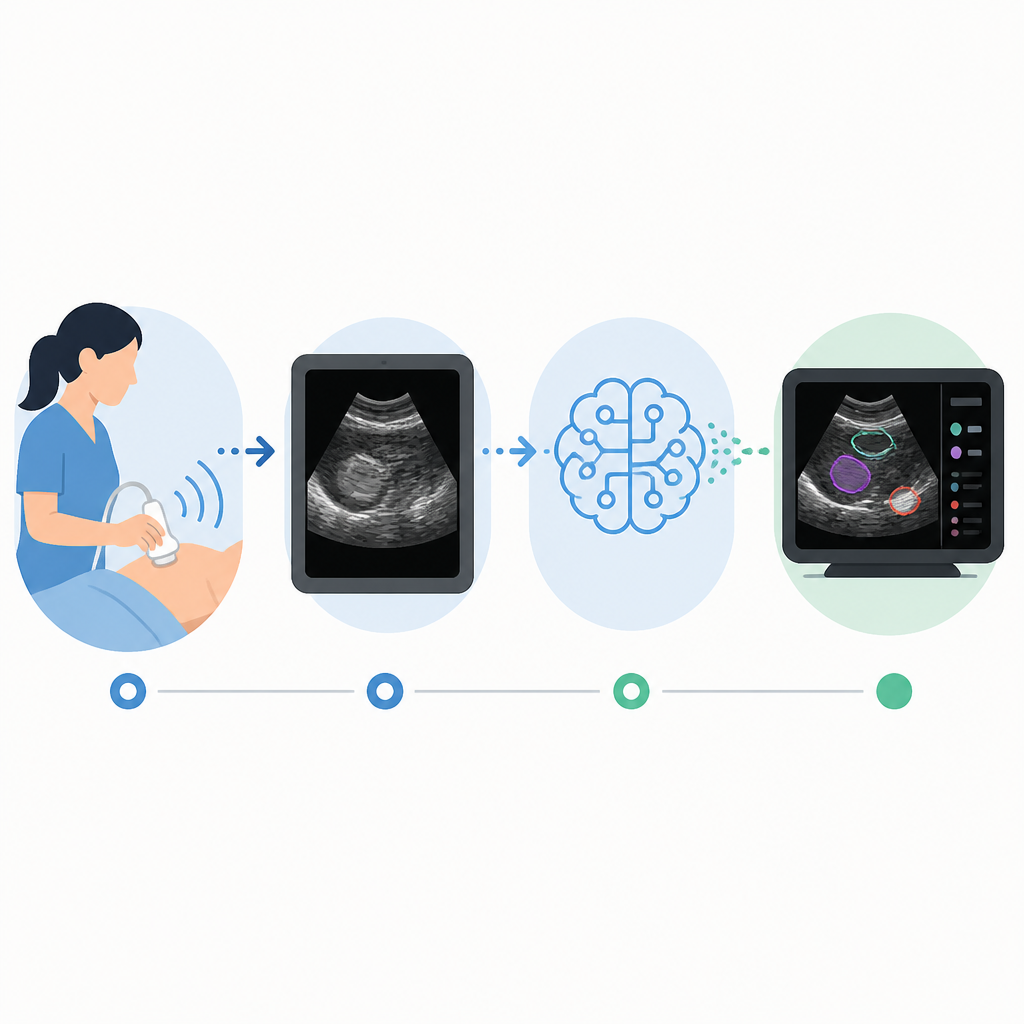
That split is where a lot of hype lives or dies. A prototype can prove that sound-based reconstruction works in a demo. It cannot, by itself, prove diagnostic accuracy, clinical usefulness, or safety across patient groups.
- Exists now: a live demo of a Gen-1 prototype.
- Exists now: a stated plan to start with body-composition maps.
- Claimed: image quality “superior to MRI.”
- Claimed: around 50,000 scanners worldwide over six years.
- Claimed: a billion full-body scans per month at scale.
Those numbers are striking, but they are still company claims. Midjourney has said it will submit test results to the FDA for broader capabilities over time, which means the diagnostic story is still waiting on evidence and review.
That is the part clinicians should focus on. A beautiful interface and a fast scan do not tell you whether the output changes management, reduces harm, or adds noise.
The Butterfly Network deal is the real technology story
The hardware backbone comes from Butterfly Network, not from Midjourney’s image-generation stack. In November 2025, Butterfly disclosed an exclusive licensing and co-development deal that could be worth up to about $74 million over five years.
Butterfly’s role matters because it explains where the imaging physics comes from. The prototype uses 40 Butterfly Ultrasound-on-Chip modules, which are transducers built on silicon using semiconductor-style manufacturing. Future versions are expected to use more modules.
That is a very different story from “AI made a scanner.” Midjourney’s brand may be the headline, but the underlying imaging system is a licensed ultrasound platform. The company is pairing that with software, product design, and a consumer-friendly experience.
- Midjourney: product vision, branding, and distribution.
- Butterfly Network: ultrasound-on-chip imaging hardware.
- FDA: the gatekeeper for diagnostic claims in the U.S.
- Patients and clinicians: the people who will judge whether the output matters.
Butterfly has said it will support claims with valid clinical data “as applicable,” which is a cautious statement and the right one. It leaves room for evidence instead of assuming the demo already equals clinical proof.
What clinicians should watch next
The biggest question is not whether the scanner is interesting. It is. The real question is whether the output can be interpreted reliably, whether it fits into a care pathway, and whether the company can show that the scan changes decisions for the better.
That matters because early users will probably include people who pay for curiosity, fitness, or body-composition tracking. Some of them will later bring the output to a GP or specialist and ask what it means. That creates a communication problem long before it becomes a diagnostic one.
If Midjourney reaches a consumer launch in late 2027, the first clinical friction may come from follow-up, not from the scan itself. Incidental findings, unclear maps, and overconfident interpretations can all create extra work for clinicians.
For readers who want the broader context on diagnostic tools and clinical pattern recognition, OraCore’s related coverage includes how doctors train diagnostic pattern recognition and free tools to practise medical diagnosis.
What happens if the prototype becomes a product
If Midjourney keeps moving, the next milestones are easy to name: FDA submissions, published validation data, and a clearer explanation of what the scanner can and cannot do. Without those, the machine stays in the “interesting demo” category.
My read is simple. The scanner could become a niche consumer imaging product, a research platform, or an expensive curiosity. The outcome depends less on the name Midjourney and more on whether the company can show reproducible clinical value.
For now, the safest takeaway is this: treat “Ultrasonic CT” as a prototype ultrasound system with ambitious branding, not as a replacement for CT or MRI. The next real test is not the launch video. It is the data package that comes after it.
// Related Articles
- [IND]
Kehua’s charging stack turns EV sites into power hubs
- [IND]
Distributed finance now powers U.S. payments and trading
- [IND]
Lore shows how binary-first version control scales
- [IND]
Pakistan Tells Banks They Can Offer Crypto Services
- [IND]
Anthropic Accuses Alibaba of Massive Claude Distillation
- [IND]
AI payment bots should run on strict limits, not full autonomy