Pakistan Tells Banks They Can Offer Crypto Services
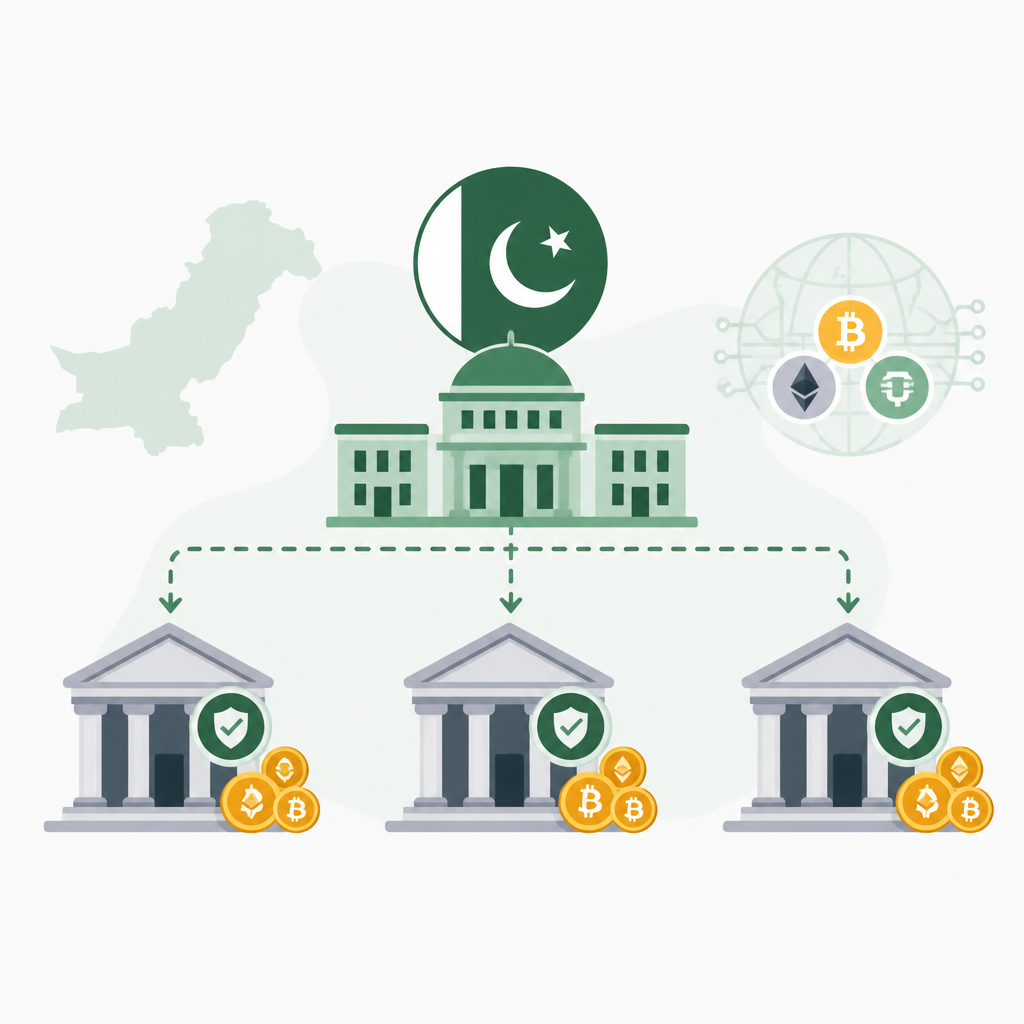
Pakistan told banks and regulators they may offer crypto services, but they still cannot trade or hold digital assets.

Pakistan told banks and regulators they may offer crypto services, but they still cannot trade or hold digital assets.
Pakistan has opened a narrow door for crypto inside its financial system. A letter sent to banks and financial firms says they may provide crypto services, while still being barred from trading or holding the assets themselves.
The policy shift matters because it tries to separate infrastructure from speculation. Banks can help customers access services, but they are not being told to put crypto on their own balance sheets.
| Policy point | What Pakistan said | Practical effect |
|---|---|---|
| Who received the letter | Banks and financial regulatory firms | The message reached the institutions that would need to comply |
| What is allowed | Providing crypto services | Institutions may support customer-facing activity |
| What is barred | Trading or holding crypto assets | Institutions still avoid direct asset exposure |
A narrow opening, not a free pass
Get the latest AI news in your inbox
Weekly picks of model releases, tools, and deep dives — no spam, unsubscribe anytime.
No spam. Unsubscribe at any time.
The distinction matters. Pakistan is not telling its banks to become crypto traders, custodians, or balance-sheet holders. It is signaling that service provision can exist inside a controlled framework, while the riskier parts stay off limits.

That approach is common when regulators want activity to move into the open without giving institutions a blank check. It gives the government more visibility, and it gives banks a clearer line between compliance work and asset speculation.
For crypto firms, the letter could matter more than a headline about legalization. Access to banking rails is often the difference between a market that functions in practice and one that stays stuck in informal channels.
- Banks may support crypto services.
- Banks may not trade crypto assets.
- Banks may not hold crypto assets.
- The policy targets regulated intermediaries, not retail traders.
Why this matters for the banking side
Financial institutions usually care less about whether a government likes crypto in theory and more about whether they can touch it without creating regulatory risk. Pakistan’s letter appears designed to answer that question with a partial yes.
That matters for compliance teams, because they need rules that are specific enough to build around. If a bank can process services but cannot custody tokens or speculate on them, the operational model becomes narrower and easier to police.
“Banks should not be in the business of speculating on crypto assets,” said Michael Barr, the Federal Reserve’s vice chair for supervision, in remarks on bank involvement with digital assets.
Barr’s point lines up with the logic behind Pakistan’s move. Regulators often worry less about software and more about what happens when deposit-taking institutions start taking market risk with volatile assets.
That is also why the wording of the letter matters so much. “May provide crypto services” leaves room for payment support, onboarding, or other regulated functions. “May trade or hold” would have been a much bigger step, and Pakistan did not go there.
How this compares with other policy moves
Pakistan’s approach looks closer to controlled access than open endorsement. Other jurisdictions have taken similar half-step models, letting firms build crypto-related products while keeping banks away from direct exposure.
Here is the practical comparison:
- Pakistan: service provision allowed, asset trading and holding barred.
- Some U.S. bank regulators: cautious approval for limited crypto activity, with heavy oversight.
- More permissive markets: banks can custody or transact in digital assets under licensing rules.
- Hardline markets: banks are told to avoid crypto entirely.
The interesting part is that Pakistan did not frame this as a philosophical embrace of digital assets. It framed crypto as a service category that can be handled by regulated firms under limits.
That is a meaningful distinction for exchanges, payment firms, and compliance vendors. If the letter leads to clearer procedures, the first beneficiaries will probably be the businesses that need bank relationships more than they need hype.
It also tells us something about the direction of policy in emerging markets. Governments often do not want to ban crypto outright when the market already exists. They want to pull it closer to formal finance without letting banks absorb the full volatility.
What to watch next
The real question is whether this letter turns into a licensing framework, a compliance rulebook, or just a warning with softer language. If Pakistan follows up with clearer guidance, the country could become easier for regulated crypto service providers to operate in.
If it does not, the letter may remain a signal rather than a system. Banks will know what they cannot do, but firms will still be waiting for the details that turn policy into something they can actually build around.
For now, Pakistan has drawn a line that many regulators prefer: crypto services may enter the banking conversation, but direct exposure stays off the table. The next move will tell us whether that line becomes a working framework or just another cautious statement.
// Related Articles
- [IND]
Anthropic is building custom AI chips for Claude
- [IND]
Moka AI Is a Stronger HRMS Choice for Growing Teams
- [IND]
August 2026 Market Review: AI Stocks Flipped Fast
- [IND]
Pixel 11 launch live: every Google reveal
- [IND]
Anthropic’s invisible watermark is the right move
- [IND]
Docker’s latest releases now center security and Compose