Nvidia’s “Open” GPU Docs Are a Defensive Concession, Not a Real Openi…
Nvidia’s open GPU documentation is a selective concession that improves drivers without opening the stack.

Nvidia’s open GPU documentation improves drivers, but it does not open the stack.
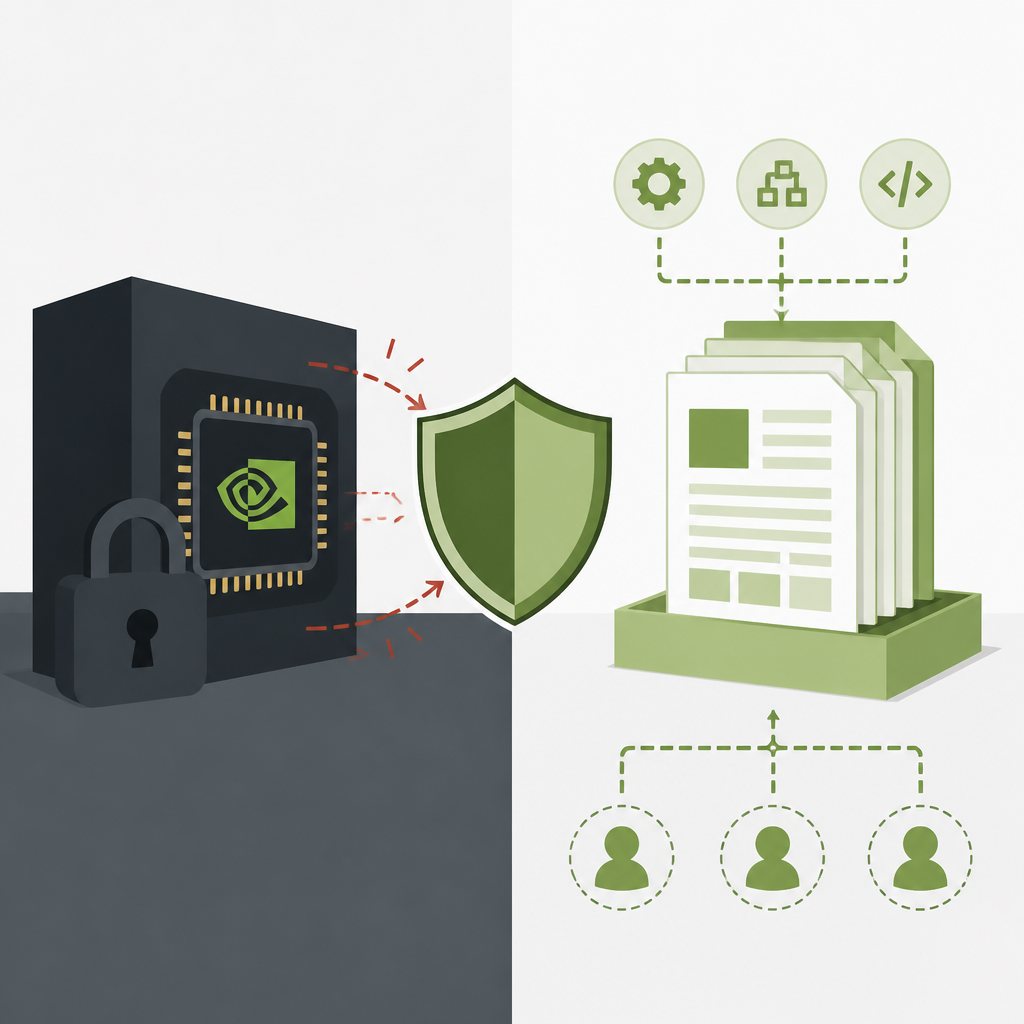
Nvidia published GPU documentation under MIT terms and put it on GitHub, which looks generous until you inspect what remains closed: hardware register definitions, firmware binaries, and the proprietary user-space driver path that games and AI workloads still depend on. That split matters because Nouveau can use the documents to build a better kernel driver, but it still cannot replace the closed pieces needed for full performance and compatibility. This is not a clean handoff to open source. It is a controlled release that gives developers enough to reduce pain while preserving Nvidia’s grip on the parts that define the commercial moat.
First, the documents improve the driver without surrendering control
Get the latest AI news in your inbox
Weekly picks of model releases, tools, and deep dives — no spam, unsubscribe anytime.
No spam. Unsubscribe at any time.
The strongest evidence is practical. Once the documentation is public, kernel developers can stop guessing at device behavior and start writing code against a real reference. That reduces reverse-engineering time, cuts down on bugs, and makes the open driver less fragile across kernel releases. In plain terms, Nvidia gave the community a better map, not the keys to the building.

That distinction is visible in the Nouveau project itself. With access to official documents, the driver can handle more hardware with fewer hacks and can become more maintainable over time. But the result is still bounded by what Nvidia withheld. The driver can improve how Linux talks to the GPU at the kernel level, yet it cannot fully replace the proprietary user-space stack that controls the performance-critical parts of graphics and compute.
Second, the move protects Nvidia’s business model
Nvidia’s most valuable assets are not the public-facing manuals; they are the closed layers that turn silicon into a product customers can trust for gaming, visualization, and AI training. Keeping firmware and user-space components proprietary preserves the company’s ability to differentiate, tune performance, and manage support. The open docs reduce friction for Linux users, but they do not remove Nvidia’s leverage.
The market outcome confirms that reading. Even after the documentation release, serious workloads still rely on the closed driver for the best compatibility and speed. That means the open material functions as an adapter for the ecosystem, not as a replacement architecture. Nvidia gains goodwill with developers and regulators while keeping the revenue-critical stack intact. In strategic terms, that is a defensive concession, not an ideological shift.
The counter-argument
To be fair, the opposing case is strong: partial openness is still progress. Open documentation lowers barriers for kernel contributors, helps distributions ship better defaults, and reduces the amount of black-box behavior Linux has to tolerate. For users who only need better stability or broader device support, that is not a cosmetic improvement. It is real value.
There is also a broader ecosystem argument. Every document Nvidia releases weakens the monopoly of pure reverse engineering and gives open-source maintainers a firmer base to build on. If the goal is incremental improvement rather than ideological purity, then selective openness can be defended as the only politically and commercially feasible path.
That argument is right about the gains and wrong about the conclusion. The release is useful, but it is not transformative because the closed user-space driver and firmware still decide the experience that most users actually feel. As long as the performance path stays proprietary, Nvidia controls the ceiling. The community gets better tooling, not real independence.
What to do with this
If you are an engineer, treat vendor documentation as a productivity boost, not a promise of liberation. Build against the open pieces, but design your stack with the closed dependencies clearly labeled so you know where your portability and support risks begin. If you are a PM or founder, read moves like this as supply-chain risk management by the vendor: useful to you, but never neutral. Budget for the closed layer, plan for the open layer, and do not confuse access with control.
// Related Articles
- [IND]
Mistral's robotics model cuts indoor navigation costs
- [IND]
Mistral missile: France’s short-range air defense workhorse
- [IND]
Apple Reclaims No. 1 by Market Cap as AI Costs Spike
- [IND]
Kimi K3 could pressure the middle tier of AI models
- [IND]
AI Weekly: 2026-07-13 ~ 2026-07-20
- [IND]
$1.7B Bloom Energy deal backs Nebius AI power