Open Code Review cuts AI code review misses
Open Code Review uses deterministic rules to cut review misses, and Alibaba says it has found 1 million defects.

Open Code Review is an AI code review system that uses rules to make reviews more consistent.
Alibaba’s Open Code Review shows how to make AI code review more reliable by pairing an LLM with deterministic rules. In Alibaba’s own use, it has already found 1 million defects, and this list breaks down the main design choices behind that result.
| Item | What it fixes | Notable number |
|---|---|---|
| File selection | Missing files in large changes | Deterministic pipeline |
| Rule matching | Inconsistent review behavior | Rule-based |
| Token use | High review cost | Up to 1/5 of existing agents |
| Adoption | Scale and trust | 20,000+ employees |
| Defect finds | Review value | 1 million+ |
1. Deterministic file selection
Get the latest AI news in your inbox
Weekly picks of model releases, tools, and deep dives — no spam, unsubscribe anytime.
No spam. Unsubscribe at any time.
Open Code Review tackles one of the biggest problems in AI reviews: an agent may inspect only part of a large change and miss the rest. Alibaba says the fix is not more prompting, but engineering logic that decides which files must be checked.

This matters when a patch spans many files or when a bug hides in a dependency chain. Instead of hoping the model notices the right path, the system uses a predictable review flow.
- Better coverage for multi-file changes
- Less dependence on prompt wording
- More repeatable review scope
2. Rule matching that does not drift
The second piece is rule matching. Alibaba says language-model-only logic can make the review process too loose, so Open Code Review uses engineering rules to decide what checks apply.
That gives teams a way to enforce known patterns such as null checks, thread safety, XSS, and SQL injection. The result is a review system that can apply the same standard across many developers and repositories.
Examples of built-in rule areas:
- Null pointer exceptions
- Thread safety
- XSS
- SQL injection
3. Line-level comments with fewer wrong references
Another weakness in agent reviews is positional misalignment, where the tool reports the wrong file or line number. Open Code Review is built to produce precise line-level comments, which makes review feedback easier to act on.
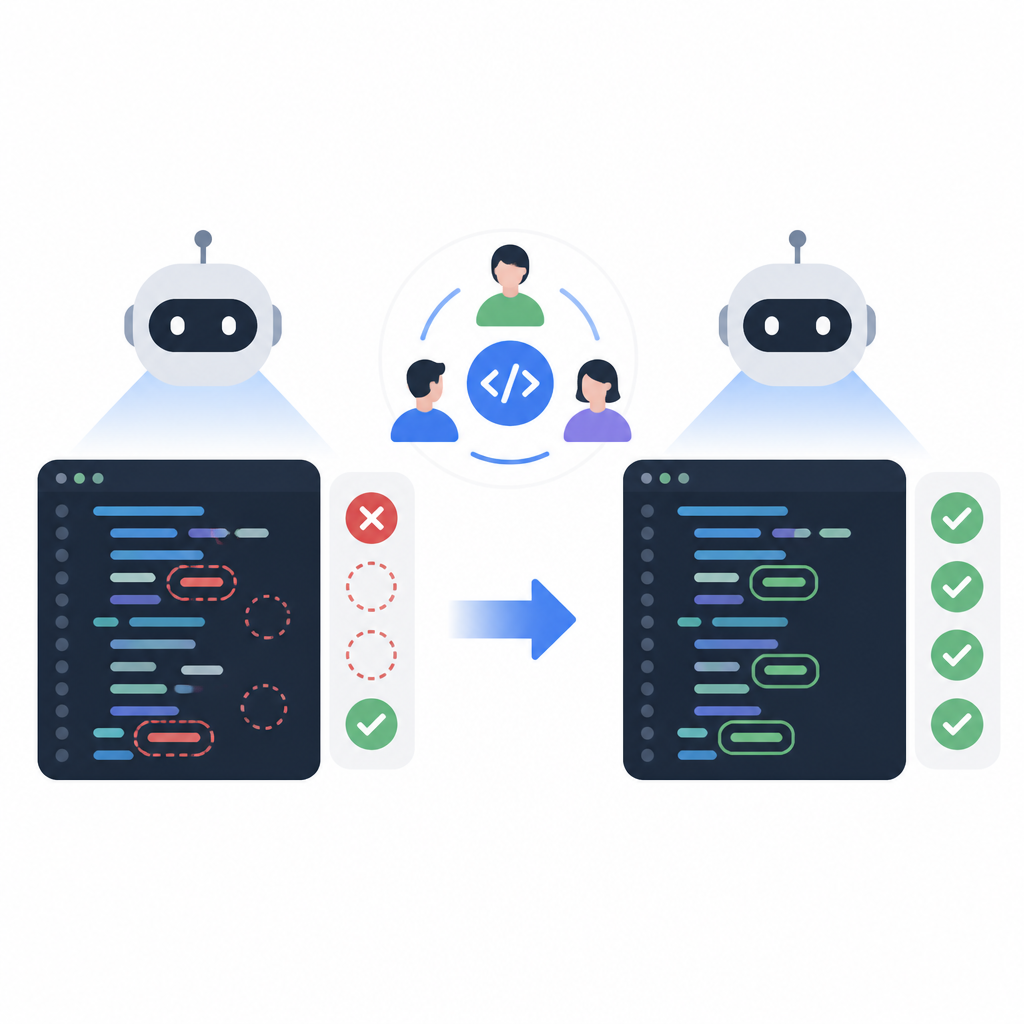
That precision matters because a correct warning at the wrong location is almost as bad as no warning. For teams that want fast fixes, accurate references save time in both review and follow-up.
- Clear file references
- More usable review comments
- Less back-and-forth with authors
4. Model flexibility without giving up control
Open Code Review can work with any AI model, including Anthropic and OpenAI compatible setups. Alibaba’s point is that the model can vary, while the review logic stays fixed.
That split is important for teams that want to swap models over time. It also helps explain why Alibaba says the system can still behave deterministically even though it is an AI agent system.
5. Lower token use at Alibaba scale
Cost is part of the story too. Alibaba says Open Code Review can cut token usage to one-fifth compared with existing agents, which becomes meaningful when thousands of developers run reviews every day.
The scale numbers are the clearest sign that this is not a lab demo. Alibaba says the tool is already used by more than 20,000 employees inside the group and has found more than 1 million defects.
- More than 20,000 internal users
- More than 1 million defects found
- Token use reduced to about 20%
How to decide
If your team wants AI review that behaves more like a policy engine than a chatty assistant, Open Code Review is the model to study. Its strongest appeal is not raw model power, but the way it constrains file selection, rule matching, and comment placement.
If you care most about consistency across large codebases, this approach fits better than prompt-heavy agents. If you only need occasional lightweight feedback, a simpler AI reviewer may be enough, but Alibaba’s numbers show why stricter control matters at scale.
// Related Articles
- [IND]
Google’s Q2 2026 results prove AI spend is now the story
- [IND]
AI regulation in India is now a business risk
- [IND]
Europe should standardise the AI Act through harmonised technical rul…
- [IND]
AMD and Anthropic’s 2GW deal reshapes AI supply
- [IND]
OpenAI’s comeback proves coding now drives the AI race
- [IND]
System design interviews get easier with 5 core ideas