Open-source AI tools beat Claude’s paid tiers on value
Open-source alternatives now cover most of Claude’s paid features and often do it with less lock-in.
Open-source tools now replace most paid Claude features without the lock-in.
Open-source is the better default for Claude-style coding, design, and desktop agents because it gives you more control, lower long-term cost, and fewer artificial limits.
Claude’s paywall is not buying you unique capability
Get the latest AI news in your inbox
Weekly picks of model releases, tools, and deep dives — no spam, unsubscribe anytime.
No spam. Unsubscribe at any time.
Claude Code is useful, but the value proposition is increasingly about access, not exclusivity. XDA notes that the cheapest path starts at $20 a month, while heavy users quickly land on the $100 to $200 Max tier just to avoid burning through quota mid-task. OpenCode covers the same core workflow, including file editing, command execution, refactoring, and multi-session work, without charging a subscription for the tool itself.
The important detail is that OpenCode is not a toy wrapper. It ships with a terminal UI, desktop apps for macOS, Windows, and Linux, a VS Code extension, image input, undo and redo, and a shareable session link. That means the paid Claude experience is no longer a moat. The open-source alternative matches the workflow and removes the monthly tax.
Open tools are better because they let you choose the model
Anthropic’s biggest weakness is that Claude Code ties you to Anthropic’s models by default. If your team wants GPT, Gemini, or a local model on your own hardware, Claude Code is the wrong center of gravity. OpenCode flips that constraint by letting you bring your own API key or run locally, so you pay only for what you use instead of paying a flat fee whether the tool is busy or idle.
That flexibility matters more than people admit. A developer who wants Claude for one repo, Gemini for another, and a local model for sensitive code can do that with one open agent. The same logic applies to privacy-sensitive work: OpenCode does not store your code or context on someone else’s servers, which is a real operational advantage, not a nice-to-have.
Claude’s design and desktop products are now easy to outgrow
Claude Design looks polished, but Anthropic folded its quota into the same shared pool as Claude.ai and Claude Code in late May 2026. That means every mockup you generate competes with your chats and coding sessions. Open Design avoids that trap by being local-first and free, with exports to HTML, PDF, PPTX, and MP4 that land in your own project folder instead of a cloud workspace.
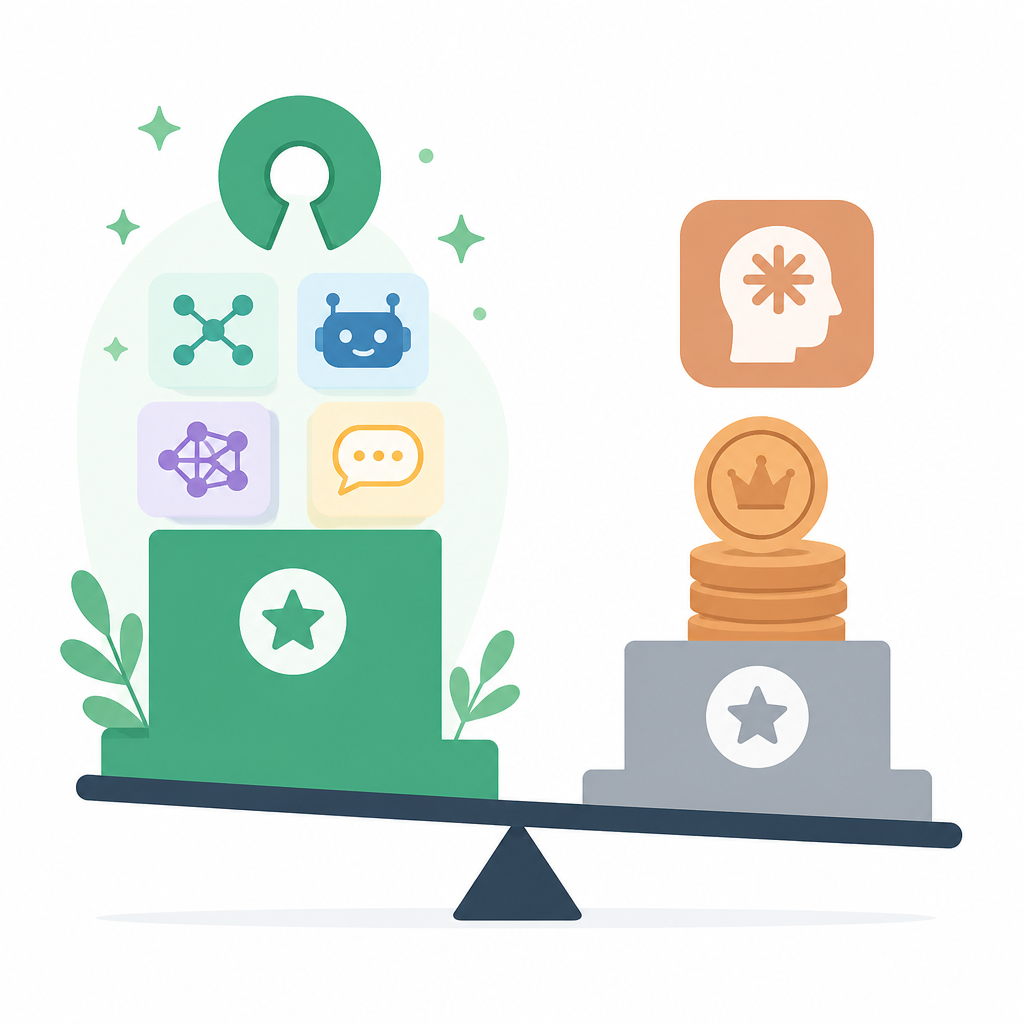
Open Design is also more modular than Claude Design. It does not force you into a single agent stack. It supports 17 first-party adapters, including Claude Code, Codex, Cursor, Gemini CLI, GitHub Copilot CLI, Grok, Kimi, Qwen, and OpenCode. For teams already using agent CLIs, that is a serious advantage: the design layer sits on top of tools you already trust, rather than replacing them with a proprietary silo.
The counter-argument
Claude’s defenders have a real point: paid products are usually easier to install, easier to support, and less likely to break under deadline pressure. Anthropic controls the whole stack, so users get a consistent experience, fewer setup steps, and a single vendor to blame when something goes wrong. For teams that value predictability over tinkering, that simplicity has weight.
There is also a legitimate quality argument. Anthropic’s models have earned their reputation in coding for a reason, and a polished integrated product can save time that open tooling spends asking you to assemble pieces. If your workflow is small, stable, and internal, a subscription can feel cleaner than maintaining your own agent chain.
That objection stops at the point where cost, flexibility, and ownership matter. Open-source tools do not just imitate Claude features, they remove the exact constraints that make Claude expensive: quota pressure, model lock-in, and cloud dependence. For engineers and product teams building real systems, that is not a compromise. It is the better operating model.
What to do with this
If you are an engineer, start by replacing one paid Claude workflow with OpenCode or Open Design and measure the real difference in speed, cost, and setup friction. If you are a PM, treat AI tooling like infrastructure: prefer tools that let your team swap models, keep data local, and avoid quota cliffs. If you are a founder, stop buying seats for convenience alone. Pay for Claude only where the integrated experience is worth the lock-in, and use open-source everywhere else.
// Related Articles
- [TOOLS]
RustRover 2026.2 turns Rust setup into one file
- [TOOLS]
Geekbench 7 setup for realistic CPU and GPU tests
- [TOOLS]
Spark 4.2 turns AI search into SQL
- [TOOLS]
OpenAI's HF breach story turns into a security template
- [TOOLS]
SAP Design System adds AI and cross-platform UI kits
- [TOOLS]
ChatGPT Health turns general chat into a health layer