OpenAI’s custom chip is the right move against Nvidia
OpenAI’s Broadcom chip is a necessary move that should reduce Nvidia dependence and improve AI economics.

OpenAI’s Broadcom chip is a necessary move that should reduce Nvidia dependence and improve AI economics.
OpenAI is right to build its own AI chip, because dependence on Nvidia has become a strategic tax on speed, cost, and control.
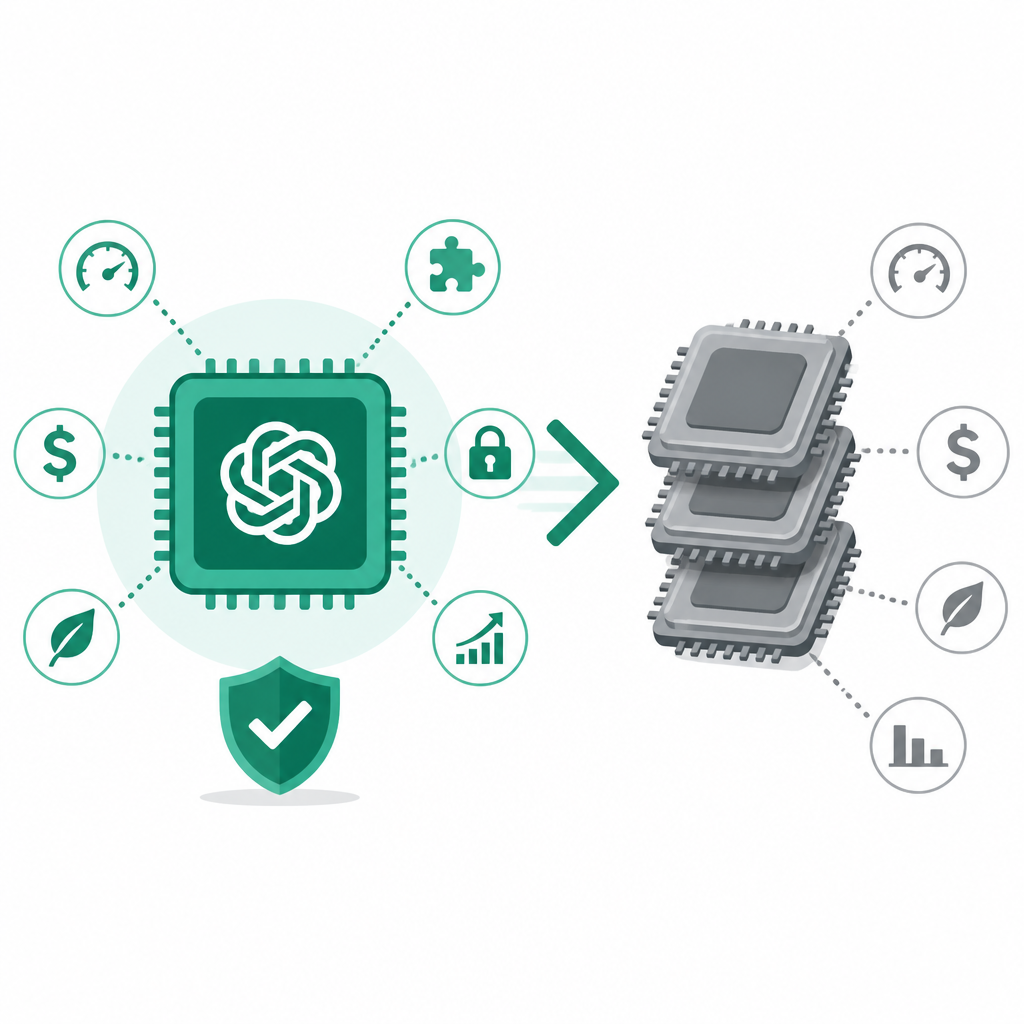
Jalapeño, the first custom chip OpenAI announced with Broadcom, is designed for inferencing and was reportedly developed in just nine months. That speed matters. In a market where access to accelerators can bottleneck product launches, custom silicon is not a vanity project; it is a way to turn compute from a scarce supplier input into an internal advantage.
First, custom silicon solves the supply problem that hyperscale AI cannot ignore
Get the latest AI news in your inbox
Weekly picks of model releases, tools, and deep dives — no spam, unsubscribe anytime.
No spam. Unsubscribe at any time.
OpenAI is one of Nvidia’s biggest buyers, which means it competes with every other serious AI company for the same limited pool of chips. That is a fragile position for a company trying to ship models at scale. A custom chip does not eliminate Nvidia, but it gives OpenAI another lane when the main highway is jammed.

We have already seen this pattern elsewhere. Amazon, Google, Microsoft, and Meta all invest in their own processors because the economics of large-scale AI reward vertical integration. When the biggest buyers keep building alternatives, that is not a trend story. It is an admission that the market leader’s product is excellent, but not sufficient for every workload, every budget, or every roadmap.
Second, inference is where the money and the leverage are
OpenAI says Jalapeño is built for inferencing, the process of running models after training. That is the right place to start because inference is the recurring cost center of AI. Training gets headlines, but inference pays the bills. If OpenAI can improve performance per watt, it can lower operating cost, increase throughput, and make its services cheaper to deliver.
The performance-per-watt claim is also the most important part of the announcement. Energy efficiency is not a side metric in data centers; it is the margin. A chip that does more work per watt can meaningfully change deployment economics, especially as AI usage shifts from occasional experimentation to constant production traffic. That is how infrastructure turns into moat.
The counter-argument
The strongest case against OpenAI’s move is that Nvidia already has the ecosystem, the software stack, and the developer mindshare. CUDA is not just a chip platform; it is an operating system for AI infrastructure. Custom silicon can be expensive to design, painful to validate, and hard to support across fast-moving model architectures. A bad chip program becomes a distraction that drains engineering talent from the core product.
There is also the risk of overbuilding. OpenAI still buys huge volumes of Nvidia hardware, and it will not replace that dependency overnight. If its own chip only handles a narrow slice of inference workloads, the savings may be real but limited. The market has seen plenty of chip announcements that sounded like a broad challenge to Nvidia and ended up as niche internal tooling.
That critique is fair, but it does not defeat the strategy. OpenAI does not need Jalapeño to replace Nvidia everywhere. It needs it to reduce exposure, improve economics on the highest-volume workloads, and gain leverage in a supply-constrained market. In infrastructure, partial independence is still independence. The goal is not ideological purity; it is bargaining power and better unit economics.
What to do with this
If you are an engineer, product manager, or founder, read this as a signal to design for optionality. Build systems that can move across chips, clouds, and inference backends without a rewrite. If you are shipping AI at scale, your real competitive advantage is not loyalty to a vendor. It is the ability to control cost, latency, and supply while the hardware market keeps fragmenting.
// Related Articles