Persona-Pruner trims models for role-playing
Persona-Pruner prunes language models into persona-specific role-play bots while keeping general capabilities intact.

Persona-Pruner prunes language models into persona-specific role-play bots while keeping general capabilities intact.
- Research org: Unspecified in arXiv abstract
- Core data: Up to 93.8% smaller performance drop on RoleBench
- Breakthrough: Isolates persona-specific sub-networks from one description
Role-playing chatbots are useful because they can stay in character, but that usefulness gets expensive fast when you need many distinct personas running at once. The paper behind Persona-Pruner: Sculpting Lightweight Models for Role-Playing argues that you do not always need to keep a full general-purpose model attached to every character.
That matters for any system with lots of NPCs, character agents, or persona-driven assistants. Instead of treating every role-play model like a separate heavyweight deployment, the authors try to carve out a smaller model that keeps the traits that matter for one persona while leaving the rest behind.
What problem this paper is trying to fix
Get the latest AI news in your inbox
Weekly picks of model releases, tools, and deep dives — no spam, unsubscribe anytime.
No spam. Unsubscribe at any time.
The core problem is inefficiency. Large language models can do convincing role-play when given a character specification, but real deployments can involve many personas interacting at the same time. If each one needs a full model, compute costs rise quickly.

The authors point out a second problem with naive pruning: cutting parameters from a model often damages role-play quality badly. Generic pruning methods do not know which weights support essential character behavior and which ones mostly store redundant knowledge.
So the paper asks a practical question: does a single persona really need the full capacity of a generalist model? Their hypothesis is that a character identity only uses part of the model, and that the useful part can be isolated more carefully than standard pruning allows.
How Persona-Pruner works in plain English
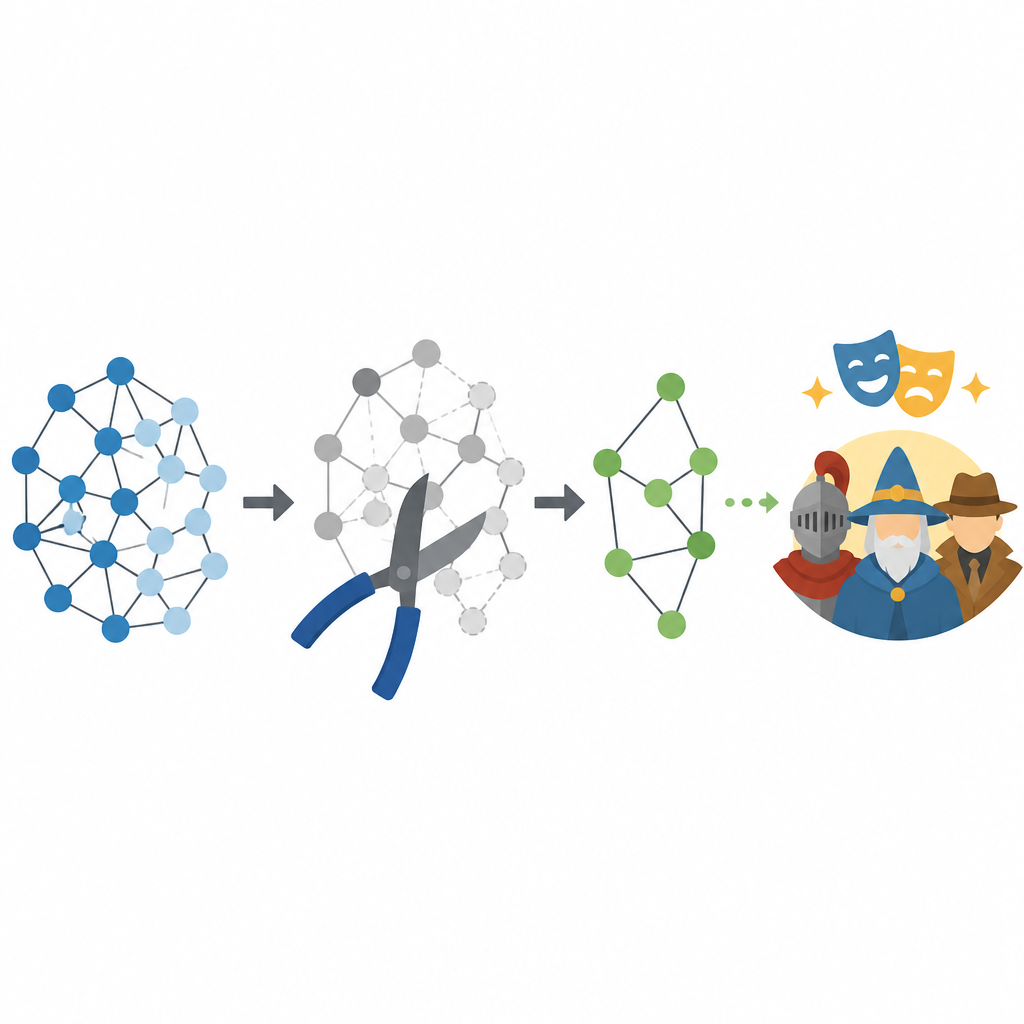
Persona-Pruner is described as a framework for sculpting a lightweight role-playing model from a single persona description. The idea is not to compress a model blindly, but to identify persona-specific sub-networks that support the character’s behavior.
In other words, the method tries to separate the model’s general language ability from the parts that matter for one identity. That is a different goal from ordinary pruning, which usually focuses on removing weights with little regard for whether they help the model stay in character.
The abstract does not give the full algorithmic recipe, layer-by-layer pruning rule, or training schedule, so those details should be checked in the paper itself. What is clear is the design intent: preserve the persona signal, cut the rest, and keep the model useful as a general LLM too.
What the paper actually shows
The main result is comparative: Persona-Pruner preserves role-playing performance more effectively than existing state-of-the-art pruning methods. The authors say it reduces the performance drop from the dense model by up to 93.8% over the strongest baseline on RoleBench, measured with LLM-as-a-judge scoring.
That is the only concrete benchmark number in the abstract, and it is important because it frames the gain as a reduction in degradation rather than a raw absolute score. In practice, that means the pruned model stays much closer to the original dense model’s behavior for the role-playing task.
The paper also claims that the pruned models still maintain general LLM capabilities. That is an important detail for engineers, because a persona model that can only role-play but cannot do normal language tasks would be much less useful in a production system.
What the abstract does not provide is just as important: there are no absolute benchmark scores, no model sizes, no latency numbers, and no memory savings quoted here. So while the result sounds strong, the abstract alone does not tell you the exact deployment footprint or the full quality tradeoff.
Why developers should care
If you build multi-agent systems, game NPCs, character chat products, or any application where many distinct personas need to coexist, the cost of running a full model per persona can become the bottleneck. Persona-Pruner points toward a more selective approach: keep a smaller persona-focused network instead of duplicating a full general model everywhere.
That could matter in two common scenarios. First, you may want to scale to many characters without scaling compute linearly with each new persona. Second, you may want to preserve character consistency without relying on brittle prompt-only tricks that still force every request through a large dense model.
Still, there are open questions. The abstract does not say how well the approach transfers across model families, persona types, or longer interactive sessions. It also does not show whether the method is easy to automate for thousands of characters, or whether some personas are much harder to prune than others.
What to take away
Persona-Pruner is best understood as a targeted compression strategy for role-play models, not a generic pruning paper. Its claim is simple but useful: if you only need one character identity, you may not need the full weight of a generalist LM to deliver it.
For engineers, the takeaway is not that pruning suddenly solves persona modeling. It is that persona-aware pruning may be a better fit than blunt parameter removal when the goal is to preserve style, consistency, and general usefulness at the same time.
- Persona-specific pruning can be more effective than generic pruning for character bots.
- The abstract reports a 93.8% reduction in performance drop versus the strongest baseline on RoleBench.
- The source does not provide absolute scores, model sizes, or latency data.
As with any arXiv result, the real test is whether the method holds up beyond the benchmark and the specific personas studied here. But the direction is appealing: make one model feel like one character, without paying for a full model every time.
// Related Articles
- [RSCH]
Build a Small Language Model with DeepMind
- [RSCH]
PAC-MAN makes humanoid dodgeball safer
- [RSCH]
ReToken uses one learned token to fetch visual context
- [RSCH]
ML helps trace Seiberg dualities
- [RSCH]
Fruitfly-Inspired Regression Without Heavy Models
- [RSCH]
Mental World Modeling: Simulating minds, not just scenes