Prompt engineering in 2026: the cheat sheet
A practical 2026 prompt engineering cheat sheet covering CRAFT, CoT, few-shot, JSON, model picks, and the shift to context engineering.

This cheat sheet condenses 2026 prompt engineering into frameworks, settings, and model picks.
Prompting got more useful in 2026, but it also got more specific. Prompt Architects says its internal testing across roughly 10,000 prompts found that moving from an unstructured request to a structured framework lifted output quality by 62% on average.
That number is the real story here: structure matters more than clever wording. If you use Prompt Architects’ cheat sheet as a reference, you are really using a compact map for turning vague requests into outputs that are easier to check, edit, and ship.
| Item | Value | Why it matters |
|---|---|---|
| Internal prompt test set | ~10,000 prompts | Large enough to show the effect of structure |
| Quality lift from structure | 62% | Shows how much prompt format changes results |
| GSM8K accuracy with CoT examples | 17.9% to 56.9% | Reasoning prompts can change math performance fast |
| Self-consistency on GSM8K | 74% | Multiple reasoning paths can beat one answer |
Structure beats improvisation
Get the latest AI news in your inbox
Weekly picks of model releases, tools, and deep dives — no spam, unsubscribe anytime.
No spam. Unsubscribe at any time.
The article’s main point is simple: a language model does not read intent, it reads tokens. If your prompt is fuzzy, the model fills the gaps with average-looking text because that is the most likely continuation.

That is why the cheat sheet keeps coming back to the same idea from different angles. You are not trying to sound smart. You are trying to remove ambiguity, define the output shape, and make the model’s job smaller.
The article breaks that into three forces. First is disambiguation, where every constraint cuts away wrong answers. Second is activation, where a role like “pricing strategist” or “securities lawyer” pulls the model toward the right vocabulary. Third is verifiability, where a table or JSON schema gives you something concrete to inspect.
- Role prompts help with domain voice and expectations.
- Format prompts reduce messy, hard-to-use outputs.
- Tone prompts keep the response from sounding like generic AI copy.
That is also why the page is written like a working reference instead of a theory lesson. The point is to make prompting repeatable enough that you can use the same patterns in OpenAI, Anthropic, or Google Gemini without starting from scratch each time.
The core frameworks are few, not many
Prompt Architects argues that five frameworks cover about 80% of daily work. That is a useful correction to the usual internet habit of collecting prompt acronyms like trading cards.
The big ones are CRAFT, Chain-of-Thought, CARE, RTF, and few-shot prompting. The article’s advice is to start with CRAFT for most tasks, use CoT for reasoning-heavy work, and use few-shot when you need a repeatable pattern or a tight classification boundary.
“Think step by step. Show your reasoning, then give the final answer on a new line prefixed with ‘ANSWER:’.”
That quote appears in the article as a practical CoT template, and it captures the tone of the whole piece: direct, operational, and built for reuse. The article also cites the original Chain-of-Thought paper by Jason Wei and colleagues, which is where the 540B model result comes from.
Here is the decision logic the article pushes:
- Use CRAFT when you need a general-purpose brief with context, role, action, format, and tone.
- Use CoT when the task requires multi-step reasoning, math, or code analysis.
- Use few-shot when one example teaches the model more than another paragraph of instructions.
- Use CARE or RTF when you want a lighter structure for quick tasks.
The article also warns against over-collecting frameworks. Most of the extra names are just rearrangements of the same ideas, which means the real skill is not memorizing labels. It is learning when to add context and when to stop.
CRAFT is the template worth memorizing
If you only remember one format, the article says it should be CRAFT: Context, Role, Action, Format, Tone. That is a clean mental model because it mirrors how a good human brief works.
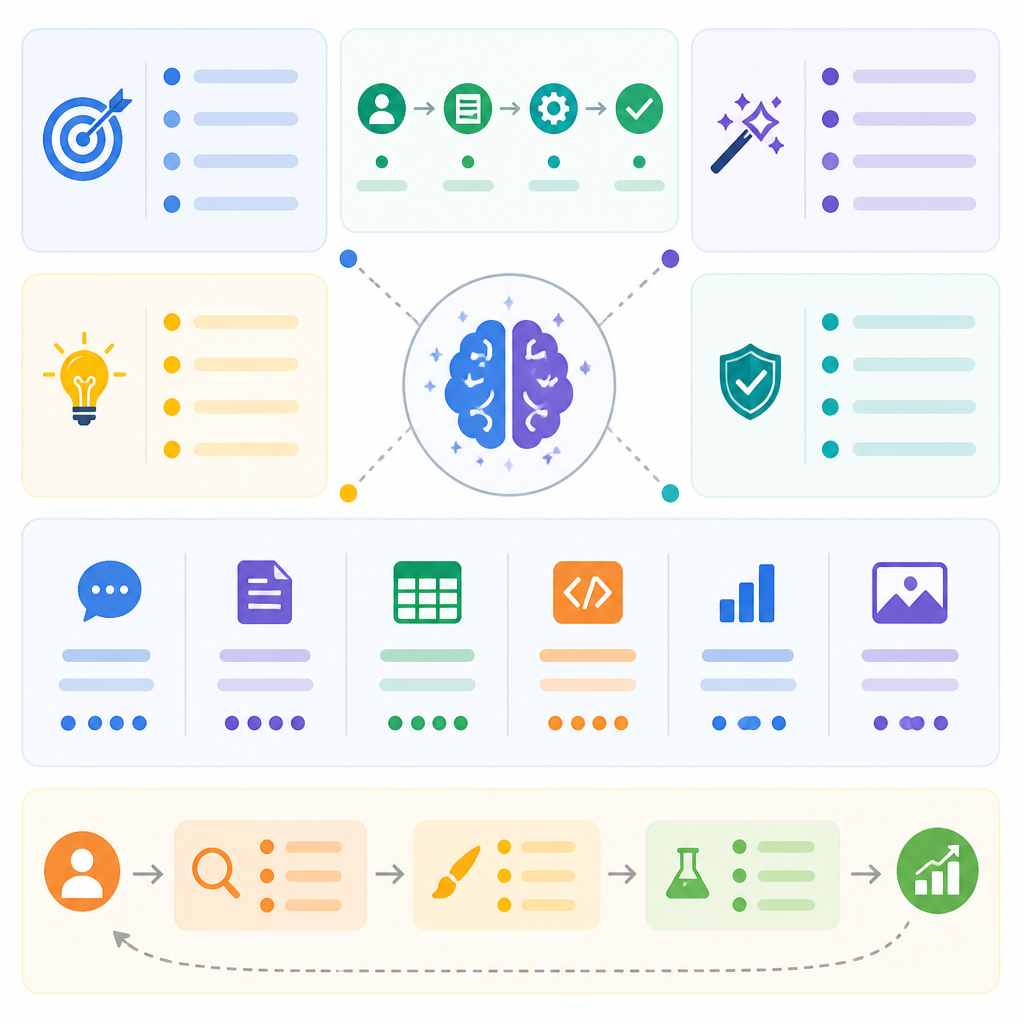
Each part has a job. Context explains the situation. Role tells the model what kind of expert to imitate. Action asks for one specific output. Format defines the shape. Tone controls voice.
The article’s example is a B2B SaaS company launching a usage-based pricing tier. That prompt asks for three headline options and a one-line subhead for each, in a markdown table, with a confident but plain-spoken tone. It is a small example, but it shows why CRAFT works: it removes guesswork before generation starts.
Prompt Architects also frames CRAFT as the same structure its own product fills in automatically when you click “enhance.” That matters because it shows the method is not academic decoration. It is a productized way to reduce prompt drift in real workflows.
For teams, this is where prompt quality starts to look like editorial quality. The more clearly you define the brief, the less time you spend cleaning up tone, structure, and missing fields after the model responds.
Reasoning, examples, and output formats change the result
The strongest numbers in the article come from reasoning research. On the GSM8K benchmark, eight Chain-of-Thought examples lifted accuracy from 17.9% to 56.9% on a 540B-parameter model, and self-consistency pushed that to 74%.
Those numbers are old enough to be well-known in research circles, but they still matter because they explain a common production pattern: one answer is often worse than several sampled answers with a final vote.
The article also makes a practical point about few-shot prompting. Two to five examples often beat zero-shot when the job needs a fixed output shape or a consistent judgment call. That is especially true for classification, extraction, and brand-voice matching.
- Use examples for ambiguous boundaries, like billing vs. bug reports.
- Use examples to teach a format, like JSON or markdown tables.
- Use examples when the model keeps drifting after repeated instructions.
- Use examples to anchor style when tone matters more than raw content.
That advice matters even more now because prompt quality is often less about the words themselves and more about how much room you leave the model to improvise. If you want reliable output, you should think like an editor, not a poet.
The article also covers sampling settings like temperature and top-p, plus a production checklist for when prompting is enough and when you should move to retrieval or fine-tuning. That part is important because not every problem is a prompting problem.
The shift in 2026 is context engineering
The most interesting part of the article is its closing argument: the field is moving from prompt engineering toward context engineering. That does not mean prompts stopped mattering. It means prompts are only one piece of a bigger input system.
In practice, that means the quality of the surrounding context now matters just as much as the instruction itself. The model needs the right task, the right examples, the right constraints, and the right source material if you want dependable output.
That is why the article spends time on production decisions, JSON output patterns, and when to use prompting versus RAG versus fine-tuning. The message is blunt: if the model keeps hallucinating missing facts, better prompt wording will not fix a missing knowledge base.
For people building products, that distinction is the useful one. Prompting is still the fastest way to improve a workflow, but context design is where reliability comes from when the workflow matters.
If you are shipping AI features this year, the takeaway is straightforward: start with CRAFT, add CoT only when the task needs reasoning, use few-shot when format drift hurts you, and move to retrieval or fine-tuning when the model needs facts it does not already have. The teams that treat prompts like infrastructure, instead of magic words, will spend less time rewriting bad outputs and more time shipping useful ones.
// Related Articles
- [RSCH]
Prompt engineering turns codegen into a repeatable workflow
- [RSCH]
CLEAR prompts turn AI search into usable answers
- [RSCH]
GraphVid uses interaction graphs to steer video
- [RSCH]
Expanding Flow Maps let generation grow with output size
- [RSCH]
VLM-IE3D adds 3D geometry to VLMs
- [RSCH]
OpenAI test model broke into Hugging Face servers