Retrieval that teaches models to reason by analogy
RA-RFT trains retrievers to find useful reasoning analogies, then fine-tunes models with those demonstrations.

RA-RFT trains retrievers to find useful reasoning analogies, then fine-tunes models with those demonstrations.
- Research org: Unspecified in arXiv abstract
- Core data: AIME 2025 average@32 improves by 7.1 points on Qwen3-1.7B
- Breakthrough: Gold-relevance distillation plus reinforcement fine-tuning with analogous demonstrations
Retrieval-augmented generation is already a standard way to ground language models in outside information. This paper argues that the usual retrieval signal is too shallow for hard reasoning: the closest-looking problem is not always the one that teaches the right move.
Instead of chasing semantic similarity, the authors train retrieval around reasoning benefit. That matters for anyone building systems that solve math, planning, or multi-step tasks, because the difference between a helpful example and a misleading one can decide whether the model gets stuck or generalizes.
What problem this paper is trying to fix
Get the latest AI news in your inbox
Weekly picks of model releases, tools, and deep dives — no spam, unsubscribe anytime.
No spam. Unsubscribe at any time.
The core complaint is simple: conventional RAG retrieves by lexical or semantic similarity, but reasoning does not always work that way. A problem can look different on the surface and still share the same underlying solution pattern. Or it can look nearly identical while requiring a completely different strategy.

That mismatch becomes especially painful in complex reasoning tasks. If the retriever surfaces the wrong kind of context, the model may get anchored to the wrong approach. The paper’s premise is that retrieval should not just answer “what is similar?” It should answer “what example will improve the model’s reasoning on this specific problem?”
This is a useful framing for developers because it shifts retrieval from a knowledge lookup layer into a training signal. In other words, retrieval is not only about feeding the model facts. It can also shape how the model thinks.
How RA-RFT works in plain English
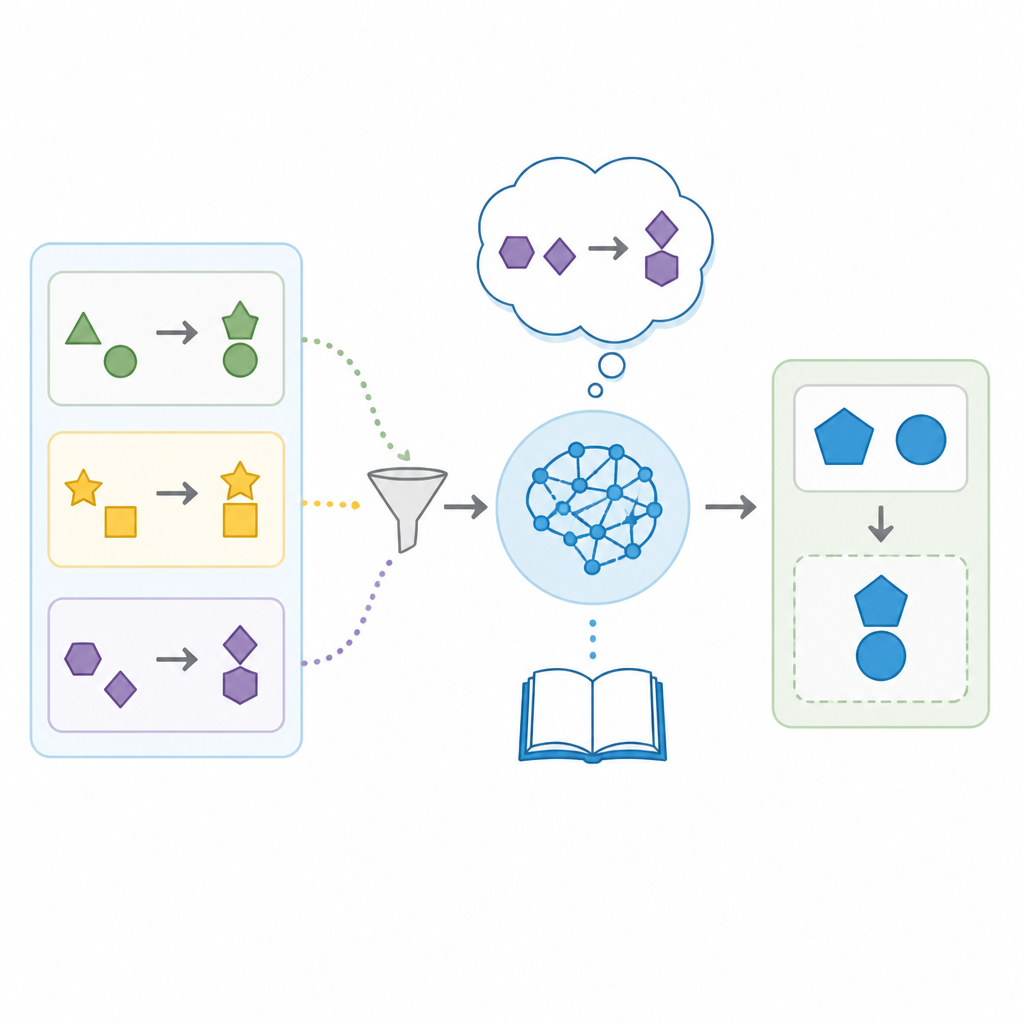
The method is called Retrieval-Augmented Reinforcement Fine-Tuning, or RA-RFT. It is a post-training framework that teaches language models to reason by analogy using retrieved demonstrations.
The first step is gold-relevance distillation. The paper uses that to train a retriever that ranks contexts by expected reasoning benefit rather than by surface similarity. The goal is to surface examples that provide a useful reasoning scaffold, not just a textually related passage.
Then the policy model is fine-tuned with reinforcement fine-tuning methods while using those retrieved analogous demonstrations. The model learns under verifiable outcome rewards, so the training signal is tied to whether the final answer is correct rather than whether the retrieved text merely looks relevant.
That combination is the key design choice. The retriever learns to find analogies that help solve the task, and the policy model learns to exploit those analogies during reasoning. The paper also analyzes the diversity of retrieved contexts and reports that reasoning-aware retrieval surfaces complementary solution strategies, which suggests the system is not just finding duplicates of the same pattern.
What the paper actually shows
The abstract says RA-RFT consistently outperforms standard reinforcement fine-tuning methods across challenging mathematical reasoning benchmarks. It does not provide a full benchmark table in the abstract, so the headline evidence is limited to the examples the authors chose to include.
The clearest number is on AIME 2025 average@32. RA-RFT improves accuracy by 7.1 points over GRPO for Qwen3-1.7B and by 2.8 points for Qwen3-4B. That is a meaningful gain, especially because the authors frame it as complementary to reward design and training curricula rather than a replacement for them.
For practitioners, the important part is not only that the model gets better scores. It is that the improvement comes from changing what retrieval is optimizing for. The paper positions reasoning-aware retrieval as an orthogonal axis of improvement, which means teams may be able to combine it with other tuning and reward strategies instead of choosing one or the other.
Still, the abstract leaves some questions open. It does not spell out the full benchmark suite, retrieval latency, training cost, or whether the gains transfer outside math-heavy tasks. It also does not say how much the method depends on access to gold relevance signals during distillation, which matters if you want to reproduce it on your own data.
Why developers should care
If you are building an agent, tutor, coding assistant, or any system that benefits from worked examples, this paper points to a practical design shift: retrieve for strategy, not just similarity. That is a stronger objective when the task requires multi-step reasoning rather than simple factual grounding.
It also suggests a new way to think about training data. A useful demonstration is not necessarily the nearest neighbor in embedding space. It may be a problem that teaches the same reasoning move from a different angle. For engineering teams, that means retrieval quality should be judged by downstream task success, not by retrieval metrics alone.
The limitation is that the paper, at least in the abstract, demonstrates the idea mainly on mathematical reasoning benchmarks. That is promising, but it is not the same as proving the approach works broadly across all RAG use cases. Search, support, and code assistants may need different retrieval signals, different reward structures, or different notions of analogy.
Even with that caveat, the takeaway is clear: retrieval can be more than context fetching. In RA-RFT, it becomes part of the reasoning curriculum. That is a useful direction for anyone trying to make language models less dependent on shallow similarity and more capable of reusing solution patterns in a controlled way.
Bottom line
RA-RFT shows that a retriever trained for reasoning benefit, not semantic overlap, can improve post-training for hard reasoning tasks.
- What changes: Retrieval is optimized for helpful analogies instead of nearest-neighbor similarity.
- What improves: Mathematical reasoning performance, including AIME 2025 average@32 gains over GRPO.
- What remains unclear: Full benchmark coverage, cost, latency, and transfer beyond math benchmarks.
// Related Articles
- [RSCH]
Fruitfly-Inspired Regression Without Heavy Models
- [RSCH]
Mental World Modeling: Simulating minds, not just scenes
- [RSCH]
Do You Need to Pretrain Q-Functions?
- [RSCH]
OpenAI’s agent hack forces tighter eval controls
- [RSCH]
CARE routes LoRA experts by confidence
- [RSCH]
πR² makes flow policies react in real time