Robostral Navigate runs robots with one RGB camera
Mistral AI’s Robostral Navigate hits 76.6% on R2R-CE using one RGB camera, no depth sensors, and an 8B model.

Mistral AI’s Robostral Navigate uses one RGB camera to guide robots through complex spaces.
Mistral AI just published a navigation model that deserves attention for one simple reason: it works with less hardware than most robotics stacks. Robostral Navigate is an 8B model that reached 76.6% success on the R2R-CE unseen validation benchmark using only a single RGB camera.
The company says that same system beat the best single-camera approach by 9.7 points and the best system using depth or multiple cameras by 4.5 points. It also trained entirely in simulation, used about 2.4 million trajectories across 350k scenes, and cut training tokens by 22× with a prefix-caching method.
| Metric | Robostral Navigate | Why it matters |
|---|---|---|
| Model size | 8B | Large enough for rich instruction following, small enough to be practical |
| R2R-CE unseen validation | 76.6% | Tests generalization to held-out environments |
| R2R-CE seen validation | 79.4% | Shows strong performance even on familiar layouts |
| Training data | ~2.4M trajectories | Large simulated dataset for navigation behavior |
| Scene count | 350k scenes | Wide variation helps with transfer to real spaces |
| Token reduction | 22× | Training becomes far more efficient |
| RL gain | +3.2% | Online reinforcement learning improved success further |
One camera, one instruction, one robot path
Get the latest AI news in your inbox
Weekly picks of model releases, tools, and deep dives — no spam, unsubscribe anytime.
No spam. Unsubscribe at any time.
Robostral Navigate is Mistral’s first model for embodied navigation, and the setup is refreshingly plain. A robot gets a natural-language instruction like “Leave the lobby, walk through the corridor, enter the supply room, and stop to face the second shelf,” then uses a single RGB camera to decide what to do next.
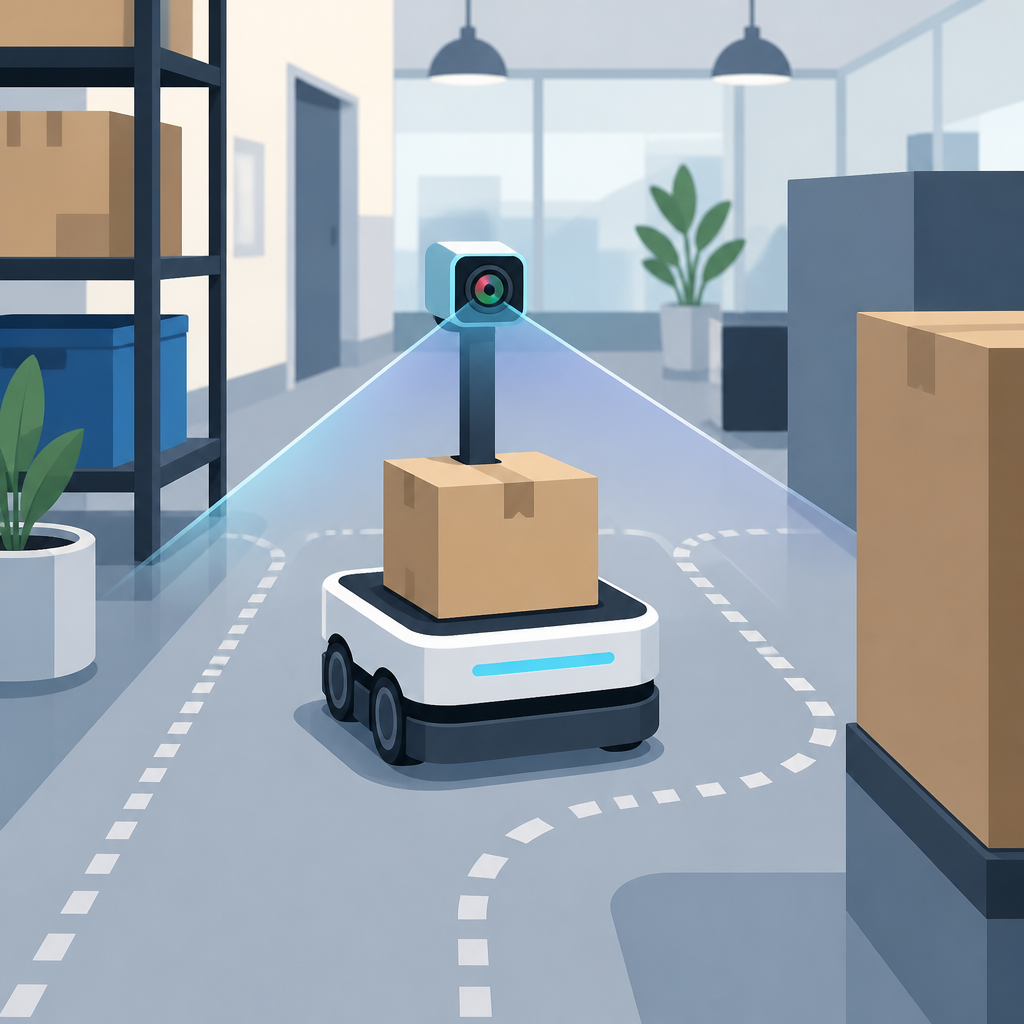
That matters because most robotics systems still lean on extra sensors. Depth cameras, LiDAR, and multi-camera rigs help with perception, but they add cost, complexity, and failure points. Mistral is betting that a strong vision-language model plus good training data can get much of the same job done with less hardware.
- Input: one RGB image plus a text instruction
- Output: the next movement target and orientation
- No depth sensors, LiDAR, or multi-camera array
- Works across wheeled, legged, and flying robots
The model uses a pointing-based navigation method for many steps. Instead of thinking in abstract meter offsets all the time, it predicts the target location in the current camera view and the desired orientation on arrival. That choice makes the policy less sensitive to camera intrinsics and world scale, which are common sources of pain when a robot moves from a lab demo into a different machine or building.
When the destination is outside the current field of view, the model falls back to local displacements such as moving forward, sliding left, and turning. That hybrid design is practical, and it is probably one of the reasons the model holds up in real spaces with people, furniture, and partial occlusions.
Built in simulation, then pushed with reinforcement learning
Mistral says Robostral Navigate was built entirely in-house and does not depend on existing open-source vision-language models. The model started from a vision-language system already tuned for grounding tasks like pointing, counting, and object localization, then extended that capability into navigation.
That path makes sense. If a model can already identify where objects are in an image, learning how to move toward them is a nearby problem, not a totally separate one. The company also built its data pipeline in simulation, which let the team iterate quickly and generate a large training set without waiting for expensive real-world robot runs.
“Navigation emerges as a natural extension of these capabilities: once it understands where things are, it learns how to move.”
— Mistral AI research team, Robostral Navigate
The training setup is where the engineering gets interesting. Mistral used prefix-caching with a tree-based attention-masking strategy so an entire episode can be compressed into one sequence. In plain English, the model trains on all time steps in one forward pass without leaking future information into the past.
That brought a 22× reduction in training tokens compared with a one-sample-per-time-step setup. Mistral says this turns runs that would take months into runs that finish in days, which is the kind of speedup that changes how often a team can test ideas.
- Training data: about 2.4 million trajectories
- Scene coverage: 350,000 simulated scenes
- Supervised training: compressed into a single sequence per episode
- Online RL: CISPO added another 3.2% success rate
Why the benchmark numbers matter
The headline number is 76.6% on R2R-CE unseen validation, but the comparison set matters just as much. Mistral says that result beats the best single-camera approach by 9.7 points and the best system using depth or multiple cameras by 4.5 points. That is a strong claim because it compares a lighter sensor setup against heavier stacks that usually have the advantage.
R2R-CE, or Room-to-Room in Continuous Environments, is a useful test because it checks whether a model can follow instructions in environments held out from training. The point is not whether the robot can memorize a route. The point is whether it can act sensibly in a new office, a new hallway, or a new room layout it has never seen before.
Here is the performance picture Mistral published:
- Validation seen success rate: 79.4%
- Validation unseen success rate: 76.6%
- Best single-camera competitor gap: +9.7 points
- Best depth or multi-camera competitor gap: +4.5 points
Those numbers suggest the model is doing more than squeezing out a small benchmark win. It is closing a hardware gap. If that holds up outside simulation and in more varied real deployments, robotics teams may start asking whether they really need the full sensor stack for every navigation problem.
What this means for robotics teams
Robostral Navigate points toward a simpler deployment model for robots that need to move through offices, warehouses, hospitals, hotels, and mixed indoor spaces. Fewer sensors can mean lower BOM cost, less calibration work, and easier maintenance. It also makes it easier to put the same software on different robot bodies without rebuilding the perception stack from scratch.
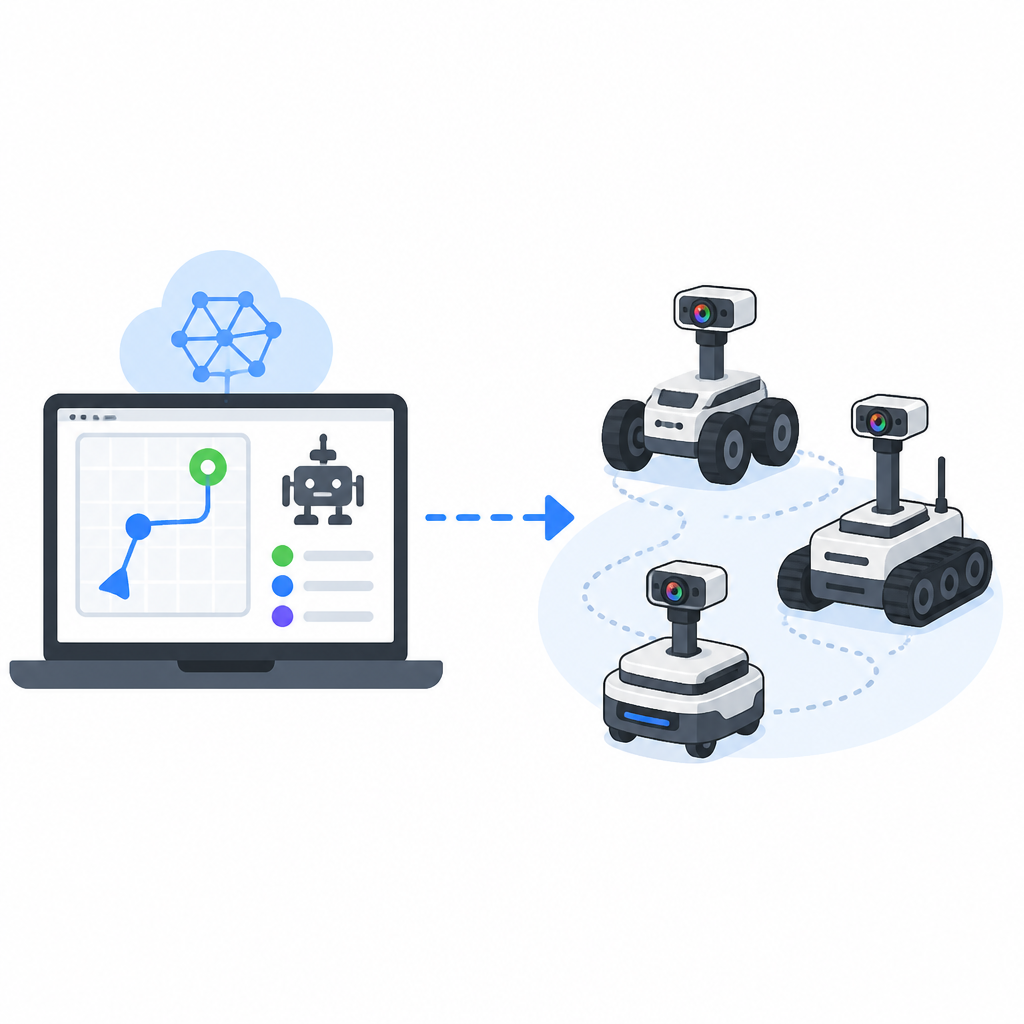
That portability matters because robotics is still fragmented. A wheeled delivery bot, a legged inspection robot, and a flying platform do not share the same motion profile, but they do share the need to understand spaces and follow instructions. Mistral says the model generalizes across robot sizes and can run on wheeled, legged, and flying robots, which is exactly the kind of cross-platform claim robotics buyers want to hear.
If you want a useful comparison, think about the tradeoff like this:
- Heavier sensor stacks improve perception but raise cost and integration work
- Single-camera systems simplify hardware but usually struggle on hard navigation tasks
- Robostral Navigate tries to keep the simpler hardware while matching stronger systems on held-out environments
The bigger strategic bet is that navigation is the entry point to a unified embodied agent. Mistral is saying the same model family that handles grounding in images can also learn action, planning, and recovery from mistakes through online reinforcement learning. That is a much more compact story than the old robotics playbook of separate modules for perception, mapping, planning, and control.
What to watch next
Robostral Navigate is a research release, but it reads like a product signal too. Mistral is clearly aiming at customers in manufacturing, delivery, logistics, and hospitality, where autonomous movement through changing spaces has real value. The company is also hiring for robotics research and engineering, which suggests this is the start of a larger embodied AI push rather than a one-off paper drop.
The key question now is whether the same results hold when the model leaves curated simulation and enters messy production settings with glare, crowded corridors, bad camera mounts, and weird edge cases. If Mistral can keep most of this performance in the wild, then the robotics industry may start rethinking how much sensor hardware a navigation stack really needs.
My read: the next meaningful milestone is not a bigger benchmark score, but a public demo in a real building with limited instrumentation and no hand-holding. That would tell us far more about whether single-camera navigation is ready for deployment than another percentage point on a leaderboard.
// Related Articles
- [RSCH]
LLM Inference Hardware Needs Memory, Not More FLOPs
- [RSCH]
Agent Skills: the next layer for LLM agents
- [RSCH]
Offline-First LLMs for Low-Connectivity Learning
- [RSCH]
How LLMs are changing US research funding
- [RSCH]
Aligning LLMs with selective prediction
- [RSCH]
Implicit Reasoning for LLM Recommendation