GraphVid uses interaction graphs to steer video
GraphVid steers video generation with interaction graphs instead of brittle track drawing.

Anyone who has tried to control multiple moving objects in a generated video knows the pain: text prompts get vague, and hand-drawn motion tracks get messy fast.
GraphVid steers video generation with interaction graphs instead of brittle track drawing.
- Research org: Unspecified in arXiv abstract
- Core data: FID reduced by up to 39.9%
- Breakthrough: Graph-conditioned image-to-video generation with structured interaction graphs
That is the problem GraphVid: Interactive Graph-Controllable Video Generation is trying to fix. The paper argues that existing controllable video systems struggle when you need precise interactions among several objects, especially when those objects overlap, occlude one another, or move in ways that are hard to describe with a short prompt.
For developers, the important shift is not just better generation quality. It is a different control interface: instead of forcing users to specify motion as raw pixel trajectories, GraphVid uses a structured graph to describe how objects should interact. That makes the control signal more semantic and, in theory, easier to scale as scenes get more crowded.
Why current video control breaks down
Get the latest AI news in your inbox
Weekly picks of model releases, tools, and deep dives — no spam, unsubscribe anytime.
No spam. Unsubscribe at any time.
The abstract points to two common control paths in controllable video generation. The first is text prompting, which is flexible but often too imprecise for multi-object scenes. The second is motion-control inputs, which constrain pixel movement but do not naturally express relationships like “this object should follow that one” or “these two objects should avoid each other.”
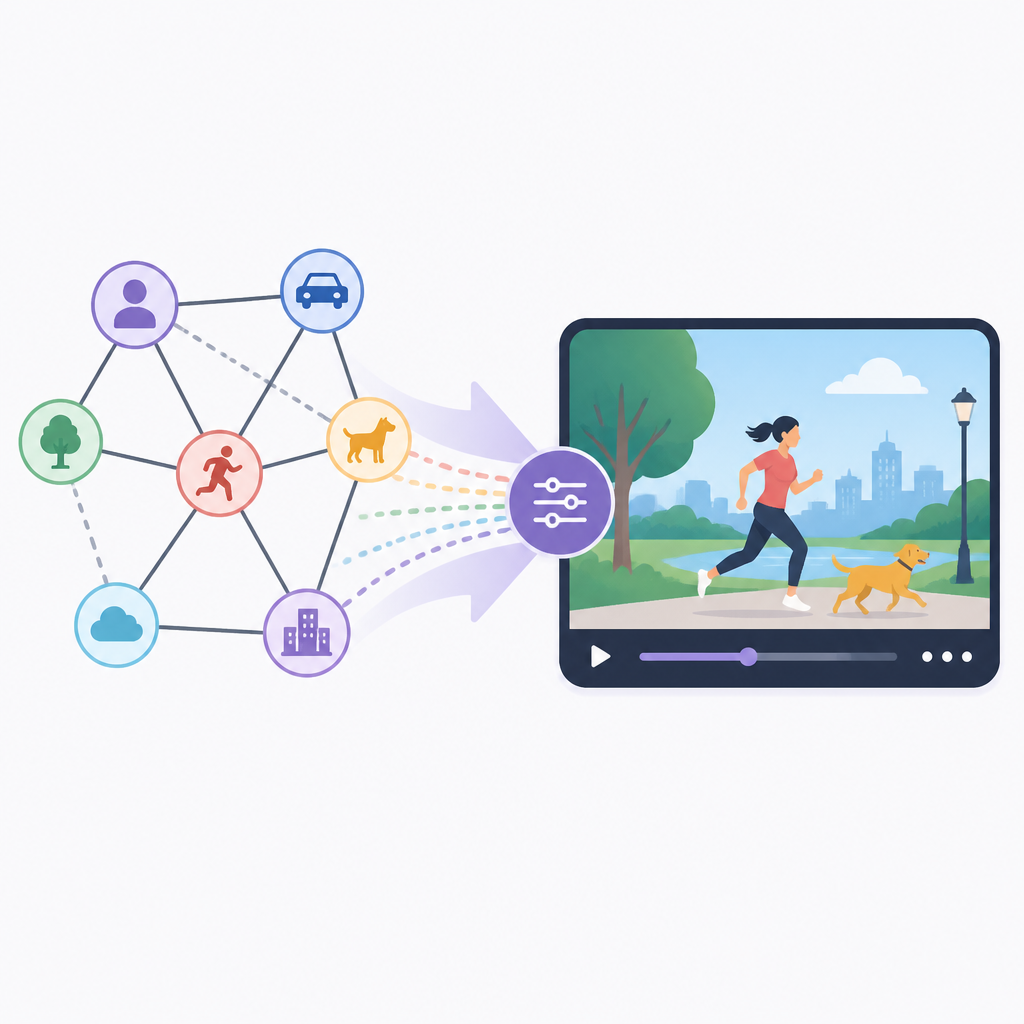
Trajectory-based control sounds more exact, but the paper says it becomes awkward in practice. If a user has to draw accurate tracks for multiple objects, the workload grows with scene complexity. Once objects overlap or get occluded, the trajectory itself can become ambiguous. In other words, the interface starts to fight the scene instead of describing it.
That is a real software design problem, not just a model problem. If the control layer is fragile, the whole pipeline becomes hard to use outside of toy demos. GraphVid is positioned as an attempt to replace that brittle layer with something more structured.
How GraphVid works in plain English
GraphVid is described as a graph-conditioned image-to-video generation model. The key idea is that the user controls the output through an interaction graph, which encodes relationships between subjects in the scene. The abstract does not spell out the full schema of that graph, but it is clear that the model is meant to accept structured relational annotations rather than only raw motion paths.
That matters because graphs are a natural fit for multi-agent scenes. A graph can represent which object interacts with which other object, and it can do so without forcing the user to specify every intermediate pixel position. Instead of drawing a continuous path for each subject, the user provides a more semantic description of the scene’s dynamics.
The paper also introduces GraphVid-Bench, a large-scale interaction-centric video dataset with structured relational annotations. That dataset appears to be part of the training setup for interaction-aware video generation models, which suggests the authors are not only changing the model interface but also building the data needed to support it.
From an engineering perspective, that is the right pairing. A new control representation is only useful if the training data teaches the model how to read it. GraphVid-Bench seems designed to do exactly that by centering interactions rather than generic motion.
What the paper actually shows
The abstract says GraphVid uses substantially less training data and fewer trainable parameters than prior motion-control methods, while still delivering strong controllability and video quality. That is an important claim, but the abstract does not provide the exact data scale or parameter counts, so those details remain unspecified in the source.
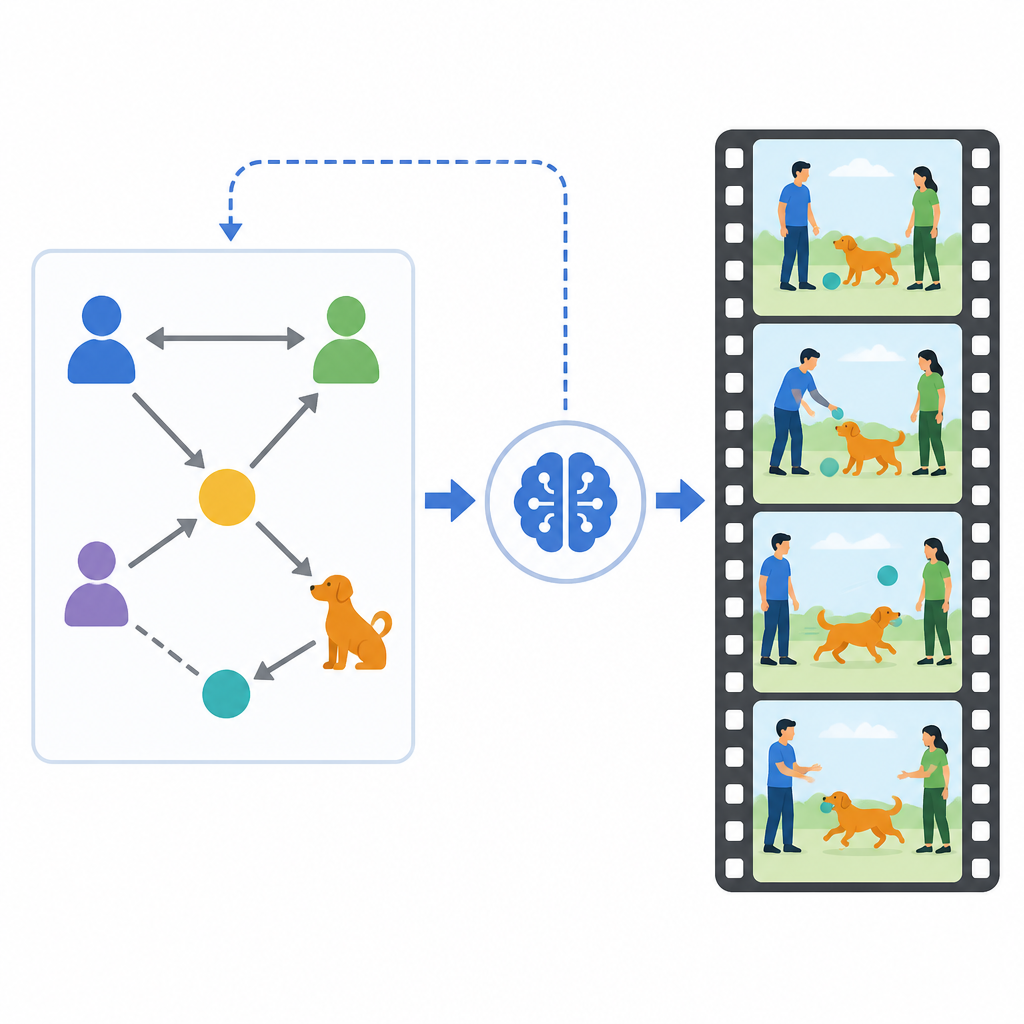
What it does provide are comparative metrics against Motion-I2V. GraphVid reduces FID by up to 39.9% and FVD by 37.6%. It also improves PSNR from 9.87 to 15.98 and SSIM from 0.38 to 0.61. Those numbers suggest gains both in perceptual quality and in reconstruction-style similarity metrics, although the abstract does not break down which parts of the method contribute most to each improvement.
There is an important caveat here: the abstract gives summary results, not a full benchmark table or ablation story. We do not learn from the provided text how GraphVid behaves across different scene types, how sensitive it is to graph quality, or how it compares on user-facing editing workflows. So the results are promising, but they are still only the high-level picture.
Still, the direction is clear. The paper is arguing that structured semantic interfaces can outperform lower-level motion controls for controllable video generation. If that holds up in the full paper, it is a meaningful design win: the control abstraction becomes closer to how people actually think about scenes.
Why engineers should care
If you build creative tools, video editing systems, or multimodal generation interfaces, the control problem is often harder than the generation problem. Users do not want to micromanage pixels. They want to describe intent. GraphVid’s graph-based interface is interesting because it tries to turn that intent into something the model can use directly.
This also hints at a broader product pattern. As generative systems get more capable, the bottleneck moves from output quality to controllability and interaction design. Graphs are one possible way to expose richer structure without forcing users into low-level annotation. For multi-object video in particular, that could be a better fit than simple prompts or trajectory drawing.
There are still open questions. The abstract does not say how easy the graphs are for users to author, whether the system supports editing after generation starts, or how robust it is when the graph conflicts with the visual context. It also does not explain whether GraphVid generalizes beyond the interaction-centric data it was trained on.
Even with those gaps, the paper is useful because it reframes controllable video generation around structure, not just motion. That is a practical idea developers can recognize: when the interface matches the problem, the model usually gets easier to use. GraphVid is an attempt to make that interface explicit for video.
Bottom line
GraphVid proposes a more scalable way to control multi-object video generation by using interaction graphs instead of raw trajectory drawing.
- It targets the control bottleneck in multi-object video generation.
- It pairs a graph-conditioned model with a new interaction-centric benchmark.
- It reports better quality and fidelity than Motion-I2V in the abstract.
// Related Articles
- [RSCH]
Prompt engineering turns codegen into a repeatable workflow
- [RSCH]
CLEAR prompts turn AI search into usable answers
- [RSCH]
Prompt engineering in 2026: the cheat sheet
- [RSCH]
Expanding Flow Maps let generation grow with output size
- [RSCH]
VLM-IE3D adds 3D geometry to VLMs
- [RSCH]
OpenAI test model broke into Hugging Face servers