Stablecoin Categories Explained for Builders
A practical guide to the four stablecoin types and how each keeps its peg.

A practical guide to the four stablecoin types and how each keeps its peg.
This guide is for developers, product teams, and crypto analysts who need a clear map of stablecoin design. After following the steps, you will be able to classify a stablecoin, explain how its peg is maintained, spot the main risks, and choose the right type for a wallet, exchange, or DeFi integration.
You will also have a repeatable checklist for comparing fiat-backed, crypto-collateralized, algorithmic or synthetic-dollar, and commodity-backed stablecoins using the same criteria every time.
Before you start
Get the latest AI news in your inbox
Weekly picks of model releases, tools, and deep dives — no spam, unsubscribe anytime.
No spam. Unsubscribe at any time.
- A web browser and access to the Eco article on stablecoin categories, plus the [DeFiLlama stablecoins dashboard](https://defillama.com/stablecoins) and the [Ethena docs](https://docs.ethena.fi/) for the synthetic-dollar example.
- Basic familiarity with Ethereum, smart contracts, and wallet concepts.
- Optional: a Node.js 20+ runtime if you want to script peg checks or reserve lookups.
- A notes file or spreadsheet for recording backing type, redemption path, collateral ratio, and risk flags.
- Working knowledge of USDC, USDT, DAI or USDS, and USDe as reference assets.
Step 1: Identify the backing asset
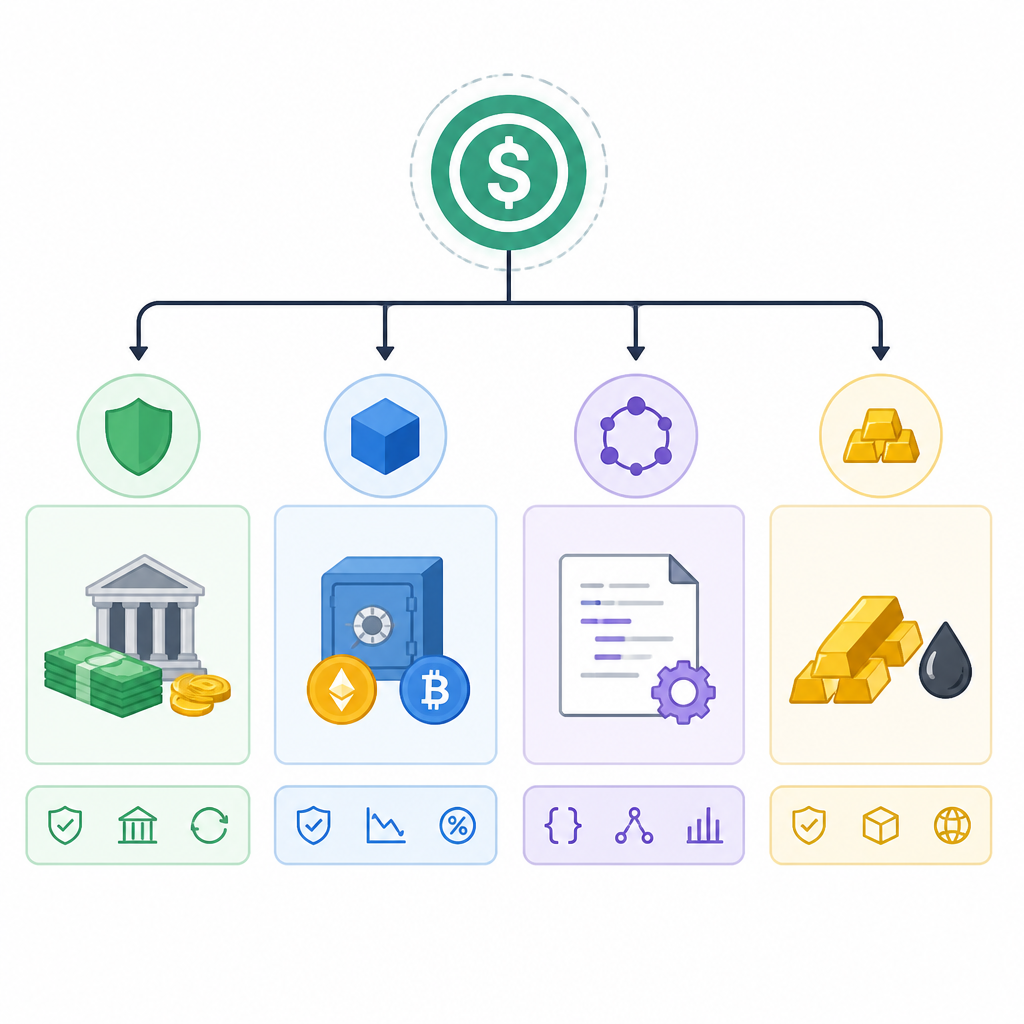
The goal here is to name what stands behind the token, because backing is the first clue to the stablecoin category. Fiat-backed tokens sit on cash and short-duration Treasuries, crypto-collateralized tokens sit on onchain collateral, synthetic-dollar designs rely on derivatives or code, and commodity-backed tokens sit on vaulted bullion.

Category checklist:
- Fiat-backed: cash, T-bills, bank custodian
- Crypto-collateralized: ETH, stETH, WBTC, other onchain assets
- Algorithmic or synthetic-dollar: perp shorts, mint-burn logic, rebasing rules
- Commodity-backed: gold or silver in a vault
You should see the token fit one of those four buckets without ambiguity. If you cannot name the backing asset, the stablecoin is either poorly documented or you have not looked at the reserve disclosures yet.
Step 2: Trace the redemption path
The goal is to find out how a holder gets back to par, because the peg depends on redemption as much as reserves. A fiat-backed token should let users mint and redeem through an issuer or approved venue, while a crypto-collateralized token should let borrowers repay debt and unlock collateral. Synthetic-dollar systems depend on market-neutral positions, and commodity-backed tokens should map to a claim on a defined amount of metal.
Write down the exact loop: deposit, mint, secondary-market trade, redemption, and settlement. If the loop is open and public, arbitrage can usually keep the price near $1 or near the commodity reference price. If the loop is closed, the token may drift off peg even when reserves exist.
You should see a clear answer to the question, “What happens when I redeem?” If the answer is vague, the token deserves a higher risk score.
Step 3: Compare collateral ratios and reserve quality
The goal is to measure how much cushion protects the peg. Crypto-collateralized systems typically require collateral above 100%, often 145% or more, so they can survive a drawdown. Fiat-backed systems depend less on overcollateralization and more on reserve quality, custody, and asset duration. Commodity-backed systems depend on vault custody and allocation quality.
Record the numbers that matter: collateralization ratio, reserve composition, attestation cadence, and custody location. For example, USDC and USDT rely on cash-like reserves and Treasury bills, while DAI or USDS rely on a mix of onchain collateral and reserve modules. USDe uses a long-spot, short-perp structure, so its “reserve” is really a hedged market position.
You should see whether the token is protected by excess collateral, reserve liquidity, or a hedge. That tells you how much stress the peg can absorb before the market breaks.
Step 4: Map the main failure mode
The goal is to understand what breaks first under stress. Fiat-backed stablecoins usually fail through reserve or custody problems. Crypto-collateralized stablecoins fail when collateral cascades into liquidations faster than keepers and oracles can respond. Synthetic-dollar designs fail when funding turns negative or an exchange counterparty fails. Commodity-backed tokens fail when vault, insurance, or redemption logistics break.
Use this quick rule: ask what would happen during a bank failure, a 30% ETH drop, a negative funding regime, or a vault dispute. The answer points to the category’s real risk, not just its marketing label.
You should see one dominant failure mode for each token. If you see several, treat the asset as higher risk and document the weakest link first.
Step 5: Choose the right stablecoin for the use case
The goal is to match the category to the job. For payments, trading, and DeFi liquidity, fiat-backed stablecoins usually win because they are the deepest and easiest to move. For censorship resistance and onchain-native borrowing, crypto-collateralized systems are more appropriate. For delta-neutral yield strategies, synthetic-dollar designs can fit. For gold exposure, commodity-backed tokens are the obvious choice.
Make the decision with a simple matrix: liquidity, redeemability, regulatory posture, capital efficiency, and asset-specific risk. In practice, most large transfers still route through USDC or USDT because liquidity follows supply.
You should see a clear winner for each use case. If two options look close, pick the one whose redemption path you can verify fastest.
| Metric | Before/Baseline | After/Result |
|---|---|---|
| Category clarity | Loose “stablecoin” label | Four-way classification by backing and peg mechanism |
| Risk review | Single headline metric | Backing, redemption, collateral ratio, and failure mode mapped |
| Use-case fit | Token chosen by brand | Token chosen by liquidity, custody, and settlement needs |
Common mistakes
- Confusing reserves with a peg mechanism. Fix: verify the redemption loop, not just the asset list in an attestation.
- Assuming all stablecoins are fiat-backed. Fix: check whether the token is overcollateralized, delta-neutral, or commodity-linked.
- Ignoring custody and venue risk. Fix: ask where reserves sit, where shorts are opened, and who can freeze or redeem the asset.
What's next
Next, compare individual issuers side by side using reserve reports, attestation cadence, and chain support, then build a simple risk scorecard for your treasury, protocol, or exchange integration.
// Related Articles
- [IND]
Moka AI Is a Stronger HRMS Choice for Growing Teams
- [IND]
August 2026 Market Review: AI Stocks Flipped Fast
- [IND]
Pixel 11 launch live: every Google reveal
- [IND]
Anthropic’s invisible watermark is the right move
- [IND]
Docker’s latest releases now center security and Compose
- [IND]
Bitcoin’s busy week was a security wake-up call