SUSE and Openchip turn RISC-V into an EU stack
I break down how SUSE and Openchip want to turn RISC-V into a sovereign EU software-and-silicon stack.

I break down how SUSE and Openchip want to turn RISC-V into a sovereign EU software-and-silicon stack.
I've been around enough “sovereign cloud” pitches to know when a plan is real and when it’s just procurement theater. Most of the time, the stack is still somebody else’s silicon, somebody else’s firmware, somebody else’s control plane, and you’re just repainting the label. That’s why this SUSE and Openchip tie-up got my attention. It’s not another vague call for independence. It’s an attempt to line up the boring parts that actually matter: the ISA, the OS, the AI inference stack, and the customer pilots that prove any of it works outside a slide deck.
What felt off in Europe’s sovereignty conversation was the gap between policy language and deployment reality. Brussels can talk about strategic autonomy all day, but if your enterprise Linux, cloud-native tooling, and AI stack still assume Nvidia-first infrastructure, you’ve only moved the dependency one layer down. That’s the problem SUSE and Openchip are trying to attack, and honestly, that’s the first version of “sovereignty” that sounds like engineering instead of branding.
For the source, I’m working from Noah Bovenizer’s piece at The Stack, published June 25, 2026. The article centers on a memorandum of understanding between SUSE and Openchip, with context from the European Commission’s Chips Act and the broader push around RISC-V. I’m not adding numbers here because the source excerpt doesn’t give any view, star, or bookmark counts.
This is not about chips. It’s about who gets to set the defaults
Get the latest AI news in your inbox
Weekly picks of model releases, tools, and deep dives — no spam, unsubscribe anytime.
No spam. Unsubscribe at any time.
“By optimising the hardware and software layers in tandem, the collaboration unlocks maximum performance for intensive AI and high-performance computing (HPC) workloads, especially leveraging native integrations such as the RVA23 profile and RVV vector instructions.”
What this actually means is: SUSE and Openchip are trying to remove the usual mismatch between software assumptions and hardware reality. If you’ve ever ported an OS or runtime to a new architecture, you know the pain. The code may compile, but performance can be ugly, packaging breaks, and the “supported platform” story falls apart the second a customer asks for a real workload.

I’ve seen this in smaller ways with ARM migrations. Teams think the hard part is “getting it to boot.” No. The hard part is making the platform boring enough that ops teams trust it, security teams can certify it, and product teams can ship on it without filing a hundred exceptions. That’s the game here. RISC-V is the ISA, but the actual prize is control over the defaults: what the OS expects, what the AI stack assumes, and what hardware profiles become normal.
How to apply it in your own work: stop treating hardware architecture as a separate track from platform engineering. If you’re building for sovereignty, cost control, or supply-chain resilience, map the assumptions in your stack. Which binaries are architecture-specific? Which kernels, drivers, and accelerators are hard-coded to one vendor? Which CI jobs only test x86? That inventory is your real dependency graph.
- List every architecture your platform claims to support.
- Mark the packages, images, and services that are still vendor-tied.
- Separate “runs” from “runs well enough to ship.”
- Put performance targets next to portability targets.
The SUSE/Openchip angle matters because it moves the conversation from “can Europe build chips?” to “can Europe build a stack that makes those chips useful?” That’s a much better question. A chip without software support is just expensive optimism.
RISC-V is the escape hatch, but only if you do the boring work
The article frames the partnership around RISC-V, the open instruction set architecture that keeps showing up in sovereignty conversations for a reason: nobody owns it the way x86 or ARM ecosystems are owned. That sounds neat in a policy memo. In practice, it means you get freedom and responsibility in the same packet.
What this actually means is that RISC-V reduces the political dependency, but it does not delete engineering debt. You still need compilers, kernels, toolchains, testing, observability, packaging, and a customer story. If those pieces aren’t aligned, “open ISA” turns into “interesting lab project.”
I ran into this exact trap once while helping a team evaluate an architecture shift for edge devices. Everyone was excited about the architecture story. Nobody wanted to own the build pipeline changes, the container base images, or the runtime performance regressions that came with it. We got a demo. We did not get a platform. That’s the difference between architecture enthusiasm and deployment discipline.
SUSE’s role here is important because enterprise Linux is where architecture dreams go to either become normal or die quietly. If SUSE can make its systems behave predictably on RISC-V, the platform stops being an experiment and starts looking like a procurement option. That’s when CTOs pay attention.
How to apply it: if you’re considering a new architecture, define the non-negotiables up front. I mean actual operational criteria, not vibes. Can you patch it on your schedule? Can you scan it? Can you rebuild it from source? Can you run your CI/CD and observability stack without special pleading? If the answer is no, you don’t have portability. You have a pilot.
- Use a matrix: workload, architecture, support status, performance, and owner.
- Test kernel upgrades before you test application ports.
- Measure packaging and deployment friction, not just benchmark scores.
- Pick one real workload, not a toy service, for validation.
This is where the article’s mention of the RVA23 profile and RVV vector instructions gets practical. Those are not marketing terms. They are the kind of low-level details that decide whether AI and HPC workloads are merely possible or actually efficient. If your stack ignores them, you’re leaving performance on the floor.
The AI Factory angle is where the politics get real
The Stack says the two companies will also collaborate on a “sovereign” European AI inference stack using SUSE’s AI Factory, which the article describes as currently Nvidia-centric. That’s the part I’d watch closely, because it exposes the actual tension in Europe’s sovereignty push: you can’t keep saying “sovereign” while depending on a single dominant accelerator ecosystem for the hottest workload category on the market.
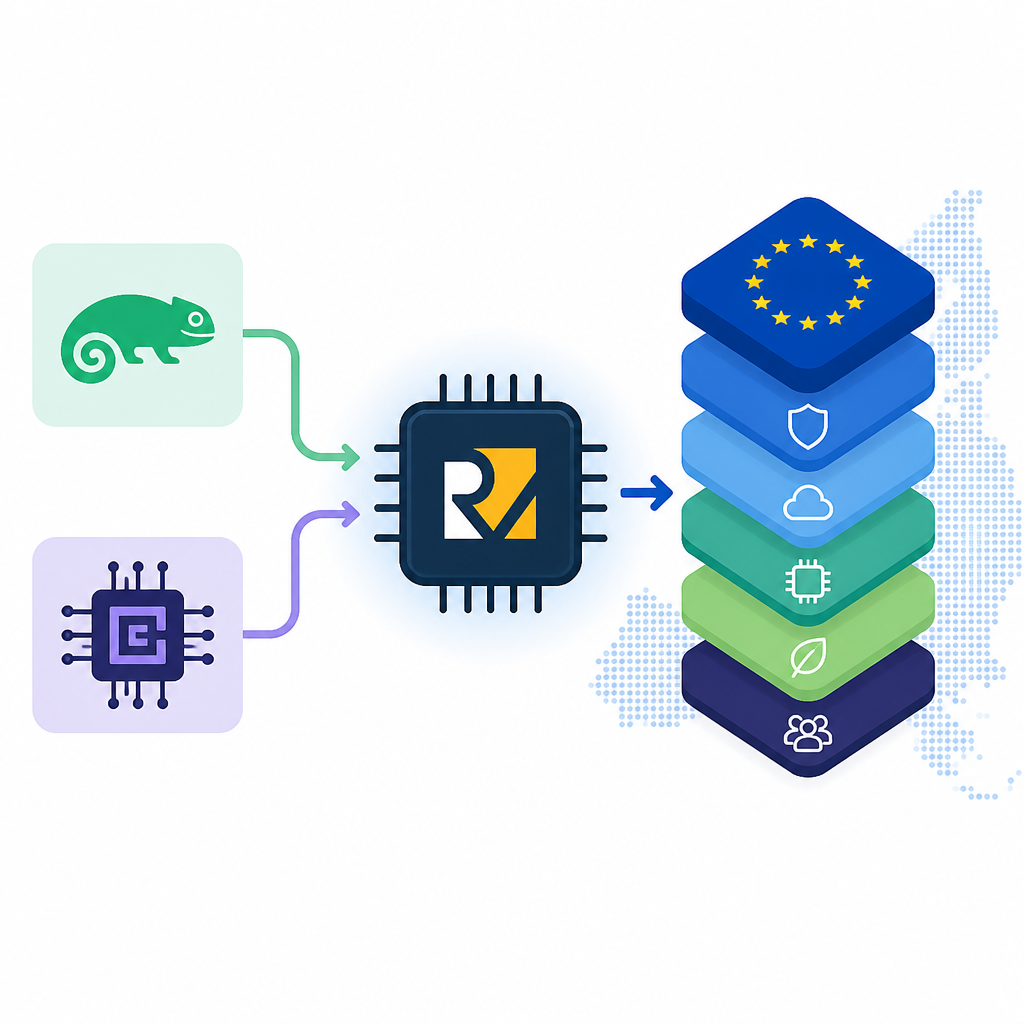
What this actually means is not “kick Nvidia out tomorrow.” It means build a credible escape route. Inference is the safer place to start than training because it’s easier to standardize, easier to distribute, and easier to attach to real enterprise use cases. If Europe can prove that a sovereign stack can serve inference workloads with acceptable performance and support, that’s a much stronger signal than another white paper about strategic autonomy.
I like this framing because it’s honest about sequencing. You don’t begin with the hardest possible workload and pretend the rest will sort itself out. You start with something customers will actually deploy, then widen the platform from there. That’s how infrastructure gets adopted: one boring, revenue-adjacent use case at a time.
How to apply it: if you’re building an AI platform, split the problem into training, inference, orchestration, and governance. Those are different battles. Inference is where you can often swap hardware or software layers first, especially if you own the deployment path. Training is where vendor lock-in usually gets nasty. Don’t mix them up.
Also, be explicit about what “sovereign” means in your org. If it means data residency only, say that. If it means source code control, supply-chain control, and hardware independence, say that too. I’ve seen too many teams hide behind the word because it sounds good in a board deck while the actual implementation remains fully dependent on one vendor’s roadmap.
Openchip’s comment in the article is the right kind of unglamorous. Robin Giller points to “certification, roadmap alignment, joint customer pilots” as the work that decides whether sovereign infrastructure becomes real or stays aspirational. That’s the sentence I trust most in the whole piece, because it acknowledges that the platform is won in the unsexy middle.
Europe’s sovereignty problem is really a supply-chain problem
The article ties the partnership to the European Commission’s warning that semiconductors “illustrate the urgency of Europe’s technological sovereignty challenge” and that the continent is vulnerable to “potential ‘weaponisation’ of supply chain dependencies.” That wording is bureaucratic, but the underlying point is easy to understand if you’ve ever been stuck waiting on a vendor decision you can’t influence.
What this actually means is that Europe is trying to reduce the number of places where one external supplier can silently veto its roadmap. That includes chips, firmware, operating systems, accelerators, and the tooling around them. If any one of those layers is locked down, the whole “sovereign” story turns fragile fast.
I’ve watched enterprises learn this the hard way even without geopolitics in the frame. A platform team standardizes on a stack, then a vendor changes licensing, product direction, or support policy, and suddenly the “standard” is a liability. Sovereignty is just that problem scaled up to a national and regional level.
How to apply it: think of sovereignty as exit cost reduction. The goal is not to remove all dependencies, because that’s fantasy. The goal is to make every dependency replaceable on a timeline you can live with. That means documentation, source availability where possible, reproducible builds, and multiple hardware options where feasible.
- Identify the top three suppliers whose decisions can block your roadmap.
- Score each one by replacement difficulty and replacement time.
- Build one alternate path for the highest-risk dependency.
- Use open standards where you can, and prove they work in production.
This is why the SUSE/Openchip partnership is interesting beyond Europe. It’s a template for how to think about strategic tech stacks without pretending that “open” alone solves everything. Open source is a good starting point. It is not the finish line. You still need integration, certification, support, and somebody willing to own the messy middle.
The real test is whether customers can buy this without a research grant
One line from Openchip’s CPO hit me because it’s refreshingly unsentimental: the work ahead includes “roadmap alignment” and “joint customer pilots.” That’s where a lot of infrastructure initiatives fall apart. They can get a policy announcement, maybe even a prototype, but they never make the jump into something a customer can evaluate, risk-assess, and actually deploy.
What this actually means is that the partnership is trying to become purchaseable. That sounds obvious, but it’s the part everyone skips. A sovereign stack is not useful if it only exists as a pilot sponsored by public money or internal R&D. It has to survive procurement, security review, support contracts, and the first ugly incident in production.
I’ve been in those rooms. The questions are never poetic. They’re dull and merciless: who patches it, who backs it up, who gets paged, who owns the kernel issue, what happens when a driver breaks, and what’s the fallback if the accelerator supply is delayed six months? If your platform can’t answer those questions, it’s not a platform. It’s a presentation.
How to apply it: design your roadmap around customer proof, not internal milestones. A good pilot should answer three things. First, does it work on real workloads? Second, does it fit operationally into existing enterprise processes? Third, can it be supported for long enough to matter? If you can’t answer all three, you need a smaller claim.
And if you’re building in Europe, don’t hide behind sovereignty language unless you can define the operational consequence. Does it change your supplier mix? Your support model? Your compliance posture? Your deployment architecture? If it doesn’t, it’s just a slogan with a flag on it.
What I’d actually watch next
If I were tracking this partnership over the next few quarters, I’d ignore the big slogans and watch four boring indicators. First, whether SUSE publishes real RISC-V support work that goes beyond announcement language. Second, whether Openchip can show hardware that is available, documented, and supportable. Third, whether the joint AI inference story moves from “architecture” to “reference deployment.” Fourth, whether any customer pilots become publicly named wins.
What this actually means is that the success criteria are visible in the plumbing. If the stack is real, you’ll see package support, tooling compatibility, performance notes, and customer-facing documentation. If it’s not, you’ll see more policy language and fewer artifacts.
How to apply it in your own organization: when evaluating any “sovereign” or “open” platform, ask for the same boring evidence. Show me the support matrix. Show me the build instructions. Show me the security posture. Show me the migration path. Show me the pilot that got turned into a contract. That’s how you separate strategy from theater.
And honestly, that’s why I like this story. It doesn’t pretend the hard part is the press release. The hard part is making the stack boring enough to trust. That’s a much better ambition.
The template you can copy
# Sovereign stack evaluation template

## 1) What problem are we actually solving?
- Reduce dependency on: [vendor / architecture / region]
- Target workloads: [inference / HPC / edge / core enterprise]
- Success definition: [supportability / portability / cost / compliance]

## 2) Architecture assumptions
- ISA: [x86 / ARM / RISC-V / other]
- OS support: [kernel versions, distro, lifecycle]
- Toolchain: [compiler, runtime, packaging]
- Acceleration: [GPU / NPU / custom silicon / none]

## 3) Dependency inventory
| Layer | Current dependency | Replacement difficulty | Exit time | Owner |
|------|--------------------|------------------------|----------|-------|
| Firmware | [name] | [low/med/high] | [weeks/months] | [team] |
| OS | [name] | [low/med/high] | [weeks/months] | [team] |
| AI runtime | [name] | [low/med/high] | [weeks/months] | [team] |
| Hardware | [name] | [low/med/high] | [weeks/months] | [team] |

## 4) Pilot design
- Workload: [real customer workload]
- Environment: [lab / staging / production-like]
- KPI 1: [performance]
- KPI 2: [operational fit]
- KPI 3: [support readiness]
- Fallback plan: [what happens if it fails]

## 5) Evidence checklist
- [ ] Build instructions are reproducible
- [ ] Security scanning works on the target stack
- [ ] Monitoring and logging are supported
- [ ] Upgrade path is documented
- [ ] Support contract exists
- [ ] Customer pilot has a named owner

## 6) Decision rule
Proceed only if:
- the platform runs a real workload,
- the operational model is supportable,
- and the exit cost from current dependencies is reduced.

## 7) Short version for leadership
We are not buying sovereignty as a slogan. We are buying optionality, supportability, and a lower-risk path out of current vendor lock-in.
That template is the part I’d actually reuse. It forces the conversation away from ideology and back to engineering, where it belongs.
Source attribution: this breakdown is based on Noah Bovenizer’s article at The Stack. My commentary, framing, and template are original, but the underlying news and quoted material come from that report and the linked company and policy sources.
// Related Articles
- [IND]
WorkBuddy Skills: 5 picks that fit real office work
- [IND]
GLM-5.3’s coding gains came from post-training
- [IND]
Anthropic’s data center push now has big capital backing
- [IND]
DailyArxiv turns arXiv keywords into a daily paper feed
- [IND]
Claude vs ChatGPT (2026): Is Claude Better?
- [IND]
CBDC Governance: Standards and Stakeholder Roles