TurboQuant makes long-context AI much cheaper
4 ways TurboQuant’s 100x KV cache cut could lower long-context AI costs, ease GPU needs, and change model serving.

TurboQuant cuts KV cache memory by about 100x, making long-context AI far cheaper to serve.
Google’s TurboQuant research, presented at ICLR 2026, points to a major shift in long-context inference. If you want the practical read on what changes first, this list breaks down the memory math, the algorithm, the cost impact, the quality trade-off, and the likely path into production.
| Item | Memory impact | Deployment stage |
|---|---|---|
| KV cache | ~100x reduction target | Research |
| 1M-token context | ~2TB to ~10GB | Serving math example |
| 2M-token context | Potentially workstation-feasible | Future inference |
| Production rollout | 6-18 months typical path | API adoption |
1. The KV cache bottleneck
Get the latest AI news in your inbox
Weekly picks of model releases, tools, and deep dives — no spam, unsubscribe anytime.
No spam. Unsubscribe at any time.
The biggest cost in long-context inference is not always raw compute. It is the memory needed to store key and value vectors for every token, every layer, across the whole context. That cache lets the model attend to earlier text without recomputing everything, but it also scales fast enough to make million-token requests expensive.

Using the article’s example, a model with 32 layers, 64 heads, 128 dimensions per head, and 32-bit precision can require about 2MB per token. At 1 million tokens, that becomes roughly 2TB of memory. Even at 16-bit precision, the footprint is still around 1TB, which is why long-context serving quickly turns into a GPU memory problem.
- 32 attention layers
- 64 heads per layer
- 128 dimensions per head
- 32-bit or 16-bit precision changes the total, but not enough to remove the bottleneck
2. TurboQuant’s two-step compression
TurboQuant uses a two-stage method to shrink the cache without wrecking attention quality. The first stage, PolarQuant, rotates the vectors into a coordinate system that makes them easier to quantize. The second stage applies a quantized Johnson-Lindenstrauss transform to compress them further while preserving useful distances between vectors.
That combination matters because the vectors in transformer attention are structured, not random. By reshaping them before compression, TurboQuant aims to keep the signal that attention relies on while stripping away much of the memory overhead. Google’s reported result is about a 100x reduction in KV cache memory use.
- Stage 1: PolarQuant vector rotation
- Stage 2: Quantized Johnson-Lindenstrauss compression
- Goal: preserve attention quality while reducing memory footprint
3. The serving economics change
A 100x memory cut changes the cost model for inference teams. If a 1M-token request once needed about 1TB of GPU memory, TurboQuant brings that closer to 10GB. That means a single 80GB GPU could handle multiple long-context sessions instead of being tied to one request at a time.
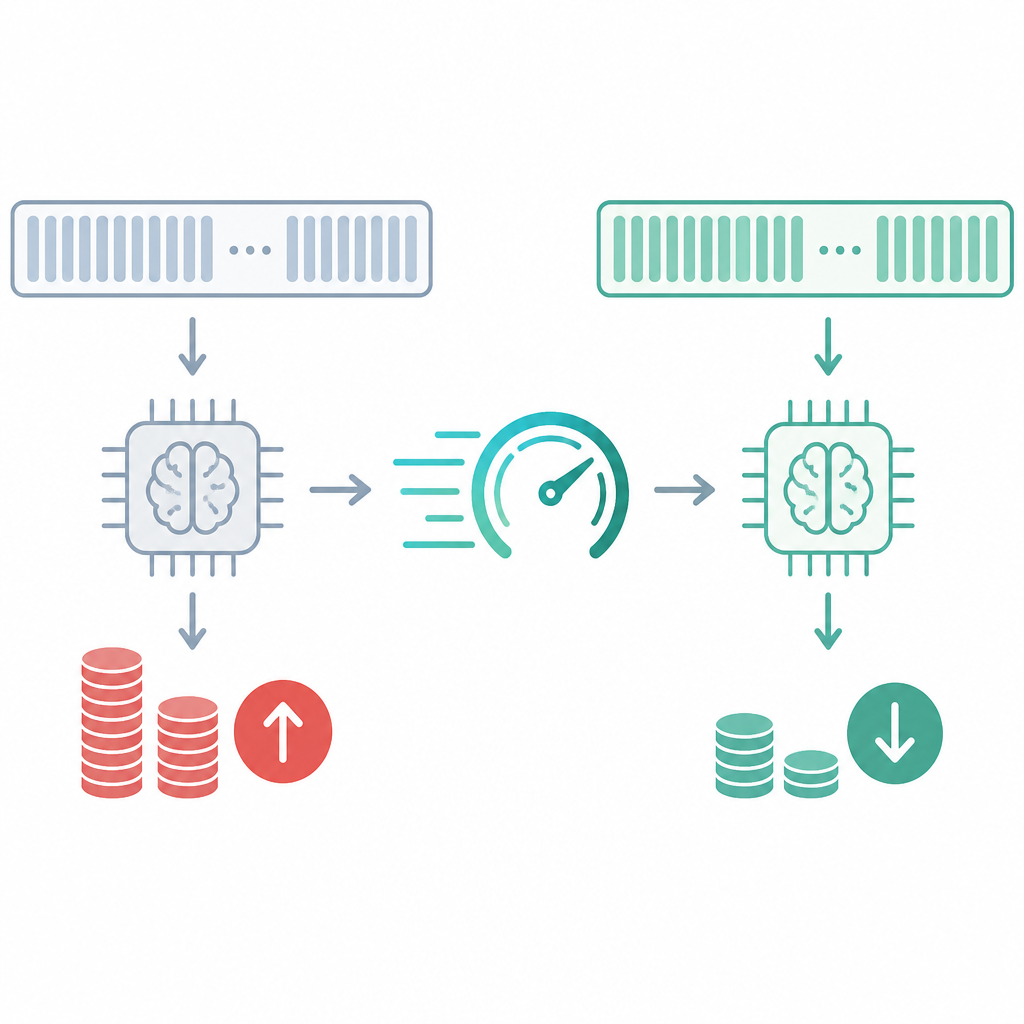
For teams running private deployments, this also changes hardware planning. Multi-GPU setups may no longer be required for every long-context workload, and some 2M-token use cases could move from cloud-only infrastructure to high-end workstations. That opens the door to cheaper document analysis, more concurrent batch jobs, and local setups with better privacy.
- Lower GPU memory pressure for serving
- More concurrent requests per machine
- Better fit for on-prem and edge deployments
4. The quality trade-off is real
Any quantization method can reduce accuracy, so the key question is how much quality TurboQuant gives up for the memory savings. The article says the rotation step helps preserve the parts of the signal that matter most for attention, and Google’s ICLR 2026 results reportedly keep perplexity and downstream task performance within acceptable bounds for most use cases.
That said, “acceptable” depends on the task. High-stakes reasoning or precision-sensitive workflows may still show degradation. For retrieval, summarization, and many coding tasks, the impact may be small enough that the infrastructure gains outweigh it. The safest move is still to benchmark on your own workload before production use.
Benchmark before rollout if your workload depends on exact reasoning or low-error outputs.5. Production may arrive through the ecosystem first
TurboQuant is research-stage, and the usual path from Google Research to production APIs can take 6 to 18 months. But open publication means inference stacks such as vLLM, TensorRT-LLM, and Ollama could adopt the method before major hosted APIs do.
That matters for teams who manage their own serving stack. If community implementations land early, you may get the memory savings in open-source tooling first, then later in products like Gemini. In practice, that could make long-context pricing fall sooner for self-hosted systems than for managed API users.
- Research to production can take 6-18 months
- Open-source inference frameworks may move faster
- API pricing could shift if serving costs drop
How to decide
If you run long-context systems today, the biggest takeaway is simple: stop assuming million-token contexts will stay economically painful. TurboQuant suggests the memory wall is getting lower, and that should influence how you design retrieval, truncation, and evaluation now.
If you build RAG or document-heavy apps, plan for larger context windows and less aggressive chunking. If you operate inference infrastructure, watch for quantization methods that cut memory without breaking quality. If you are just tracking the market, TurboQuant is a sign that long-context AI is moving from expensive novelty to routine capability.
// Related Articles
- [IND]
Immich Docker Compose setup that avoids common errors
- [IND]
Millions Raised for Zhipu-style Social World Model
- [IND]
Anthropic’s Book Scanning Strategy Could Set a Pattern
- [IND]
Huang’s open-letter playbook for open-weight AI
- [IND]
32 firms back open-weight AI in DC letter
- [IND]
Huang usa il suo primo post su X per difendere l’IA aperta