Which LoRA? Multilingual tuning says simpler wins
Massey University finds basic LoRA matches newer variants in multilingual instruction tuning.

Basic LoRA matches newer variants in multilingual instruction tuning.
- Research org: Massey University
- Core data: 0.26% trainable parameters
- Breakthrough: Compares LoRA, DoRA, VeRA, AdaLoRA, and PiSSA under multilingual instruction tuning
This paper is useful because it cuts through a common assumption in PEFT work: that a newer LoRA variant is automatically the better choice. The authors test that idea in multilingual instruction tuning, where models have to balance cross-lingual transfer and knowledge retention at the same time.
For engineers, that matters because adapter choice affects training complexity, parameter budget, and how much experimentation you need before shipping a multilingual fine-tune. The headline here is not that LoRA variants are useless; it is that, in this setting, architectural novelty did not deliver the clear gains you might expect.
What problem the paper is trying to fix
Get the latest AI news in your inbox
Weekly picks of model releases, tools, and deep dives — no spam, unsubscribe anytime.
No spam. Unsubscribe at any time.
Low-Rank Adaptation, or LoRA, is popular because it fine-tunes large language models by training only a small number of parameters while freezing the base model. That makes it attractive for teams that need to adapt models without paying the cost of full fine-tuning.

But LoRA has also spawned a long list of variants, including DoRA, VeRA, AdaLoRA, and PiSSA. The paper asks a practical question: when you are doing multilingual instruction tuning, do any of these variants actually outperform plain LoRA in a meaningful way?
The authors frame this around a real tension in multilingual tuning. You want the model to transfer knowledge across languages, but you also do not want it to forget what it already knows. That balance is especially important in low-resource languages, where training data is limited and every design choice matters.
How the method works in plain English
The study compares basic LoRA with four variants: DoRA, VeRA, AdaLoRA, and PiSSA. The paper includes a short explanation of each method. DoRA splits pretrained weights into magnitude and direction and fine-tunes both. VeRA uses frozen random matrices shared across layers plus trainable scaling vectors. AdaLoRA reallocates parameter budget based on importance. PiSSA uses singular value decomposition and trains the principal components.
Rather than testing these ideas in isolation, the authors plug them into multilingual instruction tuning. They mix English data with target-language data and evaluate performance in both languages. The target languages are Urdu, Swahili, Hindi, Bengali, and Telugu.
They also test different target-language ratios during training: 0%, 1%, 10%, and 50%. That lets them see how much multilingual exposure helps and whether any adapter method is better at taking advantage of it.
There is one more detail that matters for fair comparison. After hyperparameter tuning, the authors also run a controlled setup with rank fixed to 8 and adapters applied to all linear layers of the transformer. DoRA needed a different best setting during tuning, so they create a DoRA* version to match the others more closely in parameter budget.
What the paper actually shows
The main result is straightforward: the more complex LoRA variants do not show a significant advantage over basic LoRA for multilingual instruction tuning. In other words, the extra architectural machinery does not reliably buy you better cross-lingual transfer or better knowledge retention here.
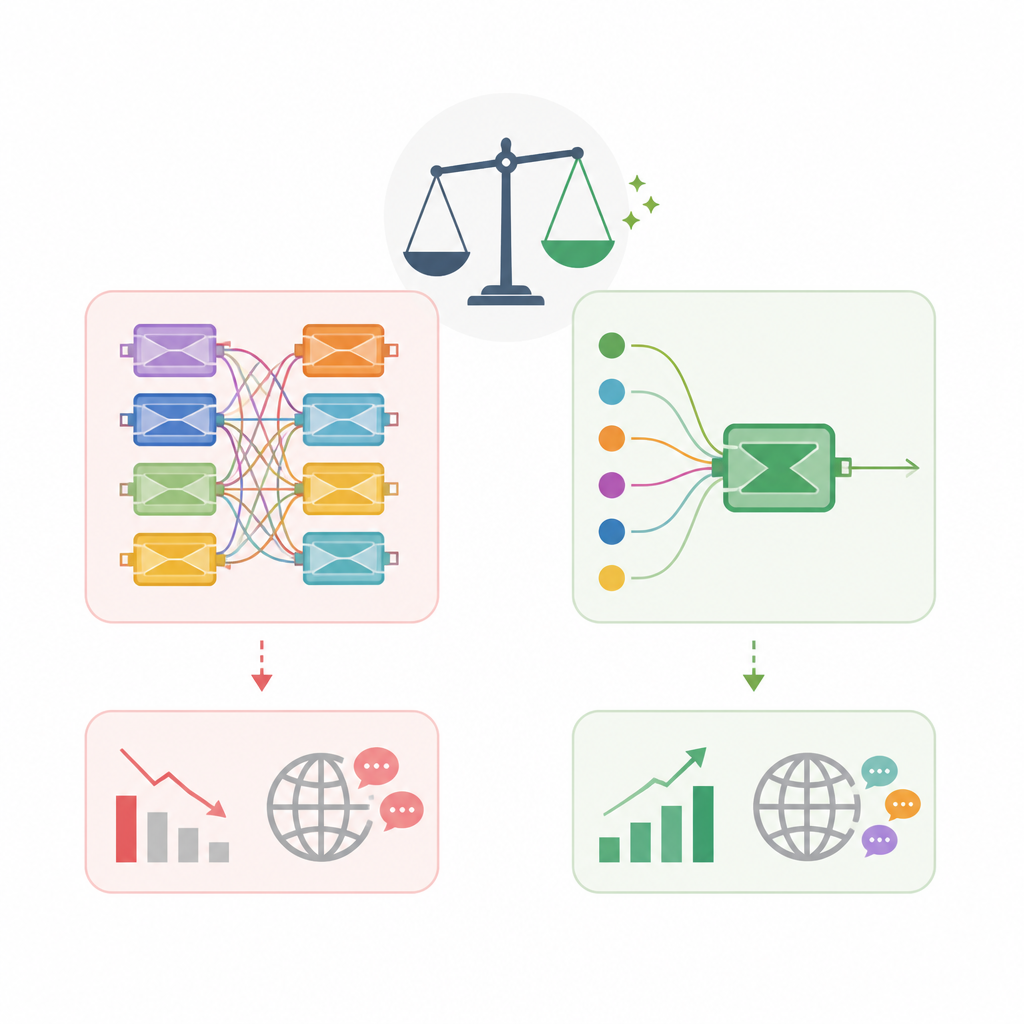
The paper also reports that multilingual instruction tuning itself is beneficial, and that even small amounts of target-language data can help cross-lingual transfer. But that is not the same as saying a fancier adapter is necessary to get those gains.
One concrete number worth noting is the parameter budget. In the controlled comparison, the common setup uses about 0.26% trainable parameters, while DoRA’s tuned setup reaches 0.36%. VeRA is listed with a much smaller budget in the table, but the paper notes that a fair higher-rank comparison was infeasible under the available hardware constraints.
The results table shows that performance differences across LoRA methods are often small and inconsistent across languages and data ratios. In several cases, the baseline LoRA is competitive with or close to the variants. The paper does not present a single benchmark headline like “X points better overall”; instead, it emphasizes the lack of a clear, repeatable winner.
The authors also look beyond task scores. They analyze layer-wise hidden embeddings and find that language representations remain largely similar across models fine-tuned with different LoRA techniques. That is an important clue: the variants are changing the adapter structure, but not obviously reshaping internal language representations in a way that explains better multilingual behavior.
Why the hidden-state analysis matters
This part of the paper is especially interesting for developers who care about what is happening under the hood. If two fine-tuning methods get similar results, hidden-state analysis can help explain whether they are learning in different ways or just arriving at similar internal representations.
Here, the answer seems to be the latter. The layer-wise language representation analysis suggests that the LoRA variants did not introduce noticeable language representation changes in the LLM. That supports the paper’s broader conclusion that the architectural novelty of these methods may not translate into better cross-lingual adaptation in this setting.
The authors also note a difference from LoRA-based pre-training work: for instruction tuning, they find LoRA should be applied to all layers rather than only the final layers. That is a concrete implementation takeaway for anyone building multilingual adapters.
What this means for developers
If you are choosing a PEFT method for multilingual instruction tuning, this paper argues for restraint. The default LoRA baseline may be enough, especially if your goal is a practical tradeoff between transfer and retention rather than chasing a small and uncertain gain from a more complex adapter.
That does not mean the variants are pointless. It means the burden of proof is higher than the marketing around new adapter methods sometimes suggests. If a variant adds implementation complexity, tuning overhead, or hardware constraints, you should expect a clear payoff before adopting it.
The study is also a reminder that results from English-only or other non-instruction-tuning settings may not carry over. The authors explicitly position their work as filling a gap in multilingual instruction tuning, especially for low-resource languages, where the interaction between adapter design and language transfer is less well understood.
There are limitations, though. The paper studies a selected set of LoRA variants, not every variant in the literature. It also focuses on a particular multilingual instruction-tuning setup, so the conclusion should not be read as “all LoRA variants are equally good everywhere.” The abstract and notes do not give a single universal benchmark to generalize from.
Still, the practical message is strong: if you are building multilingual fine-tuning pipelines, start with the simpler adapter, test multilingual data mixing carefully, and only reach for a more elaborate LoRA variant if it proves its value in your own workload.
Bottom line
This paper suggests that in multilingual instruction tuning, simpler can be just as good as newer. For teams shipping models, that means less time spent on adapter churn and more time spent on data quality, language coverage, and evaluation.
- Basic LoRA was competitive with DoRA, VeRA, AdaLoRA, and PiSSA in multilingual instruction tuning.
- Layer-wise embedding analysis did not show major representation changes across LoRA variants.
- For instruction tuning, the authors recommend applying LoRA across all layers, not just the final ones.
// Related Articles
- [RSCH]
Explainable RL for Air Traffic Control
- [RSCH]
Skill Self-Play lets LLMs co-evolve skills
- [RSCH]
SM4RT brings rigid motion into 4D reconstruction
- [RSCH]
Prompt engineering turns codegen into a repeatable workflow
- [RSCH]
CLEAR prompts turn AI search into usable answers
- [RSCH]
Prompt engineering in 2026: the cheat sheet