Jensen Huang’s AI warning is really about coworkers
Jensen Huang says AI won’t take your job. The bigger risk is a coworker who uses it faster, and Nvidia is betting on that.

Jensen Huang’s latest message about AI is less about robots taking jobs and more about workers being sorted by speed. In a Stanford Graduate School of Business interview, the Nvidia CEO said, “It is unlikely most people will lose a job to AI. It is most likely that most people will lose their job to somebody who uses AI.”
That line matters because it cuts through the usual hype cycle. Huang is not predicting a clean swap where software replaces whole professions overnight. He is saying the first big labor effect may be internal: the person who uses OpenAI-style tools, coding assistants, and AI agents better than you may simply outproduce you.
That is a much more uncomfortable idea for white-collar workers, and a more practical one for managers. It also fits Nvidia’s business model. If AI becomes a default layer in office work, the company selling the chips and software stack has every reason to argue adoption should spread fast.
Why Huang’s warning hits harder than the usual AI fear
Plenty of executives talk about AI in abstract terms. Huang’s version is specific, and that is why it lands. He is not saying your title disappears. He is saying your output matters more than your title, and AI changes the math on both.

The Fortune report points to a few numbers that help explain why this message is spreading so quickly. KPMG found in November that four in 10 workers fear AI could take their job. Writer reported that 29% of workers are actively sabotaging their company’s AI strategy, with about one-third of those people saying fear of AI is the reason.
That fear is not irrational. It is a response to how quickly AI is being inserted into everyday work. The technology does not need to eliminate a role to change the labor market. It only needs to let one employee do the work of two, or do the same work in half the time.
- Huang said most people will lose jobs to coworkers who use AI, not to AI directly.
- KPMG found 40% of workers worry AI could take their job.
- Writer said 29% of workers are actively undermining company AI plans.
- About one-third of those saboteurs said fear drove their behavior.
The bigger shift here is psychological. Workers are used to competing on experience, institutional knowledge, and communication skills. AI adds a new axis: how quickly you can turn a general-purpose model into useful output without getting sloppy.
What Huang said, and why Nvidia is acting like he means it
Huang has repeated this argument before. In an interview last May, he said AI could put up to 40 million people back into the workforce. In March, he described a workplace where 100 AI agents work alongside every human worker. That is not a side comment. It is a roadmap for how Nvidia sees AI being used inside companies.
He also made the case more directly in the Stanford interview with former National Security Advisor H.R. McMaster and Rep. Ro Khanna. Huang said AI changes tasks, not the purpose of a job. That distinction matters because many jobs are bundles of tasks, and AI can strip away the repetitive parts while leaving the judgment-heavy parts behind.
“It is unlikely most people will lose a job to AI. It is most likely that most people will lose their job to somebody who uses AI.” — Jensen Huang, Nvidia CEO
Nvidia is backing up the rhetoric with hiring strategy. At GTC in March, Huang said the company is offering engineers AI tokens worth nearly half their salary. In plain English, that means the company is willing to pay a lot to make sure talent can spend heavily on AI compute and experimentation.
That is a telling move. If Nvidia thought AI was a distant office perk, it would not be paying in the currency of model usage. It is treating AI fluency like a core job skill, and the compensation package reflects that belief.
- May 2025: Huang said AI could bring up to 40 million people back into the workforce.
- March 2026: Huang described 100 AI agents working with each human worker.
- GTC 2026: Nvidia said engineers may get AI tokens worth nearly half their salary.
- Huang said the company wants expert AI users in marketing, finance, engineering, and software.
That last point matters because it broadens the story beyond coding. When a chip company says it wants AI-native people in finance and marketing too, it is signaling that the next productivity fight is company-wide, not confined to software teams.
The data shows a split between adopters and holdouts
The labor market is already rewarding people who adopt AI early. According to the Writer report cited by Fortune, workers using AI are three times as likely to have gotten a promotion and pay raise last year compared with workers who resisted adoption. That is a huge gap, and it suggests AI literacy is turning into a career multiplier.
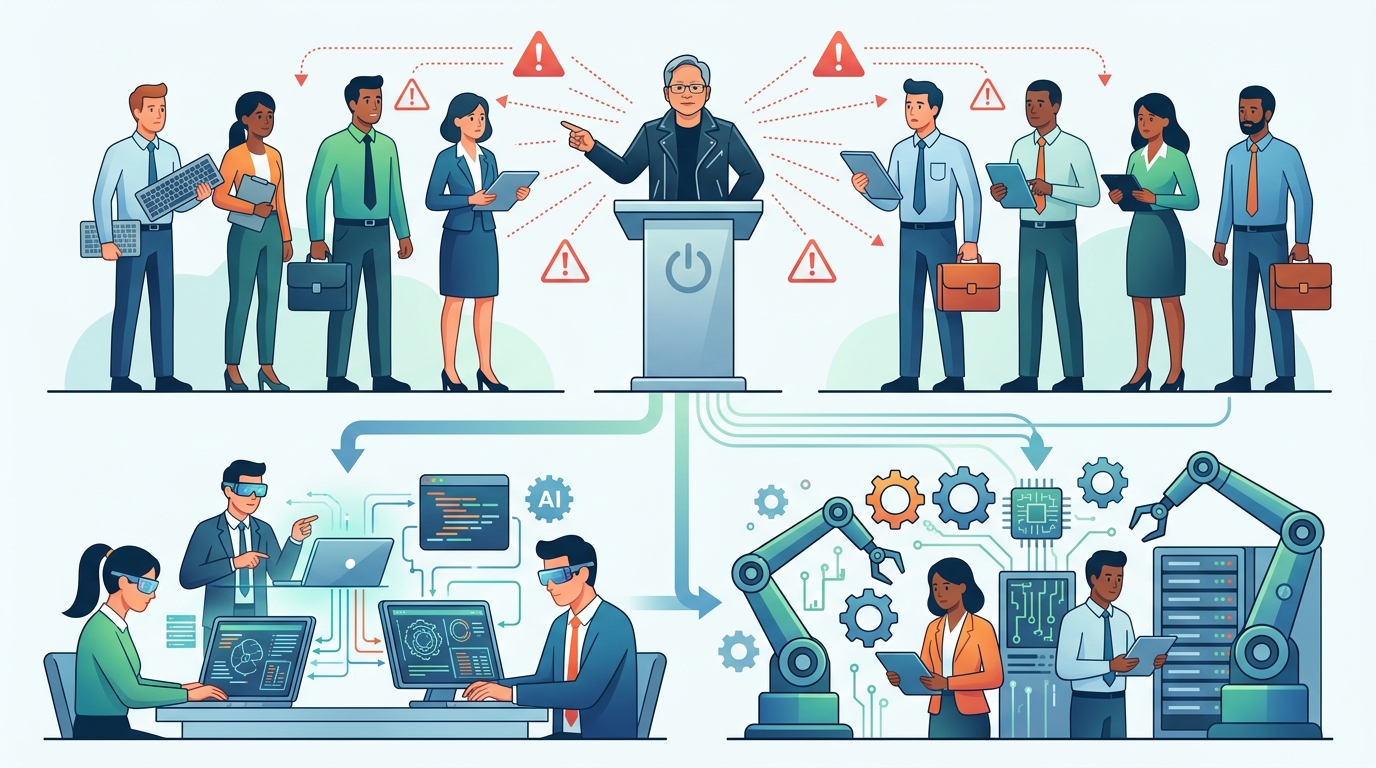
Executives are noticing. The same report says 60% of executives are considering cutting employees who refuse to adopt AI. That does not mean they will all do it, but it does show where management pressure is headed. If one team member can produce more with the same tools, the person ignoring those tools becomes harder to justify.
There is also a more technical reason this matters now. An Anthropic study argued that AI can already theoretically perform the majority of tasks tied to white-collar work in law, business, engineering, and management. That does not mean those jobs vanish tomorrow. It does mean a large chunk of office labor is now exposed to automation at the task level.
- Workers using AI were three times as likely to get a promotion and raise, per Writer.
- 60% of executives said they may cut employees who refuse AI adoption.
- Anthropic said AI can theoretically perform most tasks in several white-collar fields.
- Huang says jobs are bundles of tasks, and AI can change the bundle without erasing the role.
That is the real tension in this story. The people most likely to be punished first are not the ones whose jobs disappear. They are the ones who keep doing the same job the old way while a coworker gets faster, cheaper, and more persuasive with AI-generated output.
What workers should take from this now
If Huang is right, the practical response is not panic. It is skill acquisition, and it should be specific. Learn how to use AI for drafting, analysis, coding, research, and presentation prep. More important, learn how to verify the output, because speed without judgment just creates faster mistakes.
For companies, the takeaway is even sharper. AI training cannot be a vague policy memo or a single lunch-and-learn. If executives want adoption, they need to show employees where AI saves time, where it improves quality, and where human review still matters. Otherwise the organization gets the worst of both worlds: fear from workers and half-baked experimentation from management.
The next 12 to 18 months will probably tell us whether Huang’s view becomes the norm in office work. My bet: companies will stop asking whether employees use AI and start asking how much output changed because of it. When that happens, the coworker who learned the tools first will matter more than the person who ignored them.
For developers, analysts, and anyone in knowledge work, the question is simple: what part of your job can you make 2x faster this quarter, and what proof will you show your manager when you do it?
Related Articles

Why Jensen Huang Is Wrong About AGI Being Achieved
Apr 25

Why Jensen Huang Is Wrong About AGI
Apr 25

Why GPT Image 2 Matters More Than Another AI Image Launch
Apr 24
Anthropic and Amazon lock in 5GW for Claude
Apr 24
Why enterprises should stop treating Codex like a pilot project
Apr 24

Why the Mythos rollout is a mistake
Apr 24