7 open-source AI projects developers need in 2026
Seven open-source AI projects are replacing paid APIs, from local inference to browser agents, and they’re already pulling huge GitHub numbers.

Seven open-source AI projects are replacing paid APIs for local inference, chat, agents, and coding.
Open-source AI tooling is moving from hobbyist territory into production stacks, and the numbers are hard to ignore. In June 2026, seven projects alone had pulled in more than 650,000 GitHub stars, with Ollama leading local inference, Open WebUI taking over chat interfaces, and Browser Use making browsers usable for agents.
That matters because startups are under pressure to cut API spend, keep sensitive data in-house, and ship AI features without waiting on a closed platform’s roadmap. The seven projects in this piece cover the whole stack: model runtime, serving, fine-tuning, orchestration, browser automation, and developer assistance.
| Project | GitHub stars | Main job | Typical replacement |
|---|---|---|---|
| Ollama | 174,000+ | Local LLM inference and cloud hosting | OpenAI API, Together AI |
| Open WebUI | 142,000+ | Self-hosted chat UI | ChatGPT Team, Poe |
| Browser Use | ~99,500 | Browser automation for agents | Selenium, Playwright glue code |
| vLLM | 83,300+ | High-throughput model serving | NVIDIA Triton, TGI |
| Unsloth | 66,800+ | Fast fine-tuning on consumer GPUs | Hugging Face Trainer, Axolotl |
| CrewAI | 53,900+ | Multi-agent orchestration | AutoGen, raw LangChain agents |
| Continue | 34,100+ | Open coding assistant | GitHub Copilot, Cursor |
Ollama changed local inference from a side project into a default
Get the latest AI news in your inbox
Weekly picks of model releases, tools, and deep dives — no spam, unsubscribe anytime.
No spam. Unsubscribe at any time.
Ollama has 174,000+ GitHub stars and 16,700 forks, which is a giant signal that developers want local model runs to feel ordinary. It lets you pull models and run them on macOS, Linux, or Windows without wrestling with dependency chains.
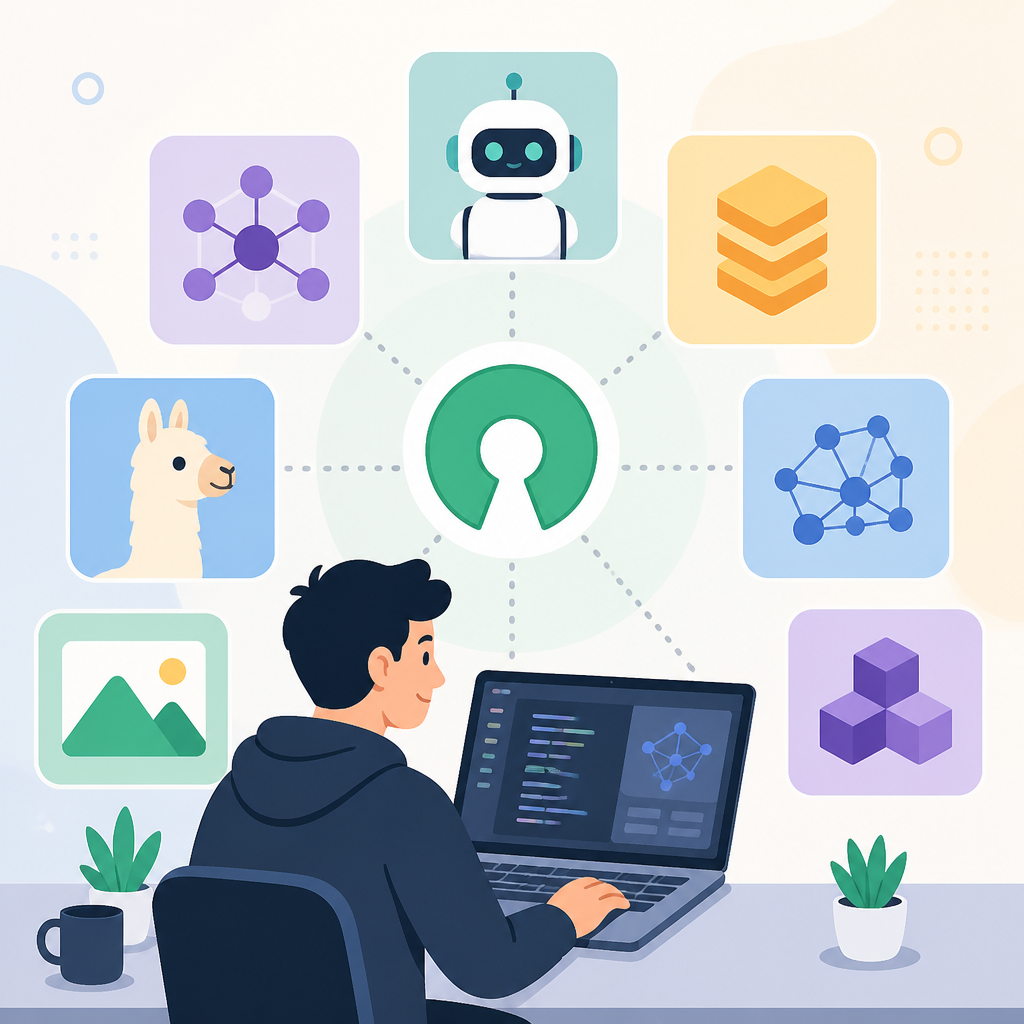
The interesting twist in 2026 is that Ollama is no longer just a local tool. It now has cloud tiers too, with Pro at $20 per month and Max at $100 per month, so teams can prototype on a laptop and move the same workflow to hosted infrastructure when they need more scale.
That split is smart product design. Local inference gives you privacy, offline access, and cost control. Cloud hosting gives you predictable deployment when a team outgrows a single machine.
- Local mode works offline for sensitive tasks.
- Cloud regions include the US, Europe, and Singapore.
- The model catalog includes Kimi-K2.6, DeepSeek, Qwen, Gemma, and open-weights GPT-OSS.
For developers, the main point is simple: Ollama removes friction. If your team is still treating local LLM work like a science project, this is the tool that makes it feel like a normal part of the stack.
Open WebUI gives teams a private ChatGPT-style front end
Open WebUI has 142,000+ GitHub stars and 20,400 forks, which puts it in rare company for an interface project. It connects to Ollama, OpenAI-compatible APIs, and other backends, then wraps them in a chat experience people already understand.
Its real value is the feature set: retrieval-augmented generation pipelines, function calling, image generation, multi-user authentication, and voice input. That is the sort of package many teams pay for through enterprise chat plans, except here the software is free and the infrastructure is yours.
“Open WebUI is the single best way to give a non-technical team access to local or self-hosted AI.” — Kunal Ganglani
That quote matches the practical reality. If you are setting this up for a group, the difference between a toy and a useful internal tool is usually authentication, history, and admin controls. Open WebUI has those out of the box.
For teams already running local models, setup can be as simple as a Docker command. For shared deployments, you will want proper hosting and storage, but the software itself removes a lot of the usual glue work.
- Supports multi-user access and per-user chat history.
- Can connect to internal docs through RAG without sending data to external APIs.
- Shows usage analytics inside the admin panel.
Browser Use is the agent tool people underestimated
Browser Use climbed to about 99,500 GitHub stars in under 18 months, which is a very fast rise for infrastructure software. It makes websites accessible to AI agents so they can click buttons, fill forms, extract data, and complete multi-step tasks.
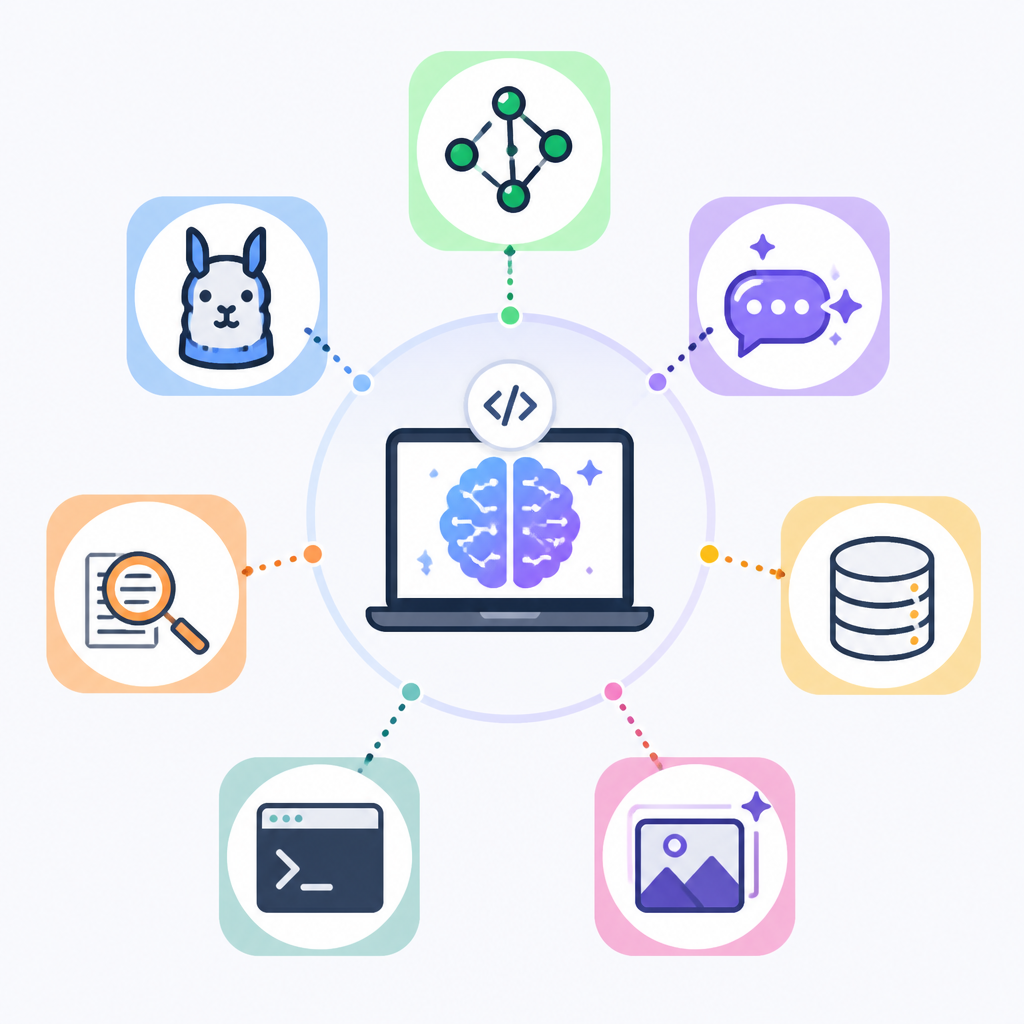
The pitch is deceptively simple: instead of writing brittle selectors for every site, you describe the goal and let the agent work through the page. That matters because a huge amount of business software still lives behind web UIs, not APIs.
I think this project is one of the most important on this list because it connects AI to the real world of internal dashboards, CRMs, and admin tools. Those systems are where a lot of automation work actually happens.
- Useful for report extraction from dashboards.
- Works well on structured pages.
- Still struggles at times with heavy JavaScript SPAs.
It is not the right choice for high-stakes financial workflows yet, but for internal automation and data collection it is already saving teams real time. That alone makes it worth watching closely.
vLLM and Unsloth attack the two biggest cost centers
vLLM and Unsloth solve different problems, but they both hit the same pain point: expensive GPU time. vLLM has 83,300+ stars and 18,200 forks, while Unsloth has 66,800+ stars and 6,000 forks.
vLLM is built for serving models at scale. Its PagedAttention design manages KV cache memory more efficiently, and the practical result is higher throughput under concurrency. The article source cites a 10x to 24x throughput gain over naive Hugging Face Transformers inference, which is exactly the kind of number that gets infrastructure teams interested.
Unsloth tackles fine-tuning. It claims 2x faster training and up to 80% less VRAM than standard Hugging Face training, which means more developers can fine-tune on consumer hardware instead of renting bigger GPUs.
- vLLM is the better fit for production serving.
- Unsloth is the better fit for local fine-tuning.
- Both reduce the need to pay per token or overbuy hardware.
On a practical level, the two tools map to different stages of the same pipeline. Use Unsloth to adapt a model to your data, then use vLLM to serve it efficiently once it is ready.
CrewAI and Continue fill the last gaps in the stack
CrewAI and Continue cover the orchestration and coding layers. CrewAI has 53,900+ stars and 7,500 forks, and it is aimed at multi-agent workflows without forcing you to build every control loop by hand.
Continue has 34,100+ stars and is the open-source coding assistant most developers can actually drop into a real editor workflow. It competes with GitHub Copilot and Cursor, but keeps the stack open and model-agnostic.
That matters for teams that care about code privacy or want to choose their own backends. Instead of sending everything into a closed product, they can keep more control over where prompts and code go.
- CrewAI is useful when a task needs multiple specialized agents.
- Continue fits engineers who want AI help inside the editor.
- Both reduce dependence on closed workflow products.
The larger pattern here is easy to miss if you only look at star counts. These projects are not isolated toys. Together they form a complete path from model access to serving, tuning, agent workflows, and developer productivity.
The real comparison is control, cost, and operational maturity
The source article argues that Ollama plus Open WebUI can replace ChatGPT Team for most teams, and that feels directionally right. You lose the convenience of a fully managed product and the quality edge of top closed models, but you gain privacy, cost control, and the freedom to run open-weights models.
The same logic applies across the rest of the stack. vLLM can replace paid inference APIs when you have the infrastructure, Unsloth can replace expensive fine-tuning runs, CrewAI can replace custom agent plumbing, and Continue can replace some of the code-assistant spend.
Here is the part that matters for 2026 planning: the gap between open and closed models has narrowed enough that the decision is often operational, not technical. If your team can run GPUs, manage deployments, and own the data path, open-source AI is no longer the backup option.
By December 2026, I would expect more startups to ship their first AI features on open stacks like these, then keep the closed APIs only for edge cases where model quality still justifies the bill. The question for most teams is no longer whether open-source AI is good enough. It is whether they are ready to run it well.
// Related Articles
- [TOOLS]
Pixel 11 launch highlights and new Gemini features
- [TOOLS]
AWS Continuum turns AI coding into safer fixes
- [TOOLS]
Open-Generative-AI turns GitHub into a studio
- [TOOLS]
Why benchmark scores don’t predict your bill
- [TOOLS]
MCP Servers for Developers: 8 workflow gains in 2026
- [TOOLS]
Doubao turns a game prompt into a mini arcade