Sightengine is the right choice for visual moderation, not general tr…
Sightengine is a strong pick for image and video moderation, but not a full trust-and-safety stack.

Sightengine is a strong pick for image and video moderation, but not a full trust-and-safety stack.
Sightengine should be bought for one job: fast, developer-friendly moderation of visual content at scale.
Its own positioning makes the case. The product centers on image and video moderation APIs, with detection for nudity, violence, weapons, offensive symbols, brand safety, and AI-generated images. That is a focused, operationally useful bundle for teams that need to screen uploads before they go live, not a sprawling platform that tries to solve every moderation problem at once.
Specialization beats breadth when the risk is visual content
Get the latest AI news in your inbox
Weekly picks of model releases, tools, and deep dives — no spam, unsubscribe anytime.
No spam. Unsubscribe at any time.
Most moderation failures happen because teams buy a broad platform and still need to stitch together the parts that matter. Sightengine avoids that trap by concentrating on visual policy enforcement. If your product lives or dies on user-uploaded photos and clips, a tool that is built around those inputs gives you a cleaner implementation path and fewer moving parts.

The use cases listed for the product are telling: social media, e-commerce, dating apps, and cloud storage. Those are all places where image review has to happen quickly, before a feed, catalog, or inbox becomes a liability. In those environments, a specialized API is not a nice-to-have. It is the shortest route from upload to decision.
Real-time moderation is the feature that matters most
Moderation is only valuable when it happens before exposure. Sightengine emphasizes real-time processing, which matters more than a long feature checklist because delay turns policy into cleanup. A platform that flags harmful content after publication has already lost the most important battle.
Its developer-first API model also matters. The listing highlights easy integration, web API support, email and dedicated enterprise support, and a free tier. That combination lowers adoption friction for small teams while still giving larger teams a path to scale. For engineering leaders, that is the difference between a pilot that ships and a compliance initiative that stalls in procurement.
AI-generated image detection is now a baseline requirement
The moderation problem has changed. Teams are no longer only screening for explicit or violent content; they also need to know whether an image is synthetic, manipulated, or policy-evading. Sightengine includes AI-generated image detection, which puts it ahead of tools that still treat moderation as a static classification problem.
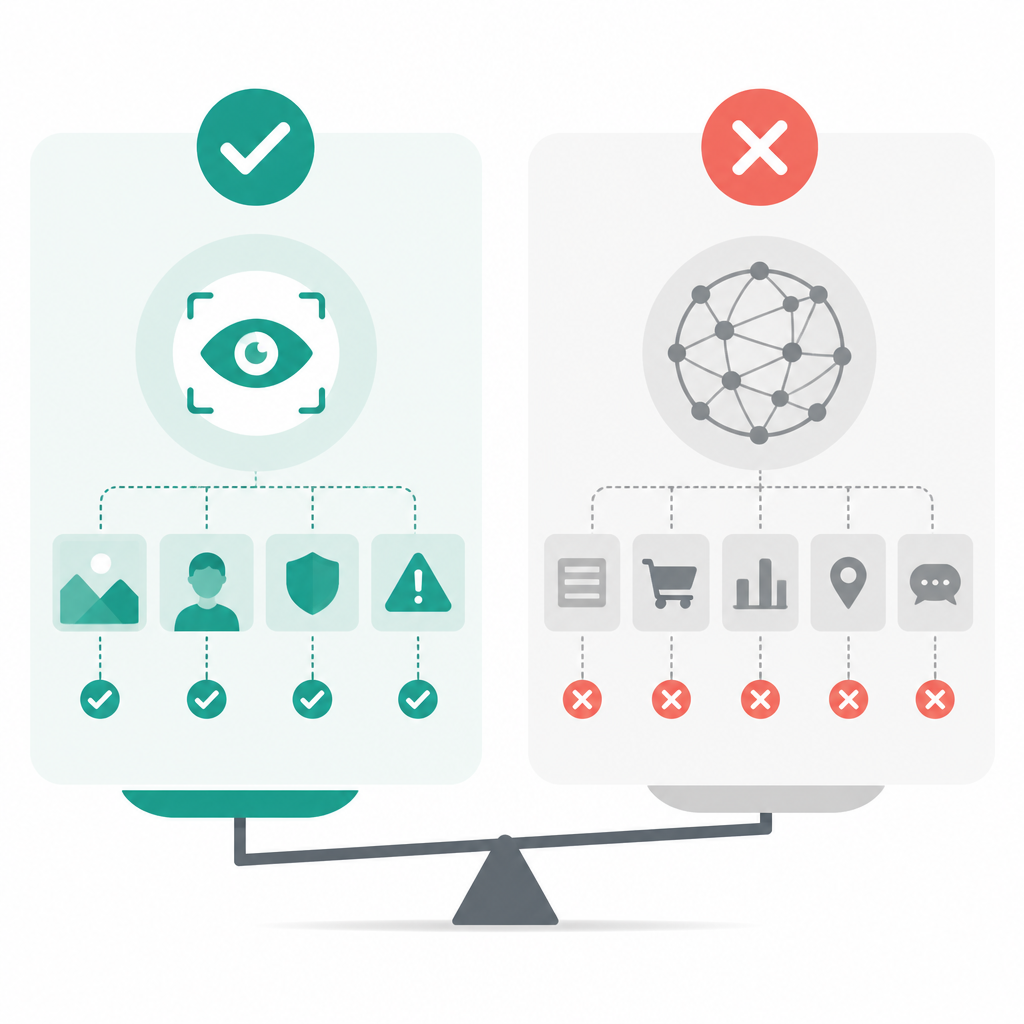
That matters because synthetic media can undermine marketplace trust, brand safety, and user safety at the same time. A dating app needs to stop fake profile photos. An e-commerce site needs to block misleading listings. A community platform needs to detect generated abuse at upload time. Sightengine’s feature set tracks that reality better than a generic AI platform trying to do everything.
The counter-argument
The strongest case against Sightengine is that moderation is rarely just visual. Many products need text, audio, identity, and behavioral signals too. A general-purpose trust and safety vendor can unify those layers, reduce vendor count, and give policy teams one place to manage enforcement.
There is also a strategic argument for hybrid systems. Some companies want human review, appeals workflows, and custom policy tuning baked into the same stack. In that world, a specialized visual API can look incomplete, especially if the business is dealing with harassment, grooming, fraud, or other harms that do not live inside pixels alone.
That critique is valid, but it does not beat Sightengine’s core value proposition. The product is not pretending to be a full trust-and-safety suite. It is a visual moderation engine, and on that narrower job it is easier to integrate, easier to reason about, and more likely to deliver fast enforcement. If a team needs text or audio moderation, the answer is not to force Sightengine into a role it does not claim. The answer is to pair it with the right complementary tools.
What to do with this
If you are an engineer or PM, use Sightengine when your highest-risk surface is user-uploaded images or video and you need an API you can ship quickly. Start with a narrow policy, instrument false positives and false negatives, and measure moderation latency as a product metric. If your roadmap includes text, voice, or appeals, plan a broader stack around it instead of expecting one vendor to cover all harms.
// Related Articles
- [TOOLS]
Use Consensus AI for faster literature scouting
- [TOOLS]
15 Perplexity prompts for better research decisions
- [TOOLS]
Mistral AI Models 2026 for Builders
- [TOOLS]
RustRover 2026.2 turns Rust setup into one file
- [TOOLS]
Geekbench 7 setup for realistic CPU and GPU tests
- [TOOLS]
Spark 4.2 turns AI search into SQL