Anthropic’s Manhattan expansion proves New York is the AI city that m…
Anthropic’s New York expansion shows the AI talent and office war is being won in Manhattan.

1,000 New York workers and a 16-story lease show Anthropic is betting on Manhattan.
Anthropic’s decision to lease a 16-story building in Lower Manhattan and double its New York workforce to 1,000 is not a vanity move. It is a clear signal that the center of gravity for serious AI work is still tied to dense talent markets, client access, and the kind of city infrastructure that makes rapid hiring possible.
New York is where AI firms go to recruit at scale
Get the latest AI news in your inbox
Weekly picks of model releases, tools, and deep dives — no spam, unsubscribe anytime.
No spam. Unsubscribe at any time.
The fastest way to understand this move is to look at the labor market. Anthropic is not expanding in New York because office space is cheap; it is expanding because the city gives it access to a deep pool of engineers, product people, researchers, and operators who can be hired faster than in thinner markets.

That matters because AI companies are no longer tiny research labs. They are building full-stack businesses with sales, policy, security, and customer success teams. A 1,000-person New York headcount says Anthropic wants a broad commercial footprint, and Manhattan remains one of the few places where that mix of talent is available in one metro area.
Office space still signals ambition in the AI era
A 16-story lease is more than a real-estate detail. It is a commitment to permanence, and in an industry that still loves to talk in abstractions, permanence is a strategic choice. Companies do not lock themselves into major buildings unless they expect the organization to keep growing and the city to matter for years, not quarters.
There is also a reputational effect. When an AI company occupies a visible office tower, it tells candidates, customers, and investors that the company is not just a remote-first software shop with a chatbot. It is building an institution. In New York, that kind of physical presence still carries weight, especially for firms trying to recruit from finance, media, and enterprise software.
Manhattan gives AI companies proximity to power
AI companies selling into large enterprises need more than code. They need access to legal teams, procurement departments, regulators, and executives who buy software at scale. New York concentrates those decision-makers better than almost any other U.S. city, and that makes Manhattan a practical base for a company like Anthropic.
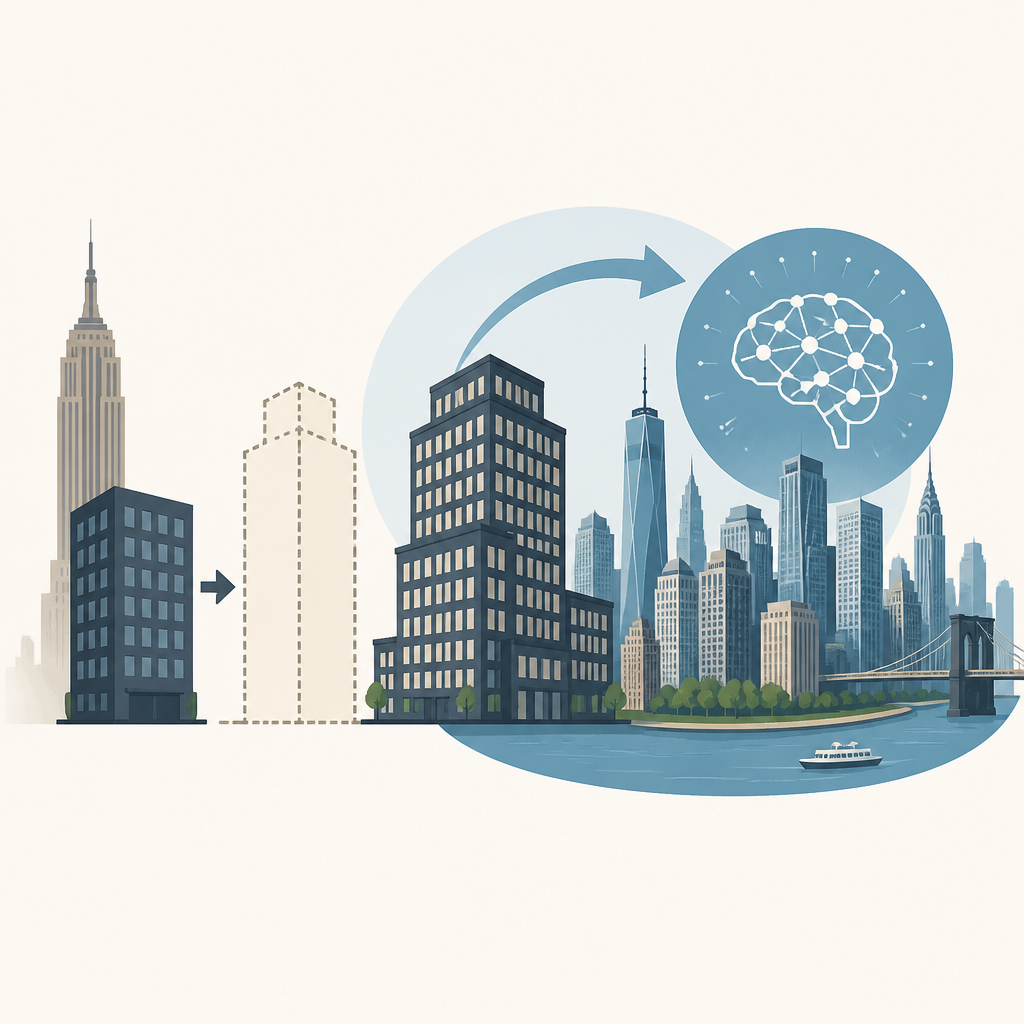
The same is true for policy and media. AI firms are under constant scrutiny over safety, competition, and labor impact, and New York is where much of that conversation gets shaped. Being in the room matters. A company that wants to influence the market and the debate benefits from sitting close to the institutions that frame both.
The counter-argument
The strongest objection is simple: AI work is increasingly distributed, and expensive urban offices are a relic. Remote hiring lets companies recruit nationally, reduce overhead, and avoid tying growth to a single city’s cost structure. From that view, a Manhattan lease looks like old-economy signaling dressed up as strategy.
That critique has real force. Many of the best AI tools are built by teams spread across time zones, and some companies will grow faster by staying lean and remote. Not every firm needs a tower in Lower Manhattan, and not every role benefits from being in the same building.
But Anthropic’s move still makes sense because scale changes the math. Once a company needs hundreds of employees across technical and business functions, coordination costs rise, culture gets harder to maintain, and hiring speed becomes a competitive advantage. A major New York hub is not nostalgia; it is an operating system for a company that wants to grow without fragmenting.
What to do with this
If you are an engineer, PM, or founder, read this as a reminder that location still shapes leverage. For builders, the lesson is not to copy Anthropic’s lease, but to choose the market that gives you the best access to the people, partners, and customers your next stage of growth requires. In AI, the best teams are not just writing models. They are choosing where the business can compound fastest.
// Related Articles
- [IND]
HP’s OpenAI Deal Meets a Cheap Stock Debate
- [IND]
Booz Allen and OpenAI push frontier AI into defense
- [IND]
Docker made containers the default, and that was a mistake
- [IND]
Anthropic’s Claude Skills define the new agent toolkit
- [IND]
Claude Fable 5 Should Be Judged by Safety, Not Hype
- [IND]
Trump lifting GPT-5.6 limits is a bad way to govern frontier AI