Cloudflare One partner program speeds AI security rollout
Cloudflare’s new partner program turns Cloudflare One into a faster path for secure AI deployment.

Cloudflare’s partner program turns Cloudflare One into a faster path for secure AI deployment.
I’ve been watching Cloudflare try to sell more than just fast DNS and DDoS protection for a while now, and honestly, the old motion always felt a little too indirect. The product was solid. The network was everywhere. But when I talked to teams about rolling out secure access or zero trust, the sales motion still had that familiar “figure it out with a few specialists and a lot of patience” smell. That works when a company is already deep in Cloudflare’s world. It’s clunky when you’re trying to move quickly on AI security and you need partners who can actually implement the thing, not just nod at the slide deck.
That’s why the new partner push caught my eye. Cloudflare announced the Cloudflare One Design Partner Designation on June 17, and the whole point is to make secure AI adoption easier through a tighter partner motion. This isn’t a press-release fluff move. It’s Cloudflare admitting that enterprise security adoption is still a services problem as much as a software problem.
Cloudflare is selling implementation, not just software
Get the latest AI news in your inbox
Weekly picks of model releases, tools, and deep dives — no spam, unsubscribe anytime.
No spam. Unsubscribe at any time.
“On June 17, Cloudflare, Inc. announced the launch of its Cloudflare One Design Partner Designation, a new high-priority partner program focused on the Cloudflare One security platform.”
What this actually means is Cloudflare is trying to reduce the gap between product availability and product adoption. The platform already exists. The issue is getting customers to deploy it in a way that actually changes behavior across the company.

I’ve seen this pattern over and over. A security team likes the platform, but the rollout stalls because identity, access policy, app routing, and user education all have to line up. That’s exactly where partners matter. If a vendor expects buyers to assemble the whole thing alone, adoption slows down and the product gets blamed for being “complex,” when the real problem is the implementation path.
Cloudflare’s move is basically a shortcut around that friction. Instead of hoping every customer has a mature internal team, it is giving selected partners a more formal role in getting Cloudflare One into production.
How to apply it if you’re building or buying in this space: stop thinking of partner programs as channel wallpaper. The good ones are deployment accelerators. If your product needs architecture decisions, policy design, or migration help, your partner motion is part of the product.
The real target is AI security adoption, not generic channel growth
The article keeps circling back to AI security, and that matters. Cloudflare isn’t just expanding reseller coverage for the sake of more logos. It’s trying to make secure AI deployment feel less risky for enterprise buyers.
That distinction is important because “AI adoption” is already messy. Teams want copilots, internal chat tools, data access controls, and model routing. Security teams want guardrails. Legal wants auditability. IT wants fewer tickets. A platform like Cloudflare One can sit in the middle of all that, but only if somebody helps stitch the pieces together.
Cloudflare’s partner list in the announcement included Arctiq, Consortium, CMT, Presidio, and The Missing Link. I’m not going to pretend those names are random decoration. These are firms that already live in enterprise implementation work, which is exactly what Cloudflare needs if it wants to be part of AI rollout conversations instead of just perimeter-security conversations.
- Arctiq: enterprise infrastructure and security services work
- Presidio: broad IT modernization and managed services reach
- The Missing Link: security and infrastructure delivery in APAC
What this actually means is Cloudflare is trying to borrow trust from partners who already have the customer relationship. That’s a lot easier than asking every security buyer to discover Cloudflare One on their own and then figure out how to operationalize it.
I’ve run into this exact problem in security rollouts: the product team thinks the buyer is evaluating software, but the buyer is actually evaluating risk. Partners help answer the risk question faster because they translate the platform into a deployment plan.
How to apply it: if you’re a vendor, identify the part of your product that scares buyers most. If it’s configuration, migration, compliance, or policy design, build your partner program around that fear. Don’t just hand out badges.
Cloudflare One is the center of gravity here
Cloudflare is anchoring this whole thing on Cloudflare One, which is its security platform for Zero Trust-style access and protection. That’s the right place to focus if the goal is to make AI adoption safer without turning every rollout into a custom consulting project.
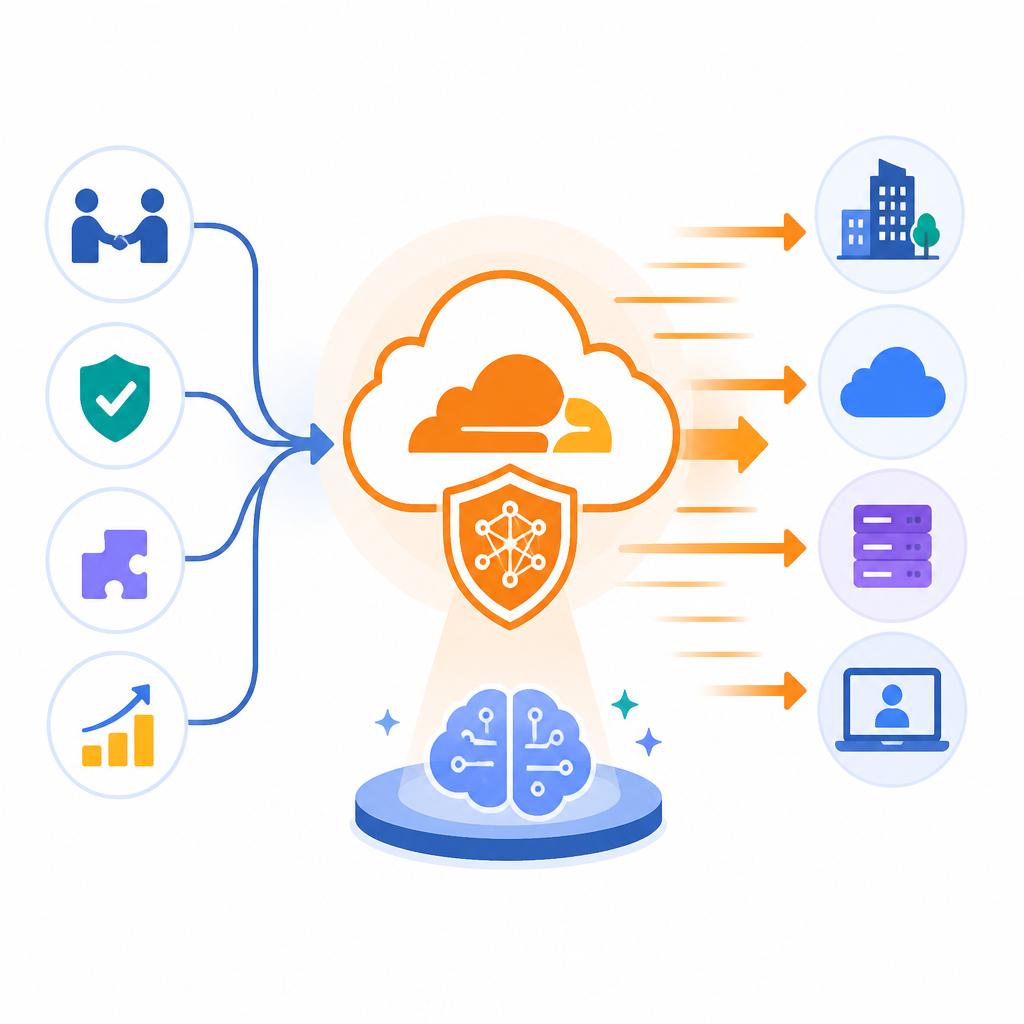
Cloudflare’s broader pitch is familiar: speed up and protect internet properties, stop malicious traffic, and provide defenses like DDoS mitigation, web application firewalls, and Zero Trust access control. You can read more about the company on the Cloudflare homepage and the Cloudflare Zero Trust product area.
What this actually means is Cloudflare wants Cloudflare One to be the control plane for modern enterprise access, including AI-related access. If employees are using AI tools, internal data sources, and third-party services, the old perimeter model is basically a joke. You need policy enforcement closer to the user and the app, and Cloudflare already has the network position to do that.
I like this part because it’s practical. They’re not inventing a new category name and hoping people clap. They’re taking a platform they already own and making it easier for partners to sell, deploy, and support it in the places where AI actually gets used.
How to apply it: if you’re a security buyer, ask your vendor where policy is enforced and who helps you operationalize it. If the answer is “our docs” and a few generic certs, you’re probably the integration team now.
Cloudflare is using partners to shorten the sales-to-value gap
There’s a boring truth in enterprise software that nobody likes to say out loud: the sale is not the hard part. Getting value is the hard part. Cloudflare’s new designation is aimed at shrinking that gap.
The announcement says the program gives a select group of global partners advanced technical expertise so they can accelerate secure AI solutions and strengthen customers’ cybersecurity infrastructure. That’s a mouthful, but the point is clear. Cloudflare wants partners who can do more than resell. It wants people who can actually carry the implementation load.
I’ve seen lots of partner programs fail because they’re really just lead-sharing dressed up with nicer branding. This looks more serious than that. A “Design Partner Designation” implies tighter involvement, deeper technical enablement, and a more curated group. That usually means Cloudflare wants consistency, not volume.
- Better technical alignment between Cloudflare and its partners
- Faster path from evaluation to deployment
- Less pressure on Cloudflare’s direct sales team to explain every architectural detail
How to apply it: if you run partnerships, decide whether your program is about distribution or deployment. If it’s deployment, make the technical bar real. If it’s distribution, don’t pretend it’s a design partner motion.
I’m blunt about this because I’ve watched too many vendors blur the line. They end up with a partner portal full of logos and no one who can actually get a customer live. That’s how trust dies.
The analyst angle is nice, but it’s not the main story
The Yahoo item also mentions that BTIG raised its price target on Cloudflare to $269 from $243 while keeping a Buy rating. It points to management’s optimistic Investor Day 2026 outlook and a path toward the “Rule of 50” by 2027. You can look up BTIG if you want the brokerage context, but I’m not going to pretend that’s the core of the operational story here.
What matters more is that the company is pairing product expansion with a better go-to-market motion. That’s the part that can actually change adoption. Analysts can like the stock, but customers still need a way to buy and deploy the product without creating a month of internal chaos.
Cloudflare’s competitive position has always depended on two things: network reach and product breadth. This partner program adds a third: a more usable path into enterprise workflows. That matters in AI security because the buyer is usually under pressure, under-informed, and expected to move fast.
How to apply it: if you’re evaluating a vendor, ignore the stock chatter and ask whether the company is making your implementation easier. If the answer is yes, that’s a stronger signal than a price target.
What I’d watch next if I were buying Cloudflare into AI security
If I were tracking this as a practitioner instead of a headline reader, I’d watch for three things. First, whether the partner list grows in a controlled way or turns into a generic channel dump. Second, whether Cloudflare publishes concrete deployment patterns for AI use cases. Third, whether customers start talking about faster time-to-value instead of just “interesting platform.”
That last one matters a lot. Security buyers don’t buy “interesting.” They buy reduced risk, fewer tools, cleaner policy, and less pain for the teams who have to live with the rollout.
Cloudflare has the advantage of already being embedded in traffic flow and access control. The partner program is a way to turn that advantage into actual adoption. That’s the whole play here, and it’s much more grounded than the usual AI-security marketing fog.
How to apply it: when you read vendor announcements, translate the language into one question. Does this help me deploy faster? If not, it’s probably just channel theater.
The template you can copy
# Cloudflare One partner motion brief template

## Goal
Use a partner-led motion to speed secure AI adoption for enterprise customers.

## What changed
Cloudflare created a design partner designation around Cloudflare One to give selected partners deeper technical enablement and a more direct role in deployment.

## Why it matters
AI security adoption usually stalls because implementation is harder than evaluation.
Partners can reduce friction across identity, policy, access, and rollout.

## Who this is for
- Security teams rolling out Zero Trust controls
- IT teams supporting AI tool adoption
- Partners delivering enterprise security implementation
- Sales teams that need a clearer path from demo to deployment

## How to position it
- Lead with deployment outcomes, not feature lists
- Tie AI adoption to access control, policy enforcement, and traffic inspection
- Use partner services to close the gap between pilot and production

## Practical rollout checklist
- Identify the AI use case you are securing
- Map the policy points that need enforcement
- Assign a partner or internal owner for implementation
- Define success as time-to-production, not just purchase completion
- Review whether the partner can support onboarding, migration, and tuning

## Copy-ready customer message
We are using Cloudflare One with a qualified partner to reduce the time and risk involved in securing AI adoption.
The goal is to move from evaluation to production faster while keeping access, policy, and traffic controls in one operating model.

## Internal questions to ask
- Which part of the rollout is still manual?
- What security control is hardest for customers to operationalize?
- Does the partner motion shorten deployment or just widen distribution?
- Can we show a repeatable AI security use case?

## Success metrics
- Time from evaluation to production
- Number of customers deployed through partners
- Reduction in implementation support burden
- Increase in enterprise adoption of Cloudflare One
That template is my cleaned-up version of the announcement, not a quote from Cloudflare. The original source is the Yahoo Finance article at this URL, and I also referenced Cloudflare’s own site and Zero Trust page for product context. The structure and advice here are mine; the underlying announcement is Cloudflare’s.
// Related Articles
- [TOOLS]
OpenAI Live turns launches into replayable demos
- [TOOLS]
OpenClaw with Ollama turns Telegram into a bot
- [TOOLS]
Aliyun Bailian Token Plan turns credits into agents
- [TOOLS]
One API gateway turns six AI APIs into one
- [TOOLS]
OpenAI FDEs turn broken agents into shipped systems
- [TOOLS]
Anthropic’s daily brief turns news into a workflow