Code2LoRA generates repo-specific adapters
Code2LoRA turns repository context into LoRA adapters, avoiding long prompts and per-repo fine-tuning overhead.
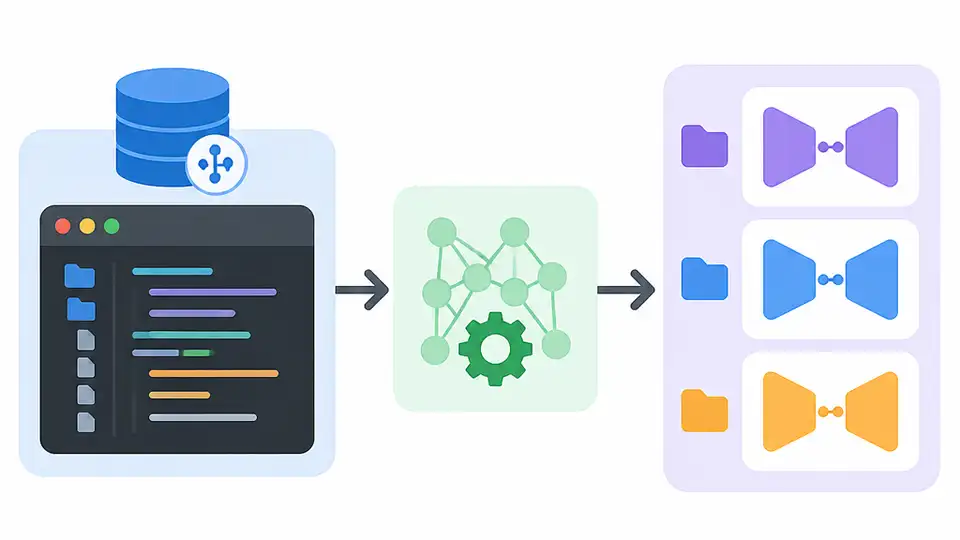
Code2LoRA turns repository context into LoRA adapters, avoiding long prompts and per-repo fine-tuning overhead.
- Research org: Unspecified in arXiv abstract
- Core data: 60.3% cross-repo exact match
- Breakthrough: Hypernetwork-generated repository-specific LoRA adapters
Code models often need more than the current file to get repository work right. They have to understand imports, project-specific APIs, and local conventions, and the usual ways of giving them that context are not cheap: either stuff more text into the prompt, or fine-tune a separate adapter for each repository.
This paper argues that both approaches break down at repository scale. Long-context retrieval adds token overhead at inference time, while per-repository LoRA or fine-tuning becomes expensive and awkward when codebases keep changing. Code2LoRA: Hypernetwork-Generated Adapters for Code Language Models under Software Evolution tries to move that repository knowledge out of the prompt and into a generated adapter instead.
What problem Code2LoRA is trying to fix
Get the latest AI news in your inbox
Weekly picks of model releases, tools, and deep dives — no spam, unsubscribe anytime.
No spam. Unsubscribe at any time.
The core issue is repository-level grounding. A code language model may know generic Python, but still miss which module a project uses, how a helper is named, or which project conventions matter in a particular repo. In practice, that means models need context that spans multiple files and sometimes multiple commits.
The paper frames the existing options as tradeoffs. Retrieval-based methods inject repository knowledge as long inputs, often through RAG or dependency analysis. That can work, but it increases the amount of text the model must read at inference time. Per-repository fine-tuning and LoRA can encode the project more directly, but they are costly when you have many repositories and brittle when those repositories evolve.
That is the gap Code2LoRA targets: can you encode repository knowledge once, as a compact adapter, instead of repeatedly feeding it in as text or retraining for every codebase?
How the method works in plain English
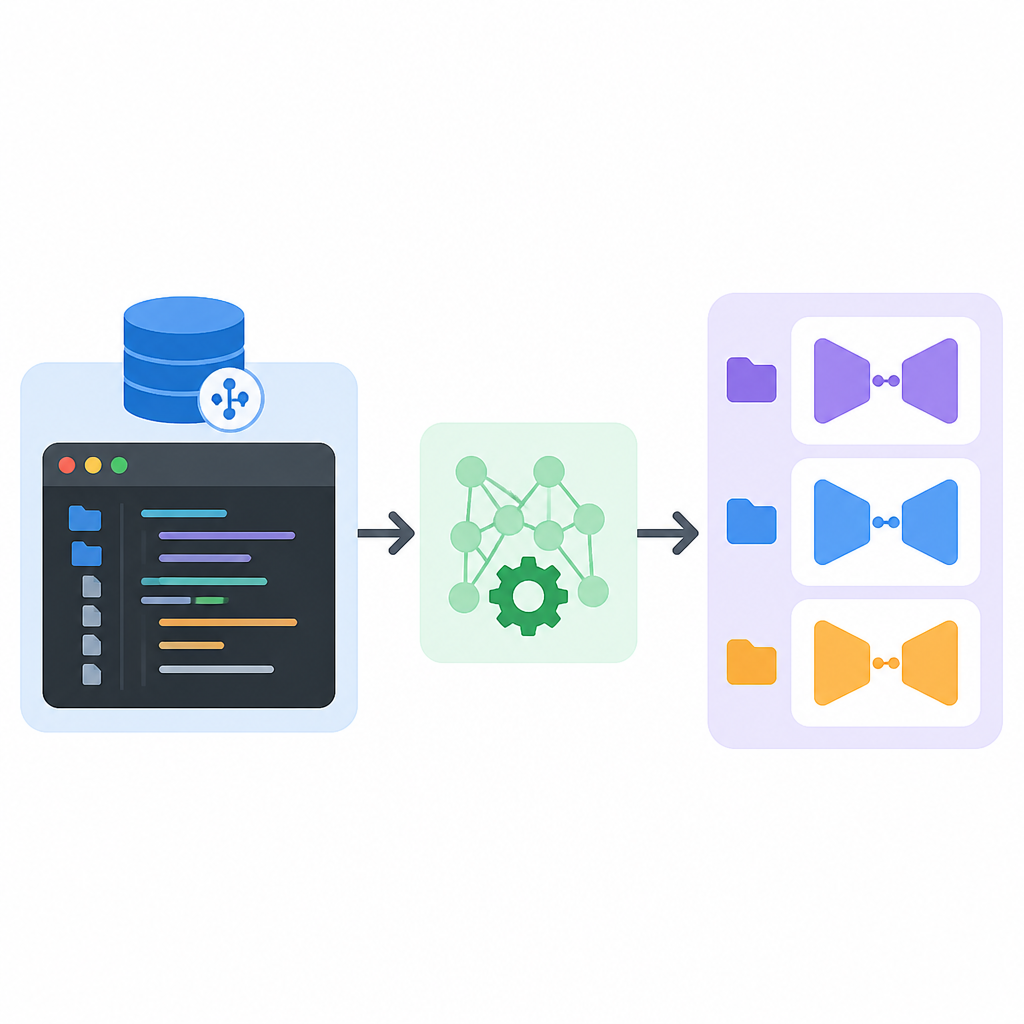
Code2LoRA uses a hypernetwork to generate repository-specific LoRA adapters. In simpler terms, instead of hand-training an adapter for each repository, the system learns to produce one from repository information.
The paper presents two modes. Code2LoRA-Static takes a single snapshot of a repository and converts it into an adapter. That makes sense for codebases that are relatively stable, where the main need is comprehension rather than continuous adaptation.
Code2LoRA-Evo is built for active development. It keeps an adapter backed by a GRU hidden state that gets updated per code diff. That means the repository representation can move with the code as commits land, instead of going stale after a one-time conversion.
The practical appeal is straightforward: the repository knowledge is injected with zero inference-time token overhead. For developers, that matters because the model does not need to reread a long retrieved context every time it answers a question or completes an assertion.
What the paper actually evaluates
To test the idea, the authors build RepoPeftBench, a benchmark of 604 Python repositories. It has two tracks: a static track with 40K training and 12K test assertion-completion tasks, and an evolution track with 215K commit-derived training and 87K commit-derived test tasks.
That benchmark design is important because it separates two real-world settings. One is a stable repository snapshot, where the model should learn the project structure once. The other is a living codebase, where the model has to keep up with diffs and commits. The paper is not just asking whether the adapter works in a vacuum; it is asking whether it still helps when software changes.
On the static track, Code2LoRA-Static reaches 63.8% cross-repo exact match and 66.2% in-repo exact match. The paper says this matches the per-repository LoRA upper bound. On the evolution track, Code2LoRA-Evo gets 60.3% cross-repo exact match, which is 5.2 percentage points better than a single shared LoRA.
Those are the only concrete benchmark numbers given in the abstract notes, so it is worth being precise about what they do and do not show. They show that the method is competitive with per-repo LoRA on the static setting and better than a shared LoRA on the evolving setting. They do not, from the abstract alone, establish broader performance across non-Python languages, non-assertion tasks, or general-purpose coding benchmarks.
Why developers should care
If you build tooling around code LLMs, the main lesson is that repository context does not have to live in the prompt. A generated adapter can carry project-specific knowledge without paying token costs at inference time, which is attractive for latency-sensitive or high-volume workflows.
That also makes the method relevant for software that changes often. Instead of retraining or managing a separate adapter for every commit, Code2LoRA-Evo tries to maintain a moving representation of the repo. For teams working on fast-moving monorepos or active libraries, that is a more realistic shape for repository memory.
There are still obvious open questions. The abstract does not give details on adapter size, generation cost, or how much compute is needed to update the GRU-backed state over time. It also does not show results outside the RepoPeftBench setup. So while the method looks promising, the real test will be whether it generalizes beyond the benchmark and whether the adapter-generation pipeline is simple enough to slot into existing developer tools.
The bottom line
Code2LoRA is a practical attempt to replace bulky repository prompts and per-repo fine-tuning with generated LoRA adapters. The static version targets stable codebases; the evolution version targets codebases that keep changing. The paper’s benchmark results suggest the approach is competitive, especially when software evolution is part of the problem.
For engineers, the big idea is not just better accuracy. It is a different way to package repository knowledge: compact, reusable, and less dependent on stuffing context into every inference call.
- Repository knowledge can be encoded into generated adapters instead of long prompts.
- The method has separate static and evolving modes for different codebase lifecycles.
- RepoPeftBench gives a repo-scale evaluation setup, but the abstract leaves broader limits open.
// Related Articles