Cuomo says blockchain can lower banking fees
Andrew Cuomo says blockchain could cut banking fees and speed payments if Congress passes the CLARITY Act.

Andrew Cuomo says blockchain could cut banking fees and speed payments for working families.
Andrew Cuomo is making a very specific pitch: blockchain should stop being treated like a side project and start being treated like financial infrastructure. In a Fox Business interview published June 23, 2026, the former New York governor said Congress is running out of time to set rules for the sector, and he tied that argument to the CLARITY Act, OKX, and Intercontinental Exchange.
His core claim is simple: if more payments and transfers run over blockchain rails, consumers can avoid some of the fees, delays, and minimum-balance rules that come with traditional banking. Cuomo also says the technology can help people who have limited access to bank accounts, especially if it works through smartphones rather than branch networks.
The pitch matters because it is coming from someone trying to bridge two worlds that usually distrust each other: Wall Street and crypto. Cuomo is now co-chairing a joint venture between OKX and ICE, the parent company of the New York Stock Exchange, and he is using that role to argue that regulated digital markets can do real consumer work, not just speculative trading.
| Fact | Detail |
|---|---|
| Interview date | June 23, 2026 |
| Cuomo role | Co-chair of OKX and ICE joint venture |
| Target legislation | CLARITY Act |
| Core consumer claim | Lower fees and faster payments |
| Market model | 24/7, global, direct trading |
Cuomo’s argument is about fees, not hype
Get the latest AI news in your inbox
Weekly picks of model releases, tools, and deep dives — no spam, unsubscribe anytime.
No spam. Unsubscribe at any time.
Cuomo framed blockchain as a practical way to make basic financial activity cheaper. In his telling, the average family should be able to hold money, pay bills, and send transfers without getting clipped by account minimums, intermediary charges, or slow settlement times.
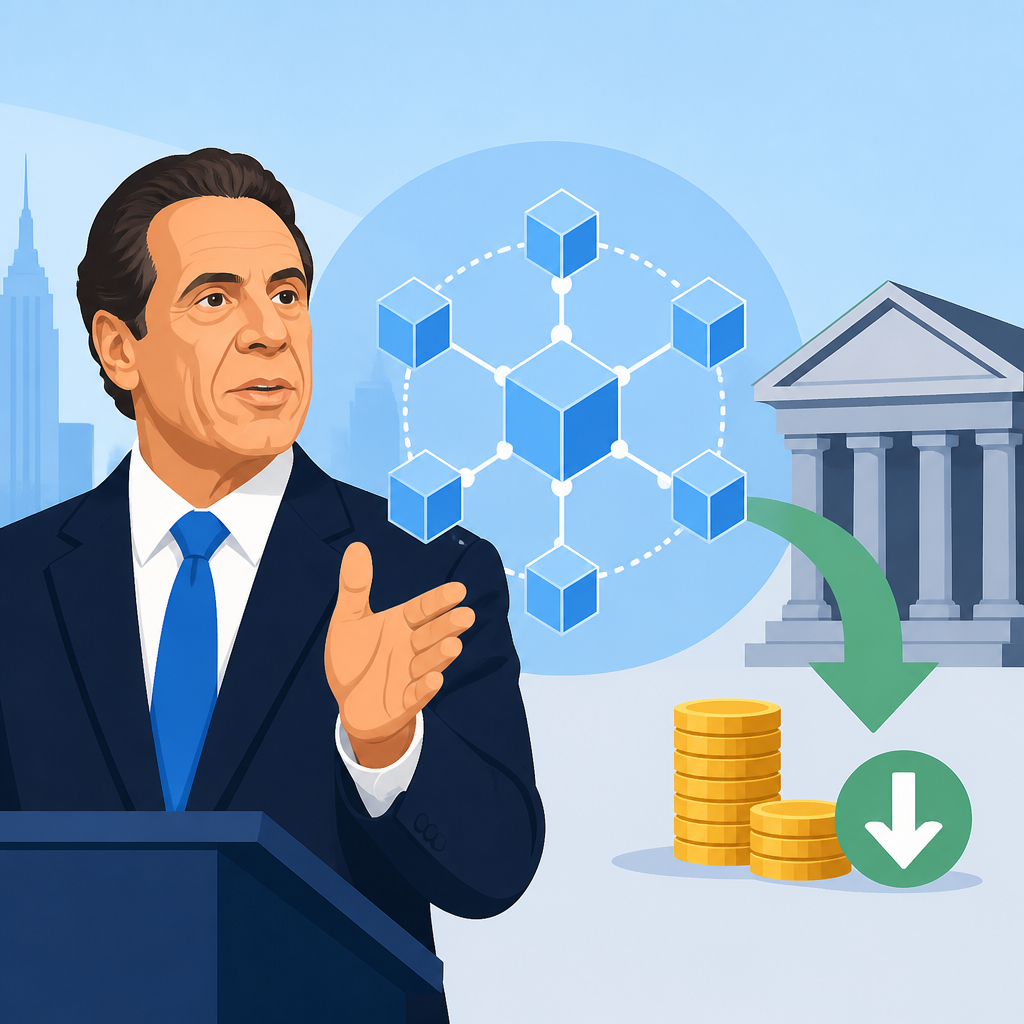
That is a more grounded message than the usual crypto sales pitch. He is not talking about speculative tokens first. He is talking about payment rails, tokenized securities, and a system where users can move money directly through a wallet.
He also linked the argument to access. Cuomo said billions of people worldwide still lack access to financial services, and he suggested that mobile wallets can reach people that bank branches never will. That is a strong claim, but it matches the direction of a lot of payment innovation over the past decade.
- Cuomo says blockchain can reduce transaction fees for consumers.
- He says payments can be faster because intermediaries are removed.
- He says wallets on smartphones can extend access to underserved users.
- He says the system can run continuously, rather than on bank hours.
He wants Congress to write the rules now
The political center of Cuomo’s argument is the CLARITY Act, which he described as the rulebook the industry needs. His message to lawmakers was blunt: the government does not have the luxury of waiting.
He argued that crypto and blockchain are already in use, so regulators are no longer deciding whether the technology exists. They are deciding whether the U.S. will set standards around it.
"You don't have more time. The situation is already manifested." — Andrew Cuomo
That quote gets to the heart of his pitch. He is saying the regulatory debate has moved past theory. Businesses are already operating, people are already transacting, and Congress is behind the curve.
Cuomo also used a familiar historical analogy. He compared the current moment to earlier financial shocks that led to new rules, including the 1929 crash and the Enron scandal. His point was that major financial changes usually force Washington to catch up after the fact, but he wants that reaction to happen sooner this time.
Wall Street compliance and crypto speed are the bet
What makes this story more interesting than a standard crypto-policy interview is the partnership Cuomo is selling. He says the goal is to combine Wall Street’s compliance expectations with blockchain’s speed and around-the-clock availability.
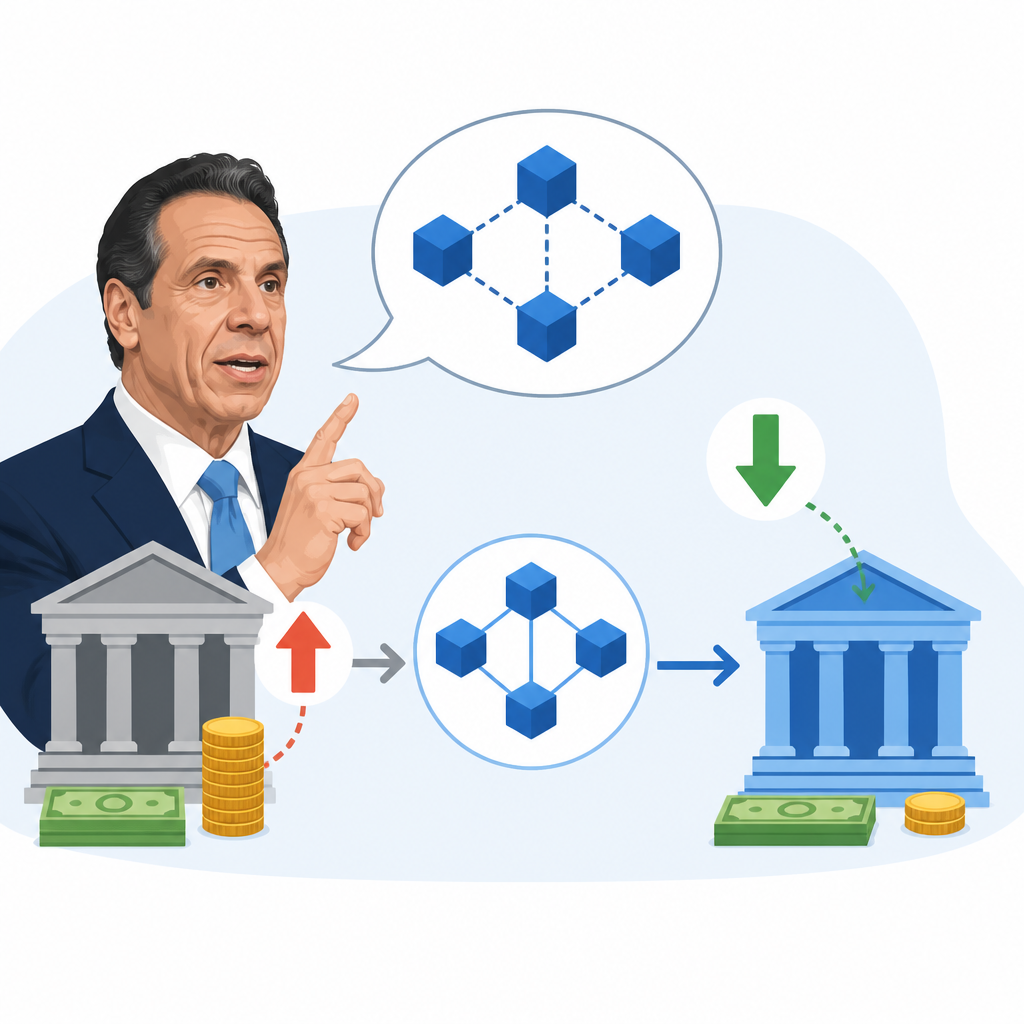
That is where the ICE connection matters. ICE runs some of the most important market infrastructure in the U.S., while OKX brings a crypto-native trading background. Cuomo’s argument is that the two sides can build something more useful than either one could alone.
He also pushed back on the idea that traditional finance should slow the transition because it might hurt existing business models. In his view, that is the wrong instinct. If the technology changes how markets work, firms either adapt or fall behind.
- JPMorgan Chase CEO Jamie Dimon has been one of the most visible critics of crypto legislation.
- Cuomo says blockchain can enable direct trading without intermediaries.
- He says the market can run 24/7 and operate globally.
- He says tokenized securities and futures are part of the next phase.
That last point is important because it shows Cuomo is thinking beyond consumer payments. Tokenized equities and futures would bring blockchain into the same territory as major exchanges, clearing systems, and regulated brokerage products. That is a much bigger target than peer-to-peer crypto transfers.
For readers following the policy fight, this also connects to the broader debate around crypto regulation in Washington. If you want the legislative backdrop, see our related coverage on the CLARITY Act and crypto regulation.
The real test is whether consumers feel the savings
Cuomo’s case will rise or fall on a simple question: do ordinary users actually save money? If blockchain-based payment systems still end up with hidden fees, complex onboarding, or weak consumer protections, the pitch will collapse fast.
But if regulated platforms can offer cheaper transfers, faster settlement, and easier access to basic financial tools, then Cuomo’s argument could move from political talking point to policy pressure. That would matter for banks, exchanges, and payment companies alike.
The next milestone to watch is whether Congress moves the CLARITY Act with enough speed to give companies a clear operating framework. If lawmakers stall, the market will keep building anyway, and regulators will be forced to catch up later. If they act, Cuomo’s bet is that blockchain stops being a crypto slogan and becomes a lower-cost way to move money.
For now, the most useful question is not whether blockchain can change finance. It is whether Washington will write rules early enough to shape who benefits from that change.
// Related Articles
- [CHAIN]
Bitcoin’s CLARITY Act now faces a 60-vote test
- [CHAIN]
Pepeto's DeFi push is a distraction from Ethereum's real upside
- [CHAIN]
AI agents will not save Web3; they will expose its weakest systems
- [CHAIN]
Panda AI launches Golden Presale for AI blockchain
- [CHAIN]
Layer 2 vs Layer 3: $38B TVL trade-off
- [CHAIN]
Layer 2 Blockchain Development Setup Guide