DeepSeek’s low-cost chatbot changed AI pricing
5 things DeepSeek changed: free access, low API prices, open weights, math tools, and AI market pressure.

DeepSeek is a low-cost chatbot that pushed AI pricing, access, and model releases into focus.
DeepSeek’s rise matters because it combined free consumer access, low API pricing, and open-weight releases in a way that rattled much bigger rivals. Its chatbot launched on 10 January 2025, and by 27 January it had overtaken ChatGPT as the most downloaded freeware app on the U.S. iOS App Store.
| Item | Access | Price / Cost | Notable signal |
|---|---|---|---|
| DeepSeek web app | Free | 500 messages/hour cap | Most-downloaded freeware app in U.S. iOS App Store |
| DeepSeek API | Usage-based | About $0.28 per million input tokens, $0.42 per million output tokens | Cheaper than some competing services |
| DeepSeek-V3 training | Model development | About 2,000 GPUs, 55 days, US$5.58 million | Far fewer resources than many peers |
| DeepSeek-Prover-V2-671B | Math-focused model | Released 30 April 2025 | Built for theorem proving and mathematical reasoning |
| DeepSeek V4 / V4-Pro | Latest releases | Released 24 April 2026 | Shows continued model expansion |
1. Free chat access with a real usage cap
Get the latest AI news in your inbox
Weekly picks of model releases, tools, and deep dives — no spam, unsubscribe anytime.
No spam. Unsubscribe at any time.
DeepSeek’s consumer pitch is simple: use the chatbot for free on the web or in its mobile apps. That makes it easy to try without paying up front, which helps explain how quickly it spread after launch.

The web version is not unlimited in practice. DeepSeek says the free web experience carries a 500 messages per hour cap to reduce bot spam, and sign-up is tied to global email services such as Gmail, Google, or Yahoo.
- Platforms: web, Android, iOS
- Launch date: 10 January 2025
- Free access: yes
- Signup: email-based, with global providers
2. API pricing that undercuts many rivals
For developers and businesses, DeepSeek also offers API access to the R1 and V3 models. The appeal is not just availability, but cost: the company priced API usage at about $0.28 per million input tokens and $0.42 per million output tokens as of February 2025.
Those rates helped position DeepSeek as a budget-friendly option for teams that want chatbot or model access without paying premium rates. The pricing model is usage-based, so it fits products that need to scale up and down rather than buy fixed capacity.
- Target users: developers, businesses
- Models exposed: R1, V3
- Pricing model: usage-based
- Access point: API
3. Open-weight releases that lower the barrier for builders
DeepSeek has also drawn attention for saying its newer models would be released and made open source. That matters because open weights and infrastructure code let researchers and companies inspect, adapt, and run models more easily than with closed systems.
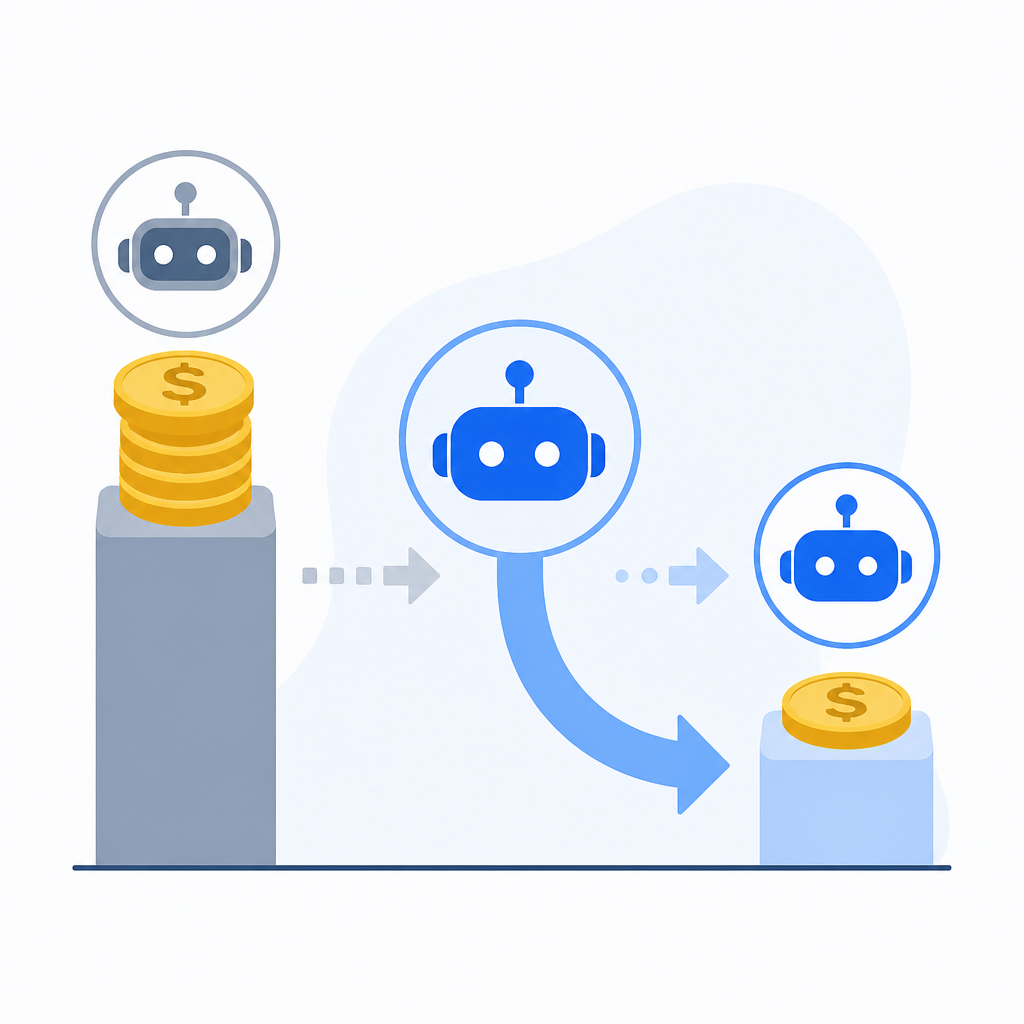
The article notes that DeepSeek has been praised for open weights, infrastructure code, energy efficiency, and contributions to open-source AI. It also says the R1, V3, and V4 model family uses the MIT License, while the web and mobile apps remain proprietary.
Open parts: R1, V3, V4 models under MIT License
Closed parts: web and mobile apps are proprietary
4. Model releases aimed at math and reasoning
DeepSeek is not only a general chatbot. On 30 April 2025, the company released DeepSeek-Prover-V2-671B, a math-focused model built for formal theorem proving and mathematical reasoning. That gives it a narrower but more specialized use case than a general chat interface.
Earlier, on 3 April 2025, DeepSeek and researchers at Tsinghua University published DeepSeek-GRM, combining generative reward modeling and self-principled critique tuning to improve inference-time scaling. Later, on 24 April 2026, DeepSeek released DeepSeek V4 and V4-Pro, showing that the product line kept expanding.
- DeepSeek-GRM: published with Tsinghua University
- DeepSeek-Prover-V2-671B: math and theorem proving
- DeepSeek V4 / V4-Pro: released 24 April 2026
5. A training story built on fewer GPUs and lower spend
DeepSeek’s operational story is one reason it drew so much attention. The company says DeepSeek-V3 was trained with about 2,000 Nvidia H800 GPUs over around 55 days at a cost of US$5.58 million. The article contrasts that with leading AI companies that may use as many as 16,000 GPUs.
That efficiency became part of the company’s identity. It suggested that strong chatbot performance might not require the largest possible training bill, which is why the release was treated as a challenge to more established AI players and a signal to the market.
- GPU count claimed: about 2,000
- Training time: around 55 days
- Training cost: US$5.58 million
- Chip family: Nvidia H800
6. A launch that moved markets and triggered scrutiny
DeepSeek’s success was not just a product story. After its rise, Nvidia’s share price fell by 18% on 27 January 2025, and the wider tech sector saw heavy losses. The article says the release of R1 helped wipe about $593 billion from AI and computer hardware market value in one day, with roughly $1 trillion lost from American stocks by the next day.
At the same time, the company faced scrutiny over censorship, privacy, and security. Concerns included Chinese government content controls, data collection practices, and questions about distillation from OpenAI outputs, although there is no conclusive method to prove that claim.
- Market effect: major tech sell-off
- Regulatory concern: censorship and privacy
- Security issue: cyberattack on 27 January 2025
- Policy issue: scrutiny in multiple countries
How to decide
If you want a free chatbot for everyday use, start with the web app. If you are building software, the API pricing and model access are the main draw. If you care about open models or research use, the MIT-licensed releases and math-focused Prover model matter most.
If your priority is trust and compliance, the censorship and privacy concerns need more weight. DeepSeek is best understood as a low-cost, high-impact AI system that offers real technical value, but asks users to think carefully about where and how they use it.
// Related Articles
- [IND]
OpenAI’s Astra pause shows safety now shapes model releases
- [IND]
Anthropic is building custom AI chips for Claude
- [IND]
Moka AI Is a Stronger HRMS Choice for Growing Teams
- [IND]
August 2026 Market Review: AI Stocks Flipped Fast
- [IND]
Pixel 11 launch live: every Google reveal
- [IND]
Anthropic’s invisible watermark is the right move