54 staff cut as Ethereum Foundation reorganizes
Ethereum Foundation cuts 54 roles and splits into five clusters plus operations and management to focus on protocol, access, users, community, and institutions.

Ethereum Foundation cut 54 roles and split its work into five clusters plus operations.
Ethereum Foundation said on June 23, 2026, it has finished a months-long reorganization tied to its Mandate and Treasury Management Policy. The change leaves the nonprofit with 54 fewer colleagues, about 20% of staff, and a new structure built around protocol, access, user, community, and institutional work.
| 項目 | 數值 |
|---|---|
| Announcement date | June 23, 2026 |
| Roles cut | 54 |
| Staff reduction | Roughly 20% |
| New work clusters | 5 |
| Additional groups | Operations plus management support |
What changed
Get the latest AI news in your inbox
Weekly picks of model releases, tools, and deep dives — no spam, unsubscribe anytime.
No spam. Unsubscribe at any time.
The EF now says it is organized into five domains of work, each with its own mandate and internal shape. Those clusters are protocol layer, access layer, user layer, community layer, and institutional layer, with separate operations and management teams supporting them.

The protocol cluster is tasked with hardening Ethereum’s base layer while keeping censorship resistance, privacy, security, and open source guarantees intact. The post says its job is not short-term market positioning, but making the network harder to corrupt or capture.
- Ethereum Foundation says the protocol team will focus on safer forks, less complexity, fewer trusted dependencies, and defense against toxic MEV.
- Long-horizon research such as post-quantum security, zkEVM, and L1 privacy is meant to move into protocol changes.
- The access layer is meant to make reading, transacting, proving, delegating, and exiting possible without relying on unverifiable intermediaries.
- The user layer will handle personas, education, research, and impact checks so protocol and access decisions reflect real users.
- The community layer will shape how the EF presents itself inside and outside crypto, while the institutional layer will work with firms, governments, universities, and nonprofits.
The institutional cluster also plans to publish best practices, standards, reference architectures, and educational material for adoption. It will work with academics and advocacy groups on policy and regulation that could affect Ethereum’s core commitments.
Why it matters
For developers, the new structure is a signal that the EF wants clearer ownership over protocol safety, user access, and institutional integration at the same time. That could affect priorities for client teams, wallet builders, researchers, and groups building privacy or exit paths.
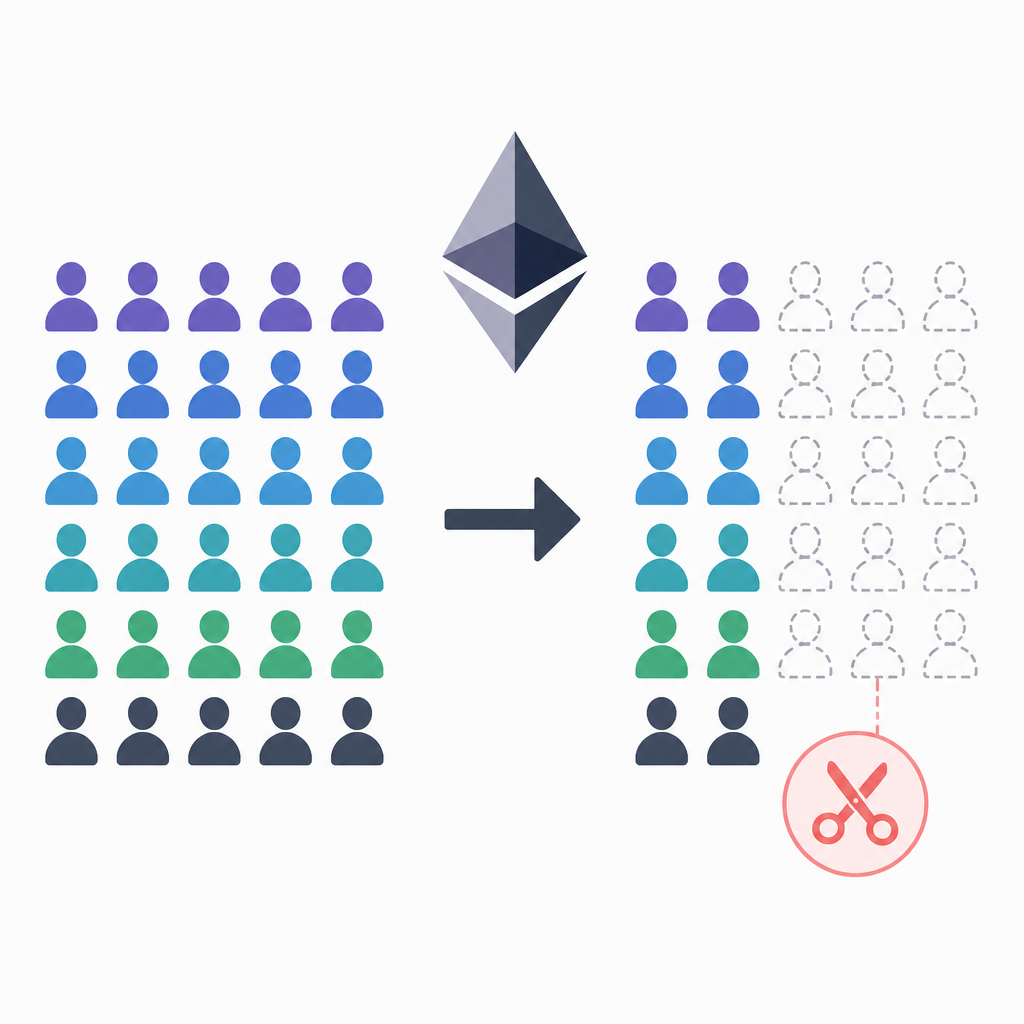
For the market, the layoff and reorg show the foundation is tightening spending and narrowing focus around work it sees as uniquely its job. The severance package includes the higher of one month’s pay per year worked or local legal minimums, plus transition support and a small grant for moving to other roles in the ecosystem.
The bigger question is whether the new setup helps Ethereum ship faster without drifting from its self-sovereignty goals. The EF says the answer will show up in the next few months as each cluster’s work becomes public.
// Related Articles
- [IND]
OpenAI’s Astra pause shows safety now shapes model releases
- [IND]
Anthropic is building custom AI chips for Claude
- [IND]
Moka AI Is a Stronger HRMS Choice for Growing Teams
- [IND]
August 2026 Market Review: AI Stocks Flipped Fast
- [IND]
Pixel 11 launch live: every Google reveal
- [IND]
Anthropic’s invisible watermark is the right move