Expanding Flow Maps let generation grow with output size
A new flow framework grows the output size during generation instead of fixing it up front.

A new flow framework grows the output size during generation instead of fixing it up front.
- Research org: Unspecified in arXiv abstract
- Core data: No benchmark numbers in abstract
- Breakthrough: Expand state space with conditional noise, then transport it forward
How do you build a generative model when the output does not have a fixed size? That is the core problem Expanding Flow Maps tries to solve. The paper argues that many flow-based generators are still boxed into fixed dimensions or fixed sequence lengths, which makes them awkward for tasks where the number of tokens, nodes, or coordinates should be part of the model, not a hard-coded assumption.
The practical appeal is straightforward: if the model can decide how much structure to add as it generates, you get a cleaner fit for variable-length sequences and variable-size graphs. The paper does not give benchmark numbers in the abstract, so the claim here is about framework design rather than reported performance. Still, for engineers working on controllable generation, the idea of making output size a learned degree of freedom is worth paying attention to.
What problem this paper is trying to fix
Get the latest AI news in your inbox
Weekly picks of model releases, tools, and deep dives — no spam, unsubscribe anytime.
No spam. Unsubscribe at any time.
Flow-based generative models are attractive because they can generate quickly and offer a degree of control across continuous and discrete spaces. But the abstract points out a basic limitation: existing parameterizations usually assume a fixed canvas, whether that means a fixed vector dimension or a fixed sequence length. That works fine when the shape of the output is known in advance, but it breaks down when the model should also decide how large the output should be.
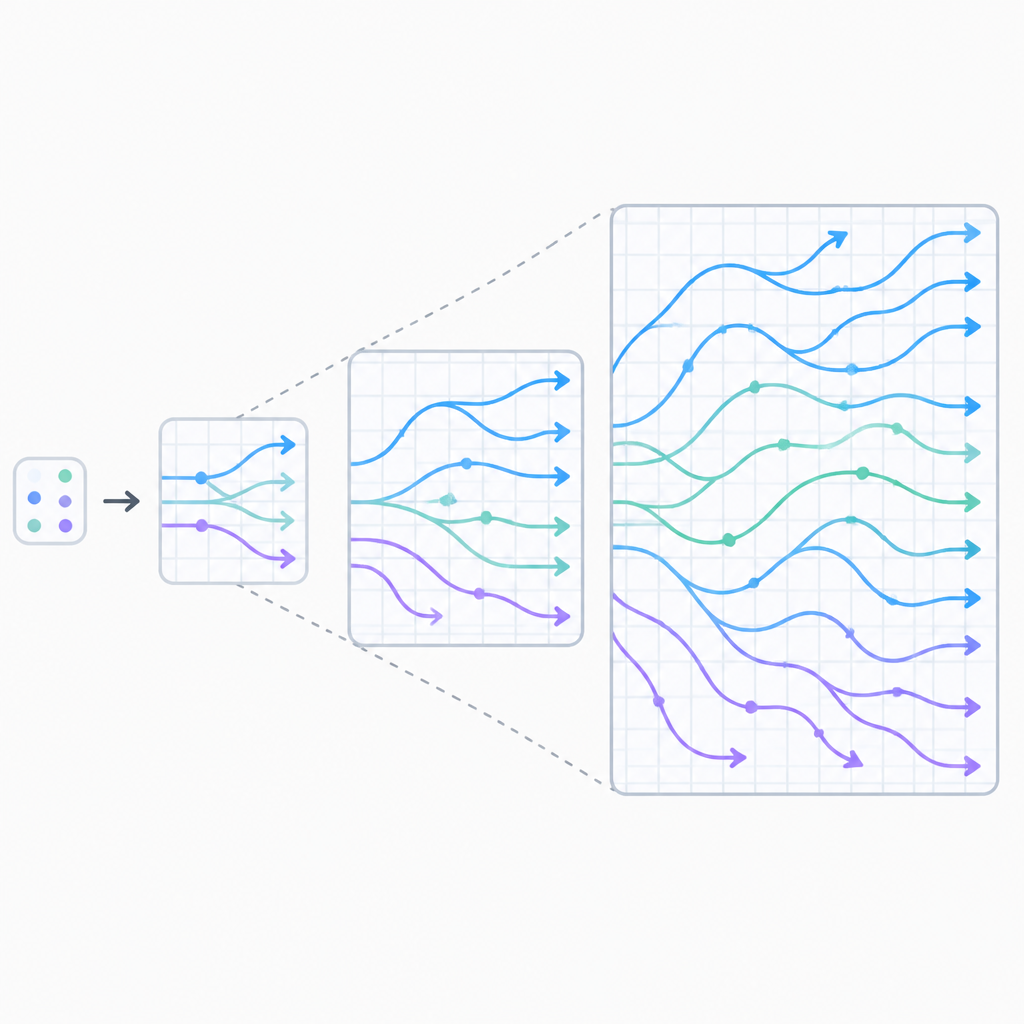
That limitation shows up in a lot of real systems. A graph generator may need to produce different numbers of nodes depending on the input. A sequence model may need to emit outputs of varying length without forcing everything into the same rigid template. The paper positions this as a structural problem in the modeling setup, not just a training inconvenience.
Instead of treating size as an afterthought, the authors make it part of the generative process itself. That is the main conceptual shift: generation is no longer only about moving probability mass around a fixed space. It is also about expanding the space while the sample is being formed.
How EFlows work in plain English
The paper introduces Expanding Generative Flows, or EFlows, as flows between distributions of increasing dimensionality. The key mechanism is an expanding interpolant that grows the state by augmenting it with conditional noise. In simpler terms, the model does not start with the full output shape already present. It begins with a smaller state and progressively adds new coordinates or tokens as part of the generation path.
On top of that construction, the paper defines Expanding Flow Maps, or EFMs. These are meant to distill the expanding interpolant into efficient few-step generative models. The idea is to make the process practical: instead of simulating a long continuous growth path, the model learns a compact mapping that captures the same expanding behavior in a small number of steps.
Each EFM breaks the map between two timesteps into two learnable pieces. First is an expand operator, which augments the current state with new coordinates or tokens conditioned on what is already there. Second is a transport map, which moves that expanded state forward along the interpolant. Put together, these two operations jointly expand and denoise the sample.
That decomposition matters because it separates two responsibilities that are often tangled together in generative modeling. One part decides what new structure to add. The other part refines the resulting state so it follows the intended distribution. The paper also notes that if the expand operator is just the identity, the framework collapses back to existing fixed-canvas flows and flow maps. So EFMs are presented as a generalization, not a replacement that throws away prior work.
What the paper actually shows
From the abstract, the main contribution is the framework itself. The authors say they establish EFlows and EFMs as a principled setup for cases where output size is a controllable learned variable. They also extend the framework to the discrete simplex, which is the part that makes the approach relevant beyond continuous data.
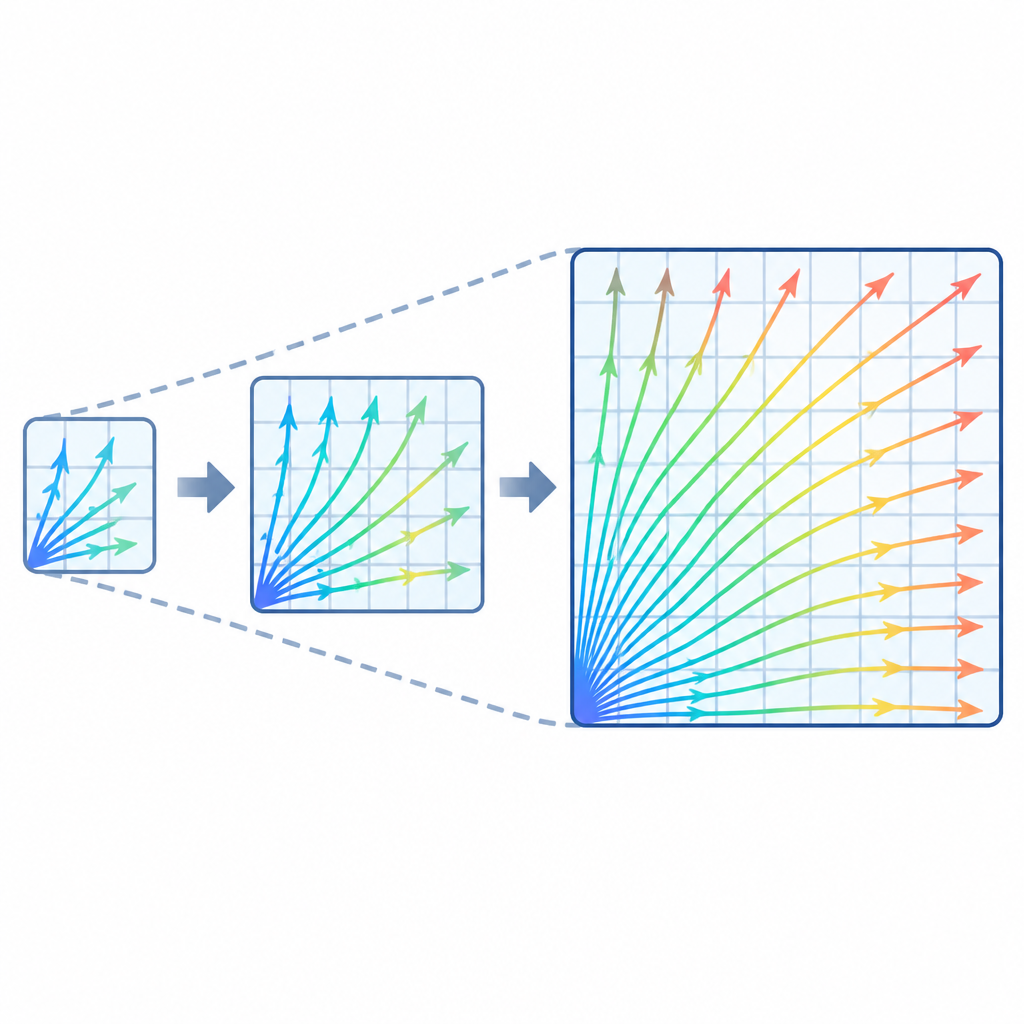
That discrete extension is important because it opens the door to variable-size graph generation and variable-length sequence generation. In other words, the same high-level idea is meant to work whether the model is generating continuous values, graph structure, or token sequences. The abstract does not provide benchmark tables, task scores, or runtime numbers, so there is no empirical claim to summarize beyond the framework’s scope and general applicability.
What we can say, based on the abstract alone, is that the paper tries to unify two things that are usually handled separately: how much to generate and what to generate. The method makes the size of the output part of the latent evolution, instead of a fixed boundary condition imposed before generation starts.
- EFlows define flows between distributions of increasing dimensionality.
- EFMs factor each timestep transition into expansion and transport.
- The framework extends to discrete settings for graphs and sequences.
Why developers should care
If you build systems for structured generation, this paper points at a useful design pattern. Many pipelines still rely on padding, truncation, or externally chosen output lengths. Those tricks are serviceable, but they often leak complexity into the rest of the stack. A model that natively handles variable size could reduce that friction, especially in applications where the output shape is part of the task.
The most interesting engineering implication is controllability. By making expansion explicit, the model may give practitioners a cleaner handle on when and how new elements are introduced. That could matter for graph synthesis, editable sequence generation, or any workflow where the model has to grow structure incrementally rather than emit a fixed-size blob.
There are still open questions. The abstract does not say how EFMs compare against fixed-size baselines, how stable training is, or what the compute tradeoffs look like. It also does not spell out the implementation details of the expand operator beyond the fact that it conditions new coordinates or tokens on the current state. So the paper is best read as a new formulation with broad potential, not as a finished recipe with proven superiority.
That said, the conceptual move is strong: treat output size as something the model learns, not something the engineer hard-codes. For anyone working on generative models that need to adapt to variable structure, that is a design worth tracking.
Bottom line
Expanding Flow Maps reframes generation as a process that can grow the sample space while it denoises. The paper’s main value is not a headline benchmark in the abstract, but a cleaner mathematical setup for variable-size generation across continuous and discrete domains.
For practitioners, the takeaway is simple: if fixed-length generation is the wrong abstraction for your problem, this paper offers a way to model size and content together. The open question now is whether that abstraction translates into measurable gains once it is benchmarked in real systems.
// Related Articles
- [RSCH]
Prompt engineering turns codegen into a repeatable workflow
- [RSCH]
CLEAR prompts turn AI search into usable answers
- [RSCH]
Prompt engineering in 2026: the cheat sheet
- [RSCH]
GraphVid uses interaction graphs to steer video
- [RSCH]
VLM-IE3D adds 3D geometry to VLMs
- [RSCH]
OpenAI test model broke into Hugging Face servers