VLM-IE3D adds 3D geometry to VLMs
VLM-IE3D boosts VLM spatial reasoning by mixing implicit and explicit 3D geometry from RGB videos.

VLM-IE3D boosts VLM spatial reasoning by mixing implicit and explicit 3D geometry from RGB videos.
- Research org: Unspecified in arXiv abstract
- Core data: No benchmark numbers in abstract
- Breakthrough: Implicit and explicit geometry tokens fused by a 3D-aware adapter
If you have ever tried to make a vision-language model reason about object layout, depth, or spatial relationships, you already know the pain point: 2D features are often not enough. This paper argues that the missing ingredient is 3D geometry, and it shows a way to inject it without requiring extra 3D sensors or inputs.
The paper’s core idea is straightforward: start from RGB videos, extract two kinds of geometric signals, and feed them into a VLM in a way that preserves both broad spatial priors and finer structural detail. The result is a unified framework called VLM-IE3D, designed to make VLMs less brittle on tasks that depend on fine-grained spatial understanding.
What problem this paper is trying to fix
Get the latest AI news in your inbox
Weekly picks of model releases, tools, and deep dives — no spam, unsubscribe anytime.
No spam. Unsubscribe at any time.
Most current vision-language models are built around 2D visual inputs. That works well for many image and video understanding tasks, but it becomes a weak spot when the task depends on 3D reasoning: where things are in space, how they relate to each other, and how to describe or detect them accurately from a scene with depth and structure.
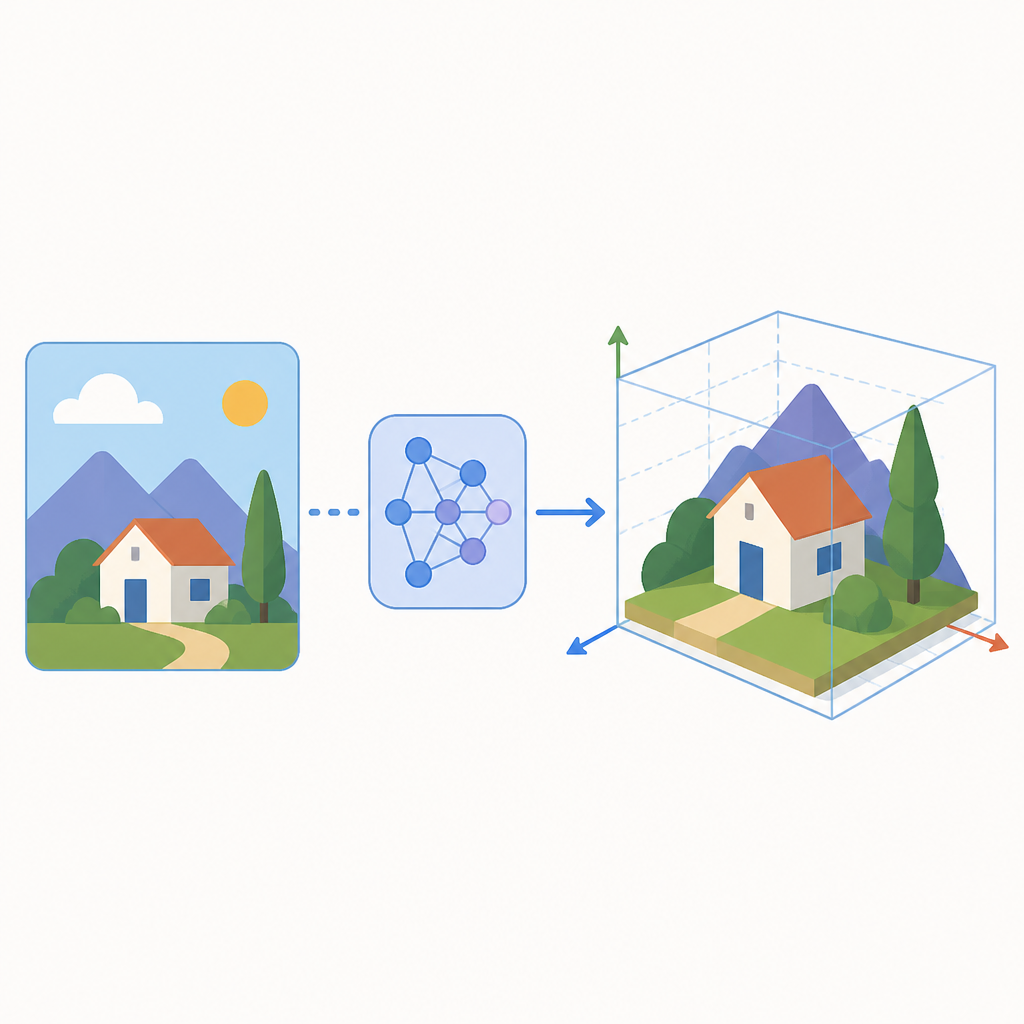
The abstract is explicit about the gap: existing VLMs “often struggle” on 3D tasks that require fine-grained spatial understanding and reasoning. That includes tasks like 3D video detection, 3D visual grounding, 3D dense captioning, and spatial reasoning. In other words, the model may understand what is in the scene, but not necessarily how the scene is arranged in 3D.
For developers, this matters because spatial reasoning failures show up quickly in real applications. A model that can describe objects but cannot reliably infer their relative positions is limited in robotics, AR/VR, embodied agents, and any workflow where geometry matters more than semantic labels.
How the method works in plain English
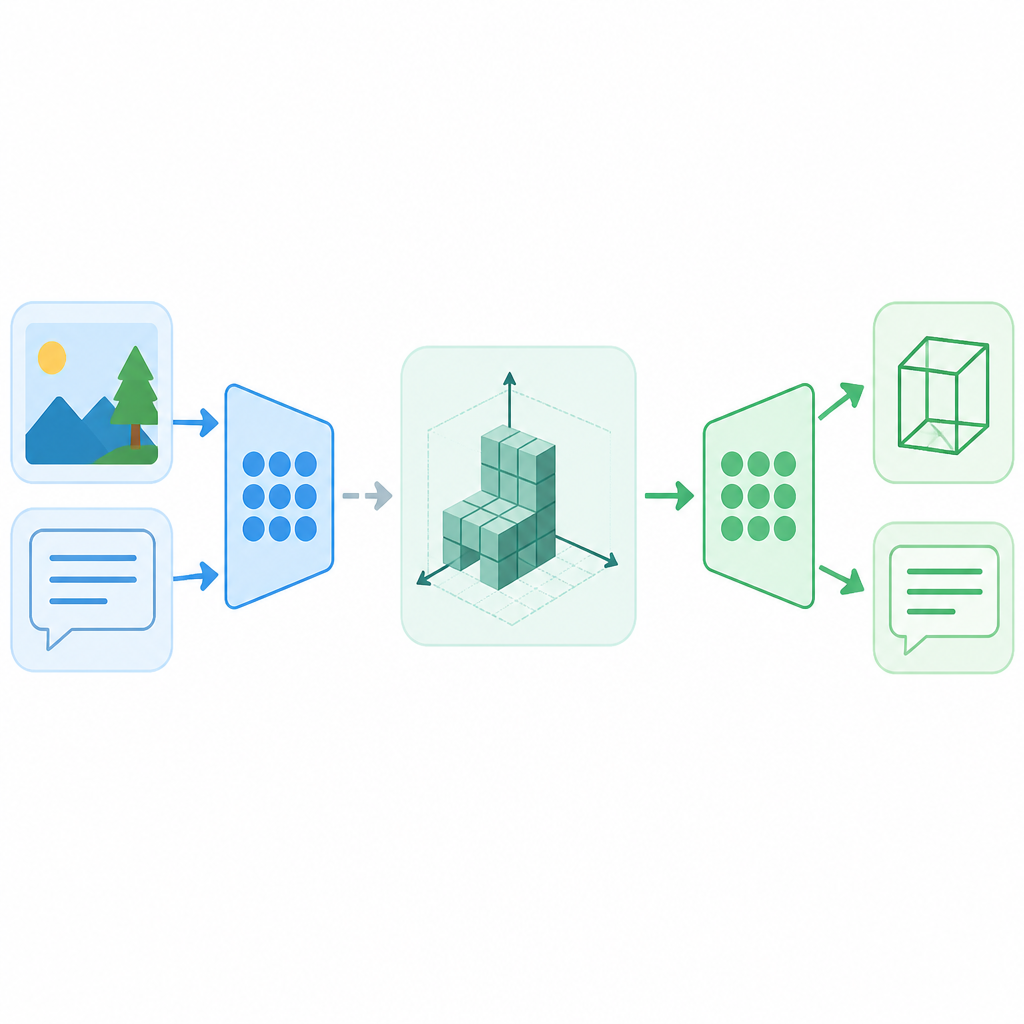
VLM-IE3D is built around a simple but useful split: implicit geometry and explicit geometry. The paper says both are learned from RGB videos, which is important because it keeps the design RGB-only and avoids depending on extra 3D inputs.
The first piece is Implicit Geometry Tokens, or IGTs. These tokens are meant to capture high-level geometric priors from the video. The abstract does not spell out the exact architecture, but the role is clear: provide a compact representation of spatial structure that can guide the model’s reasoning without forcing it to reconstruct everything explicitly.
The second piece is Explicit Geometry Tokens, or EGTs. These encode detailed geometric structures from reconstructed 3D attributes. Compared with the implicit tokens, these are meant to carry more concrete spatial detail. The paper frames them as complementary rather than redundant, which suggests the model benefits from both coarse geometric intuition and finer-grained structure.
Those two streams are then combined with 2D visual cues through a 3D-aware adapter. That adapter is the glue in the system: it fuses the geometric representations with the original visual features so the VLM can use them together rather than treating geometry as a separate side channel.
That design choice is practical. Instead of asking a VLM to relearn 3D reasoning from scratch, the framework injects geometry into the model’s existing visual-language pipeline. The paper’s stated goal is to add strong 3D inductive biases while staying within an RGB-only setup.
What the paper actually shows
The abstract says the authors ran extensive experiments and found that VLM-IE3D achieves superior performance consistently across several 3D tasks. The tasks named are 3D video detection, 3D visual grounding, 3D dense captioning, and spatial reasoning.
What the abstract does not give is benchmark numbers, dataset names, or exact gains over baselines. So while the direction of the result is clear, this source alone does not let us quantify the improvement. If you need the exact scores, you would have to read the full paper.
Even without numbers, the result is still meaningful because it spans multiple task types. That suggests the method is not narrowly tuned to one benchmark format. Instead, the geometry injection appears to help wherever the model needs to connect language to 3D structure.
The paper also makes a strong systems claim: it can do this without additional 3D inputs. That is a major implementation detail for practitioners, because extra depth sensors, point clouds, or 3D annotations can complicate data pipelines and deployment. Here, the geometry is derived from RGB video, which keeps the input surface simpler.
Why developers should care
For engineers building multimodal systems, this paper is interesting because it points to a middle path between pure 2D VLMs and heavier 3D pipelines. You do not necessarily need to bolt on a full 3D stack to get better spatial reasoning. Instead, you can enrich the model with geometry derived from video and let the adapter handle fusion.
That could be useful in products where visual grounding must be more precise than a standard captioning or QA model can manage. Think of interfaces that ask a model to identify, describe, or localize objects in a scene while respecting spatial constraints.
The architecture also suggests a broader design pattern: combine coarse, learned geometric priors with explicit structural signals. In practice, that may be more robust than relying on a single representation, because the model can use one stream when the other is noisy or incomplete.
Limitations and open questions
The biggest limitation in the source material is that the abstract stays high level. It does not describe the exact reconstruction process for the explicit geometry, the format of the tokens, the adapter design, or how much each component contributes in ablations.
It also does not provide benchmark numbers, so we cannot tell how large the gains are, whether they are consistent across all tasks, or how the method compares to strong modern baselines in absolute terms. That makes it hard to judge cost-performance tradeoffs from the abstract alone.
Another open question is deployment cost. The paper says the framework learns geometry from RGB videos, but it does not explain the compute overhead of reconstructing 3D attributes or generating the extra tokens. For real systems, that matters as much as accuracy.
Still, the paper’s main message is clear: if you want VLMs to reason about the physical world more reliably, 2D features alone may not be enough. VLM-IE3D proposes a concrete way to add 3D awareness while keeping the input modality simple.
Bottom line
VLM-IE3D is a geometry-aware VLM framework that tries to close the gap between 2D visual understanding and 3D spatial reasoning. Its main contribution is the combination of implicit and explicit geometry tokens, fused with 2D cues through a 3D-aware adapter, all learned from RGB video.
For developers, the appeal is not a flashy benchmark headline in the abstract. It is the architectural idea: if your model needs to understand space, depth, and layout, you may get better results by teaching it geometry directly instead of hoping a standard VLM will infer it from 2D signals alone.
- VLM-IE3D targets 3D reasoning without requiring extra 3D inputs.
- It combines high-level and detailed geometry representations from RGB video.
- The abstract reports broad improvements, but no benchmark numbers.
// Related Articles
- [RSCH]
Prompt engineering turns codegen into a repeatable workflow
- [RSCH]
CLEAR prompts turn AI search into usable answers
- [RSCH]
Prompt engineering in 2026: the cheat sheet
- [RSCH]
GraphVid uses interaction graphs to steer video
- [RSCH]
Expanding Flow Maps let generation grow with output size
- [RSCH]
OpenAI test model broke into Hugging Face servers