Korea’s Nvidia talks point to an AI factory push
4 takeaways from Korea’s meeting with Nvidia on chips, physical AI, and an AI factory plan.

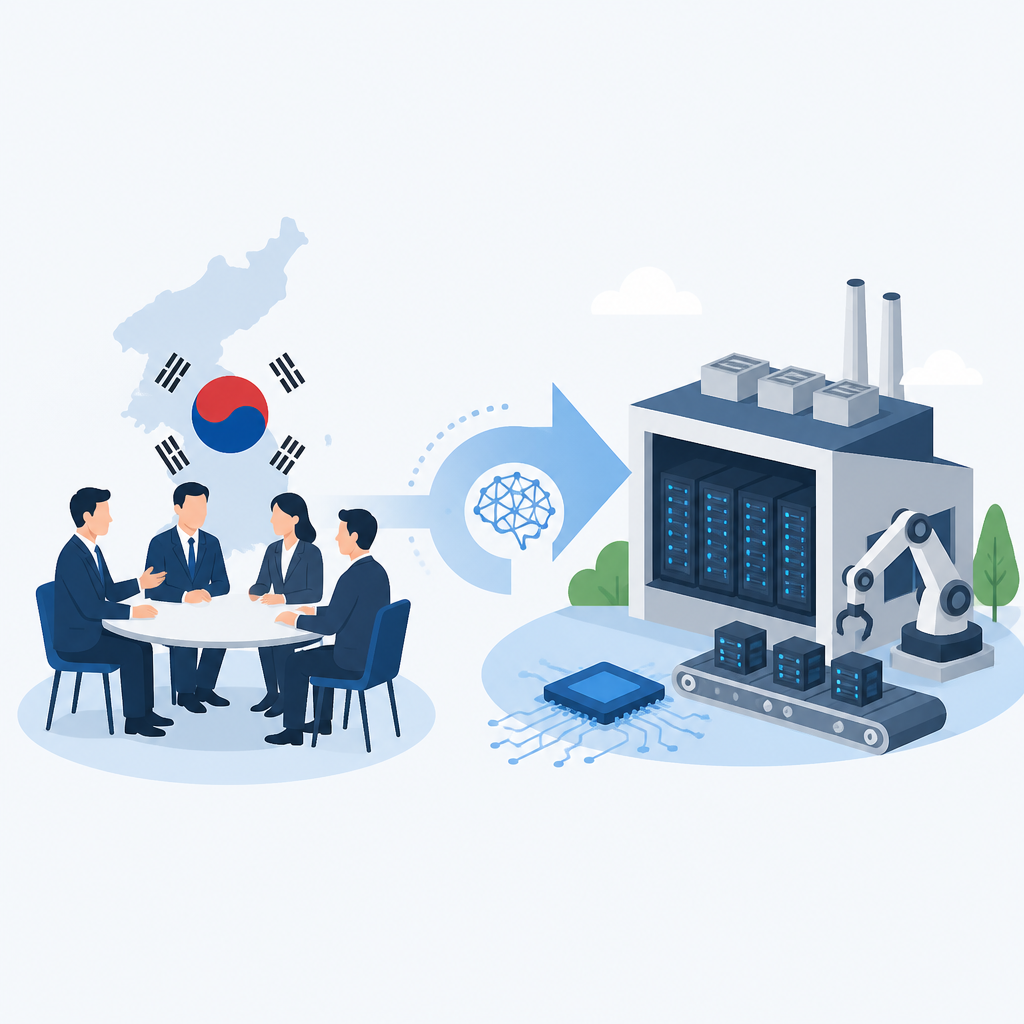
Korea and Nvidia discussed chips, physical AI, and a Seoul AI factory plan.
Science Minister Bae Kyung-hoon’s meeting with Nvidia chief Jensen Huang points to a practical agenda: secure chip supply, grow physical AI, and turn Seoul into a working hub for joint AI projects. The talks come after a prior pledge tied to the APEC meeting, including about 260,000 advanced chips.
1. A chip supply promise that now needs delivery
Get the latest AI news in your inbox
Weekly picks of model releases, tools, and deep dives — no spam, unsubscribe anytime.
No spam. Unsubscribe at any time.
The most immediate issue is execution. Bae asked for smooth delivery of the roughly 260,000 advanced chips agreed to at the APEC event, which makes this less about fresh announcements and more about timing, logistics, and follow-through.

That matters because chip access shapes how fast Korean firms can train models, run inference, and build new AI services. If the supply arrives on schedule, it gives local companies a clearer path to scale their AI plans without waiting on scarce hardware.
- Agreed volume: about 260,000 advanced chips
- Context: prior Korea-Nvidia commitment from APEC
- Goal: support local AI buildout with reliable hardware
2. Physical AI is now part of the policy agenda
The meeting also covered physical AI, a term that points to AI systems tied to machines, robots, factories, and other real-world operations. That suggests Korea is not only chasing model development, but also applications that can move into industrial settings.
For Korea, this can connect AI research with manufacturing, logistics, and robotics, where the country already has strong industrial depth. For Nvidia, it opens a path to place its hardware and software stack inside systems that need fast, dependable computation.
- Focus area: physical AI
- Likely use cases: robotics, factories, logistics, automation
- Policy value: links AI strategy to industrial deployment
3. Seoul could become Nvidia’s local R&D base
Bae said he hopes Nvidia’s planned AI research and development center in Seoul can grow into a base for Korea’s partnership with the U.S. chipmaker. That is a signal that the government wants a lasting local presence, not just periodic executive visits.
A Seoul R&D center could help with technical collaboration, talent exchange, and faster feedback between Korean partners and Nvidia engineers. It also gives startups and researchers a clearer point of contact if they want to work on joint projects or test ideas against Nvidia’s platform.
- Location: Seoul
- Purpose: AI R&D and partnership building
- Potential benefit: easier collaboration with startups and researchers
4. The Vera Rubin platform is part of the plan
The science minister also asked for Nvidia’s support in Korea’s effort to build an AI factory based on Nvidia’s Vera Rubin platform. That makes the discussion more concrete, since it ties the partnership to a named hardware and systems roadmap.
In practical terms, an AI factory means infrastructure that can continuously produce AI models and services at scale. If Korea can anchor that effort around a specific platform, it may be easier to align public policy, enterprise demand, and technical deployment.
Focus points from the meeting:
- AI factory based on Nvidia Vera Rubin
- support for local physical AI ecosystem
- chip supply execution
- Seoul R&D center growth
5. The visit was broader than one government meeting
Huang’s four-day Seoul visit included meetings with executives from major conglomerates in Korea’s AI supply chain, as well as researchers and startup representatives. That wider schedule shows the trip was designed to connect policy, capital, and technical partners in one place.
For Korea, the value of that approach is simple: a national AI push needs more than a single ministry conversation. It needs chip buyers, system builders, labs, and startups all working from the same map, with clear roles and near-term deliverables.
- Trip length: four days
- Other meetings: conglomerates, researchers, startups
- Broader aim: align Korea’s AI supply chain around Nvidia
How to decide
If you care most about near-term industrial impact, the chip supply deal and the AI factory plan matter most. If you care about longer-term ecosystem building, the Seoul R&D center and physical AI cooperation are the bigger signals.
Read the meeting as a test of whether Korea can turn a high-level AI partnership into working infrastructure, local talent pipelines, and real deployments. The next milestone is not the photo op; it is whether the promised chips, projects, and centers actually move forward.
// Related Articles
- [IND]
Deepwoken’s Second Layer hides Ethiron below Scyphozia
- [IND]
AMD is right to use Anthropic to break CUDA’s grip
- [IND]
AI Weekly: 2026-07-20 ~ 2026-07-27
- [IND]
WAIC 2026 turns AI hype into real work
- [IND]
KPMG’s OpenAI deal turns SaaS into agents
- [IND]
Trump adviser accuses Moonshot AI of stealing Anthropic