New matrix-multiplication bound via AlphaEvolve
A new optimization setup plus AlphaEvolve lowers the best known matrix multiplication exponent bound to ω < 2.371177.
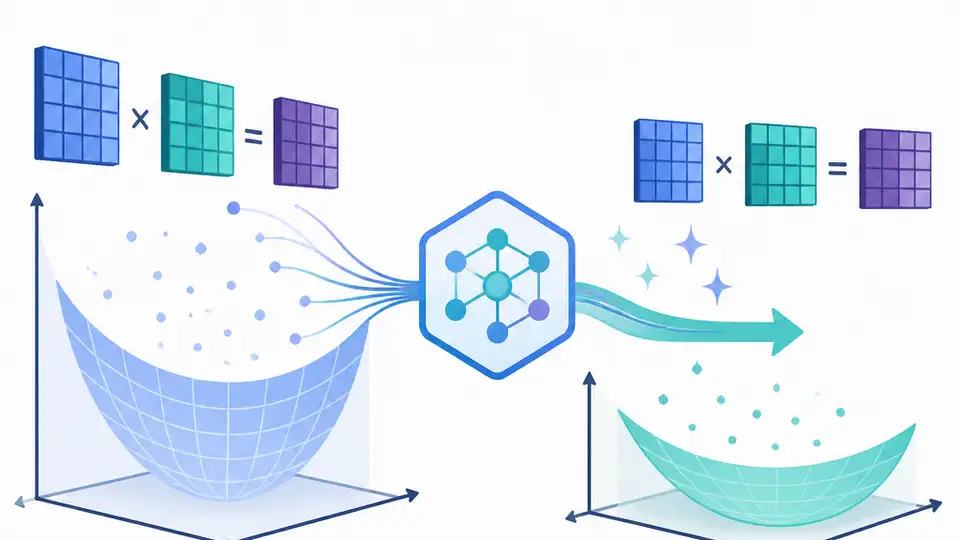
A new optimization setup plus AlphaEvolve lowers the best known matrix multiplication exponent bound to ω < 2.371177.
- Research org: Unspecified in arXiv abstract
- Core data: ω < 2.371177
- Breakthrough: Reformulated combination-loss optimization and refined it with AlphaEvolve
This paper is about a very specific kind of progress: not a new matrix multiplication algorithm you can drop into NumPy tomorrow, but a tighter theoretical bound on how fast matrix multiplication can be in principle. That still matters, because matrix multiplication sits under a huge amount of modern computing, from numerical linear algebra to parts of machine learning and scientific software.
The authors focus on the optimization problem at the heart of the current best bounds on the matrix multiplication exponent, ω. Their contribution is to make that optimization easier to solve, then push it further with machine-learning-assisted search and AlphaEvolve. The result is a new upper bound, improving the previous best known value.
What problem this paper is trying to fix
Get the latest AI news in your inbox
Weekly picks of model releases, tools, and deep dives — no spam, unsubscribe anytime.
No spam. Unsubscribe at any time.
The matrix multiplication exponent ω is the standard way researchers describe the asymptotic cost of multiplying two n×n matrices. Lowering ω means showing that, in theory, matrix multiplication can be done with fewer operations as matrices grow larger. The current best bounds come from a refinement of the laser method called combination loss analysis.
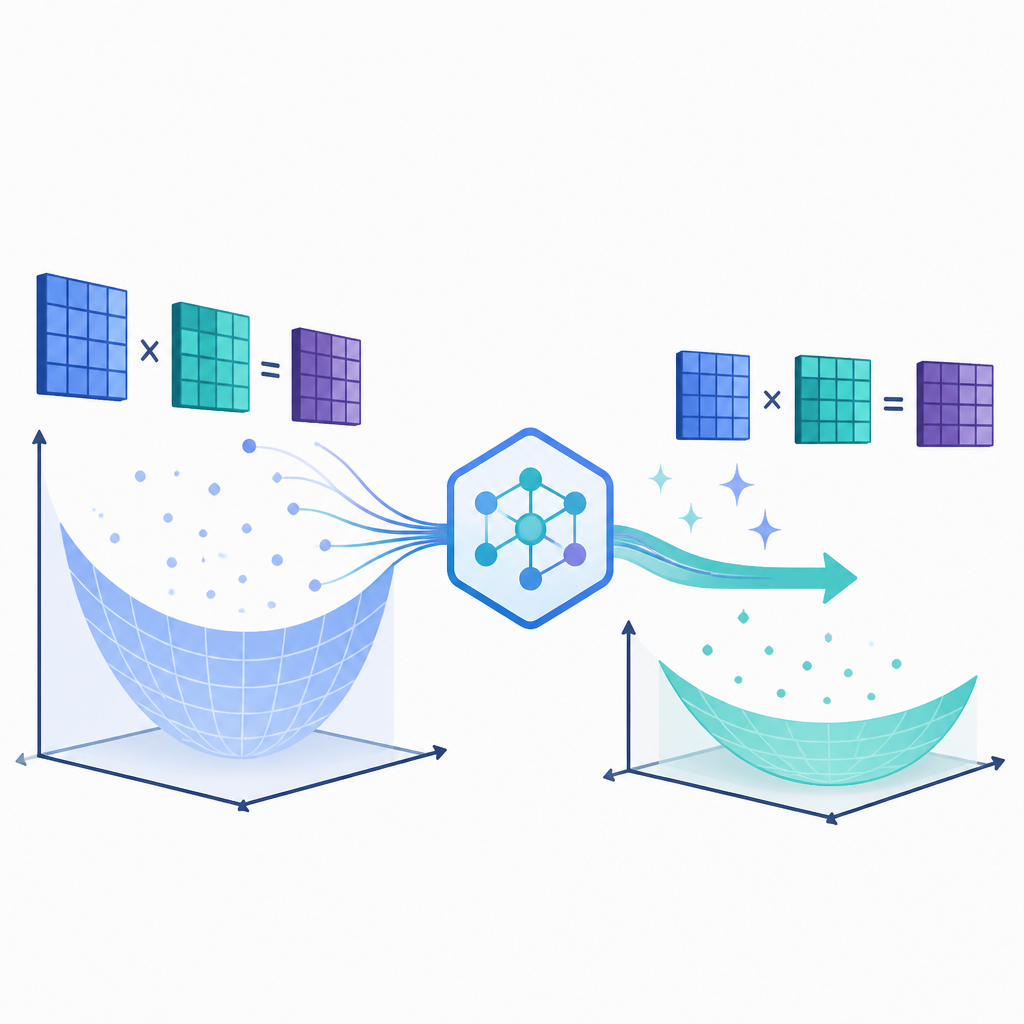
The paper says the bottleneck is the optimization problem at the core of that approach. In other words, the theoretical framework already existed, but getting the best possible bound out of it required solving a difficult optimization problem extremely well. The authors are not trying to invent a completely new proof strategy; they are trying to squeeze more out of the existing one.
That distinction matters. In research like this, the breakthrough is often not a new theorem shape, but a better way to search the space of valid proofs. If you can improve the optimizer, you can improve the bound.
How the method works in plain English
The paper makes three moves. First, it reformulates the optimization problem so it can be solved in a larger setting than before. The abstract does not spell out the full mathematical details, but the practical meaning is clear: the search space is broadened, which gives the solver more room to find better solutions.
Second, the authors use recent machine learning advances to design a new optimization algorithm for the problem. Again, the abstract does not provide implementation specifics, but the role of ML here is not to replace the proof. It is being used as a tool for navigating a hard optimization landscape more effectively than previous methods.
Third, they refine the resulting optimization algorithm with AlphaEvolve. The abstract does not describe AlphaEvolve in detail, but its role in the pipeline is as a further search-and-tuning layer on top of the new optimizer. Put simply: reformulate the math, build a better solver, then let AlphaEvolve polish the result.
This is a good example of how modern optimization work often looks in practice. The “algorithm” is not one thing. It is a stack of mathematical reformulation, heuristic search, and iterative refinement. The paper is about improving that stack enough to move a long-standing theoretical bound.
What the paper actually shows
The headline result is an upper bound of ω < 2.371177. The previous best bound was 2.371339, so the improvement is small in absolute terms, but that is normal in this area. When you are working at the frontier of asymptotic complexity, even tiny gains can be meaningful because they represent a new best-known limit.
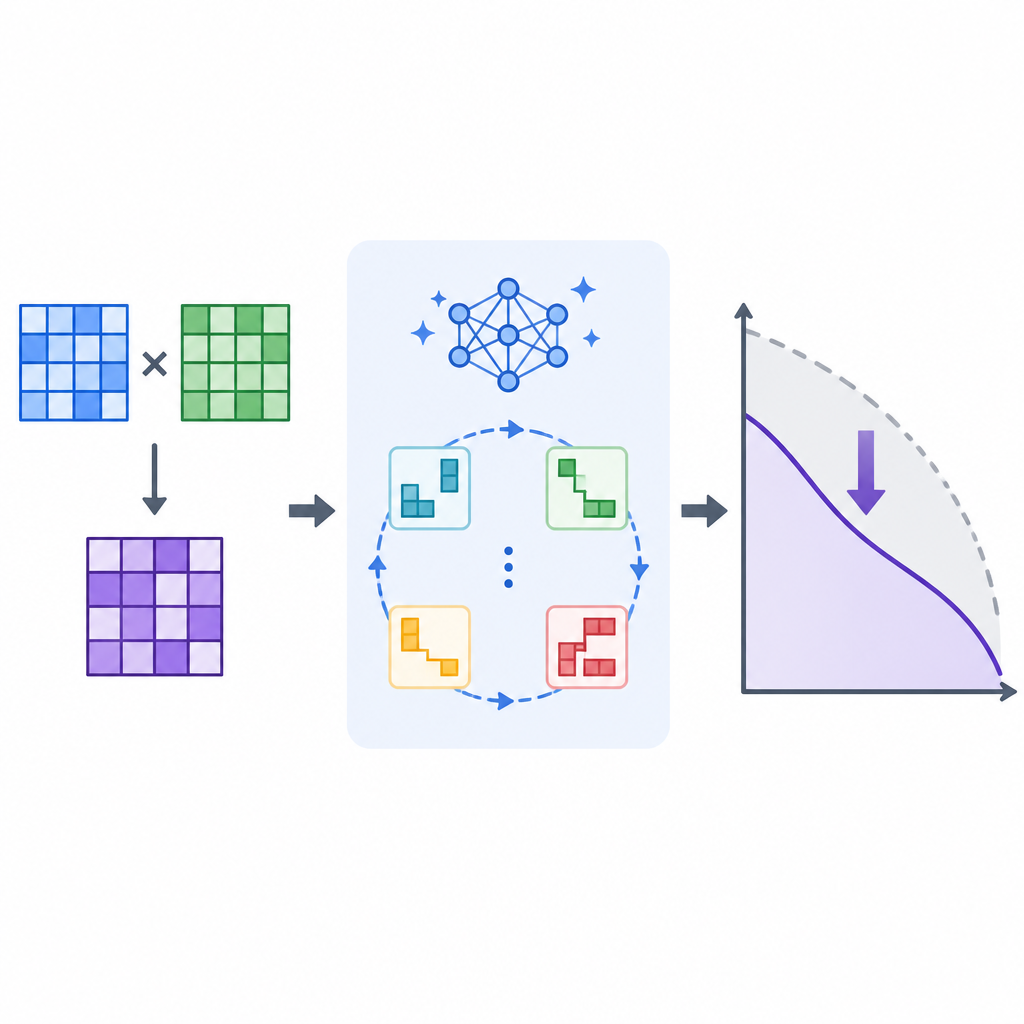
The abstract does not include any benchmark suite, runtime numbers, or practical matrix multiplication speedups. That means this paper should be read as a theoretical optimization advance, not as an empirical systems result. It improves the best known upper bound, but it does not claim that everyday dense matrix multiplication in production code will suddenly run faster.
For developers, the important signal is that the paper shows how modern optimization techniques can still move a classic complexity result. The combination of a reformulated problem, a new optimizer, and AlphaEvolve produced a better bound than prior work. That suggests there is still exploitable structure in old mathematical problems when you revisit them with newer search tools.
Why engineers should care
Most engineers will never need to reason directly about ω, but the same pattern shows up everywhere: a hard problem, a large search space, and a need for better optimization rather than a totally new model. This paper is a reminder that ML-assisted optimization is not just for product ranking or neural architecture search. It can also help in pure math and complexity theory.
It also highlights a broader trend: research tools are becoming part of the proof pipeline. If a theorem depends on solving a difficult optimization problem, then advances in solvers and search systems can change the frontier. That is relevant to anyone building optimization software, automated reasoning tools, or ML systems that assist technical work.
Limitations and open questions
The main limitation is that the abstract gives only the high-level method and the final bound. It does not provide the full derivation, the size of the search space, the exact role of AlphaEvolve, or any ablation study showing which part of the pipeline contributed most to the gain.
It is also important not to overread the result. A better upper bound on ω is a theoretical improvement, not evidence that practical matrix multiplication libraries will improve by the same amount. Real-world performance depends on constants, hardware, cache behavior, parallelism, and implementation details that are not addressed in the abstract.
Still, the paper is a strong signal that modern optimization and automated search can still help in places that used to be dominated by purely hand-crafted mathematical reasoning. For developers who work on optimization, compilers, symbolic systems, or ML-assisted research tools, that is the real takeaway.
Bottom line
This paper improves the best known bound on matrix multiplication by making the underlying optimization problem easier to solve and then pushing it further with AlphaEvolve. The result is modest numerically but important conceptually: it shows that newer optimization methods can still advance a classic complexity-theory frontier.
- It tightens the best known upper bound on the matrix multiplication exponent.
- It uses a reformulated optimization problem plus ML-driven search and AlphaEvolve.
- It is a theoretical result, not a benchmarked systems improvement.
// Related Articles
- [RSCH]
TurboQuant is not a niche trick; it is the new baseline for long-cont…
- [RSCH]
QVIRL learns rewards with uncertainty
- [RSCH]
BATON tackles long-horizon robot manipulation
- [RSCH]
How to hand off LLM session state
- [RSCH]
Marionette splits game world state from appearance
- [RSCH]
Uncertainty-Aware AI Reads Prehistoric Hand Stencils