QVIRL learns rewards with uncertainty
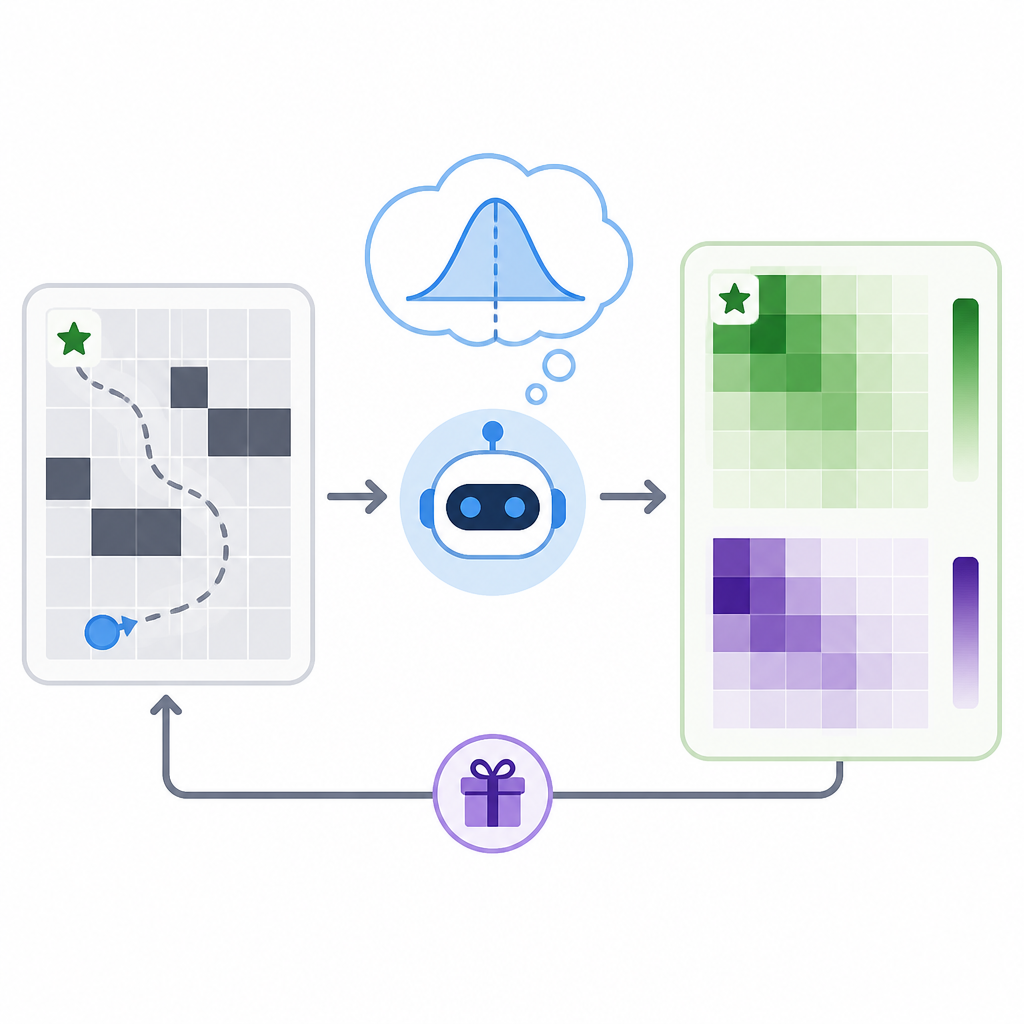
QVIRL infers reward uncertainty from demonstrations and is the first Bayesian IRL method trained on raw pixels.

QVIRL infers reward uncertainty from demonstrations and is the first Bayesian IRL method trained on raw pixels.
- Research org: Unspecified in arXiv abstract
- Core data: No benchmark numbers in abstract
- Breakthrough: Learns a variational distribution over optimal Q-values
For engineers building systems that need to follow human preferences, the hard part is often not the policy itself but the reward signal underneath it. This paper argues that inverse reinforcement learning can help when hand-specifying those preferences is impractical, and it pushes that idea toward a Bayesian setting where uncertainty is part of the output instead of an afterthought.
The paper is available as Q-based Variational Inverse Reinforcement Learning. The main selling point is not just that it learns a reward from demonstrations, but that it does so while recovering a posterior distribution over rewards. That matters in safety-critical settings, because a single “best guess” reward can hide ambiguity that should be surfaced, tested, or queried.
What problem this paper is trying to fix
Get the latest AI news in your inbox
Weekly picks of model releases, tools, and deep dives — no spam, unsubscribe anytime.
No spam. Unsubscribe at any time.
Inverse reinforcement learning exists because real-world preferences are usually too messy to write down cleanly. Instead of manually encoding every objective, IRL tries to infer a reward function from expert behavior. That is a useful idea for robotics, autonomy, and other systems that need to imitate or align with human demonstrations.

But the abstract points to two practical gaps in prior work: scalability and uncertainty quantification. If a method cannot scale beyond toy settings, it is hard to use in realistic environments. And if it cannot tell you how uncertain it is about the inferred reward, it is harder to use for safety-critical deployment or for active learning, where the system decides what demonstrations to ask for next.
QVIRL is positioned as a Bayesian IRL method that tries to address both issues at once. The paper’s claim is that it recovers a posterior over rewards by primarily learning a variational distribution over optimal Q-values. In plain terms, it shifts the learning problem into the space of action values, then uses that to infer what reward structure could have produced the expert’s choices.
How the method works in plain English
The key idea is in the name: Q-based Variational IRL. In standard reinforcement learning, Q-values estimate how good an action is in a given state. QVIRL uses a variational approach to learn a distribution over those Q-values rather than a single deterministic estimate. From there, it infers a reward posterior consistent with the demonstrations.
That “variational” part matters because it gives the method a Bayesian flavor without requiring an exact posterior, which is often too expensive to compute directly. The abstract does not spell out implementation details beyond that, but the high-level design is clear: approximate the unknown reward landscape through a learned distribution over optimal action values, then use that uncertainty to represent multiple plausible explanations for the same expert behavior.
This is also what makes the method interesting for active learning. If the model knows where it is uncertain, it can in principle identify cases where additional demonstrations would be most informative. The abstract does not describe the active-learning policy in detail, so we should not overread the claim, but the connection is straightforward: uncertainty is the signal that makes query selection possible.
What the paper actually shows
The abstract says the authors demonstrate strong performance in apprenticeship learning across a range of tasks: gridworlds, Lunar Lander, the Highway Environment, and two Atari games. It also says the method works both with static expert data and with active learning. That is a broad evaluation setup, and it suggests the approach is not limited to one narrow class of environments.
One especially notable claim is that this is the first Bayesian IRL method to demonstrate training from raw pixel observations. That is a meaningful step for practical use, because many real systems do not get clean state vectors. They get images, sensor streams, or other high-dimensional observations. Showing that a Bayesian IRL method can handle raw pixels makes the approach more relevant to vision-based agents and real-world robotics pipelines.
The abstract does not include benchmark numbers, so there is no accuracy table or reward-recovery score to compare here. That is an important limitation of the source material itself. We can say the authors report strong performance, but not how much stronger, against which baselines, or under what exact evaluation protocol from the abstract alone.
It is also worth noting what the paper does not claim in the abstract. It does not say that QVIRL solves IRL in general, nor that it removes the need for expert demonstrations. It presents a Bayesian method with better scalability and uncertainty handling, evaluated on a set of tasks that includes pixel-based inputs. That is a useful advance, but not a universal alignment solution.
Why developers should care
If you are building agents that learn from human examples, uncertainty is not just a nice-to-have. It can help you decide when to trust the inferred reward, when to ask for more data, and when a policy may be exploiting an underspecified objective. QVIRL is relevant because it treats reward inference as a distributional problem, not a single-point estimate.
That makes it appealing for applications where demonstrations are scarce, expensive, or ambiguous. In those settings, a method that can express “I’m not sure” is often more valuable than one that confidently returns the wrong reward. The abstract explicitly connects this to safety-critical applications and active learning, which are exactly the places where uncertainty-aware modeling tends to pay off.
For practitioners, the raw-pixel result is also a signal that the method may be usable in more realistic pipelines than classic tabular or low-dimensional IRL demos. Still, the abstract leaves open several implementation questions: how stable the variational optimization is, how sensitive the method is to demonstration quality, and what compute cost looks like relative to prior Bayesian IRL approaches.
What to watch next
The most useful next questions are practical ones. How well does QVIRL scale as observation complexity increases? How does the posterior behave when demonstrations are noisy or inconsistent? And how much of the reported benefit comes from the Q-value parameterization versus the variational Bayesian setup itself?
Those details are not in the abstract, so they remain open. But even from this short description, the paper’s direction is clear: it tries to make inverse reinforcement learning more usable in real systems by combining scalability, uncertainty, and visual inputs in one framework.
- QVIRL learns a posterior over rewards by modeling optimal Q-values variationally.
- The paper reports strong apprenticeship-learning results across gridworld, control, highway, and Atari tasks.
- Its standout claim is Bayesian IRL trained from raw pixel observations.
// Related Articles
- [RSCH]
TurboQuant is not a niche trick; it is the new baseline for long-cont…
- [RSCH]
New matrix-multiplication bound via AlphaEvolve
- [RSCH]
BATON tackles long-horizon robot manipulation
- [RSCH]
How to hand off LLM session state
- [RSCH]
Marionette splits game world state from appearance
- [RSCH]
Uncertainty-Aware AI Reads Prehistoric Hand Stencils