OpenAI’s 5% fund pitch turns equity into policy
I break down OpenAI’s 5% fund pitch and turn it into a copyable template for public-wealth proposals.

A copyable breakdown of OpenAI’s 5% public-wealth fund pitch.
I've been watching OpenAI’s policy language get sharper for a while now, and honestly, it’s been bugging me. They don’t just ship models anymore. They ship model releases, then a memo, then a policy frame, then a whole moral argument about who should get paid when the AI money starts landing. That’s the part that feels off. Not because the argument is automatically wrong, but because it keeps arriving half as product strategy and half as public philosophy, and I’m supposed to pretend those are cleanly separated.
So when I saw the report that Sam Altman proposed donating 5% of OpenAI’s equity to a U.S. sovereign wealth fund, I immediately read it as more than a headline. It’s a template for how a company tries to turn political pressure into a structured offer. I’ve seen enough framework docs, founder memos, and “let’s align incentives” decks to know the pattern: if you can define the pool, the beneficiaries, and the story, you can sometimes make a wild idea sound administratively inevitable.
This one is interesting because it sits right on the edge between public policy and corporate self-protection. And that’s exactly why it’s worth unpacking.
Source anchor: TechCrunch’s report says the proposal came from OpenAI CEO Sam Altman, citing the Financial Times. TechCrunch did not publish any star or bookmark counts, so I’m not inventing any.
1. This is not a donation. It’s a pressure valve.
Get the latest AI news in your inbox
Weekly picks of model releases, tools, and deep dives — no spam, unsubscribe anytime.
No spam. Unsubscribe at any time.
“The donation would be meant to ‘secure good relations with the administration and … address political blowback.’”
What this actually means is that OpenAI is not just trying to be generous. It’s trying to buy down friction with a structured equity gesture. That’s a very different thing. A real donation is mostly about transfer. This is about stabilizing the political environment around a company that knows it is becoming impossible to ignore.

I’ve seen teams do a smaller version of this all the time. They’ll call it “community investment” or “ecosystem support,” but the real goal is to stop getting dragged into every meeting as the villain. Same instinct here, just on a national scale. The company is effectively saying: if AI is going to create huge upside, let’s pre-negotiate a public slice so the backlash doesn’t harden into regulation that hurts everyone more.
If you’re building in a regulated space, this matters. You need to understand when a proposal is actually a compliance tool disguised as a values statement. The wording in the TechCrunch report matters because it frames the move as a way to maintain “good relations” and reduce blowback. That’s not altruism. That’s conflict management.
How to apply it: when you draft a policy-facing proposal, write down the actual operational objective before you write the moral one. If the objective is to reduce opposition, say that privately. Then decide whether the public version can survive scrutiny without pretending to be pure.
- Separate “what we want” from “what we want people to think we want.”
- Map who loses, who gains, and who gets blamed if you do nothing.
- Don’t call a political compromise a gift unless it really is one.
2. 5% is small enough to discuss, big enough to matter
“OpenAI CEO Sam Altman has proposed giving 5% of the company’s equity to a U.S. sovereign wealth fund.”
What this actually means is that the number is doing a lot of work. Five percent sounds modest in a headline, but in a company with massive upside, 5% is not pocket change. It’s the kind of number that says, “We’re serious, but we’re not surrendering control.”
I’ve negotiated enough equity-adjacent deals to know that percentages are never just percentages. They’re signals. A token amount says “we heard you.” A huge amount says “we’re capitulating.” Five percent sits in the awkward middle where both sides can pretend they got something. That’s often where the real deal shape lives.
The reason this is smart, if you want to call it that, is that it creates room for conversation. It’s a concrete stake, not a fuzzy promise to “share the benefits.” And concrete stakes can be argued over, modeled, taxed, legislated, and defended. Vague promises can’t. They evaporate the second a lawyer enters the room.
How to apply it: if you’re proposing any kind of revenue share, equity carve-out, or public-benefit pool, pick a number that is legible. Not symbolic mush. Not maximalist theater. A number people can actually debate. If you can’t explain why the number is what it is, you don’t have a proposal yet.
- Use a percentage only when the base is clearly defined.
- Explain whether the stake is one-time, recurring, or contingent.
- Write down what happens if company valuation changes sharply.
3. OpenAI is turning a policy paper into a bargaining chip
“A policy paper titled ‘Industrial Policy for the Intelligence Age,’ released by OpenAI in April, proposed a public wealth fund that could invest directly in AI labs and companies deploying their technology.”
What this actually means is that OpenAI has been building the intellectual runway for this move for months. The company didn’t just wake up and decide to offer equity. It laid down a policy frame first, which makes the later proposal feel less like a reaction and more like a continuation.
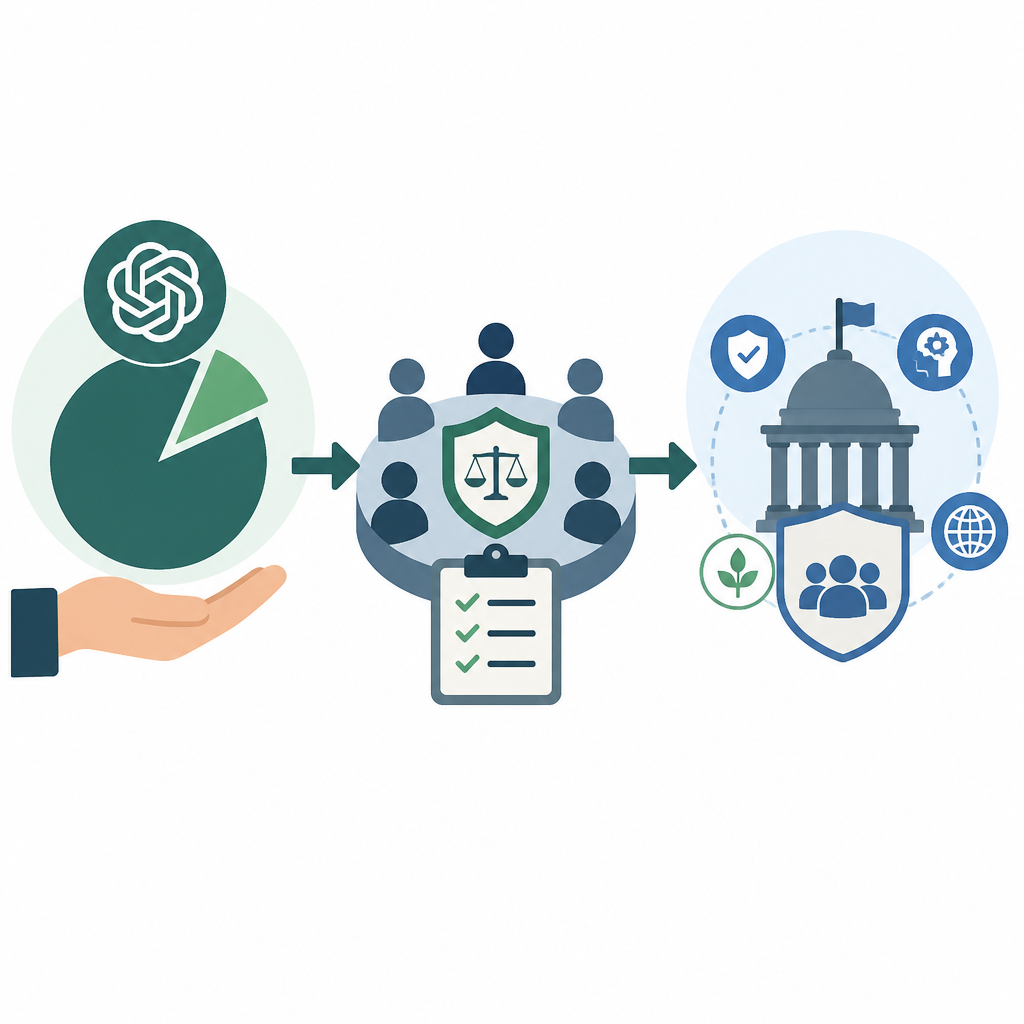
I’ve done this myself in product orgs. You publish the architecture note before the migration plan, then later the migration looks inevitable instead of optional. Same trick, different arena. Once the argument exists in writing, you can point back to it and say, “We’ve been consistent.” That consistency is powerful, even when everyone knows it was staged.
The quoted line from the April paper is the key one: “Returns from the Fund could be distributed directly to citizens, allowing more people to participate directly in the upside of AI-driven growth, regardless of their starting wealth or access to capital.” That is not just a policy suggestion. It is a narrative machine. It reframes AI profits as something that should be socially distributed, not just privately captured.
How to apply it: if you’re building a proposal that needs public legitimacy, don’t start with the transaction. Start with the principle. Then make sure the transaction can actually support the principle without collapsing under its own contradictions.
And yes, that means your internal docs matter. A lot. If your memo says one thing and your later proposal says another, people notice. Especially regulators. Especially journalists.
4. The public wealth fund idea is older than OpenAI’s version
“Sen. Bernie Sanders (I-VT) in June [proposed] a one-time 50% tax on AI company stock, with the collected shares being deposited into a public wealth fund.”
What this actually means is that OpenAI is not setting the terms alone. It’s responding to a broader political argument that AI gains shouldn’t just stay locked inside private cap tables. Bernie Sanders’ proposal is much harsher, which is exactly why it matters in the background. It shows how quickly the overton window can move once people start talking about AI as a source of concentrated wealth.
I think this is where a lot of builders get naive. They assume policy debates are abstract until they aren’t. Then they’re shocked when a senator proposes a tax, or a regulator drafts a rule, or a White House conversation turns into a formal ask. The OpenAI proposal looks moderate partly because the alternative is much more aggressive.
TechCrunch also notes that President Trump confirmed he had discussed “concepts where pieces could be given to the American public, where the American public essentially becomes a partner with the companies.” That’s not a minor aside. It tells you the idea has moved from theory to political vocabulary. Once a phrase gets repeated by the President, the idea stops being niche.
How to apply it: when you’re building a strategy around a controversial change, look at the most aggressive version of the proposal in the wild. Your “reasonable” version will be judged against it, whether you like that or not.
- Track the strongest public counterproposal, not just the one you prefer.
- Assume policymakers will compare your offer to harsher alternatives.
- Build your case around what prevents escalation.
5. Congressional approval changes everything
“It’s likely that any formal action would require congressional approval, which would significantly complicate the matter.”
What this actually means is that the proposal is still mostly theater until legislation exists. That’s not me being cynical. That’s just how equity, taxation, and public funds work in the real world. If Congress has to bless it, then the hard part isn’t the idea. It’s the coalition.
I’ve sat through enough “we can probably do this” meetings to know how dangerous that phrase is. You can get a room to nod at almost anything. You cannot get law to nod. Law wants definitions, jurisdiction, administrative ownership, and a way to survive lawsuits. If you don’t have those, you have a headline.
This is also where founders tend to overestimate their own influence. A company can shape the opening frame. It cannot just declare the end state. Once Congress gets involved, the proposal gets translated into committee language, lobbying pressure, and budget math. That’s a different game.
How to apply it: if your proposal depends on a legislative or board-level approval path, build a checklist for the actual gatekeepers. Don’t write for your allies. Write for the people who can say no.
That means asking boring questions early:
- Who has formal authority?
- What legal vehicle would hold the assets?
- Who audits the fund?
- How are returns distributed?
6. The real product here is legitimacy
“Returns from the Fund could be distributed directly to citizens.”
What this actually means is that OpenAI is trying to convert legitimacy into infrastructure. If citizens can point to a visible benefit, then the company’s growth story becomes easier to defend. That’s the core move. Not just “we’re profitable,” but “the public can see a path from our profits to their own lives.”
I think this is the part people underestimate. The AI conversation is full of technical arguments, but the public argument is much simpler: who gets paid, who gets protected, and who gets left holding the bag. If a company can answer those questions in a way that feels concrete, it buys room to operate. If it can’t, it gets treated like a monopolist with a nicer logo.
This is why the public wealth fund idea keeps resurfacing. It’s a legitimacy machine. It says the upside of AI can be socialized without fully nationalizing the companies. Whether that’s fair, practical, or politically survivable is another matter. But as a framing device, it’s strong.
How to apply it: if you’re trying to justify a controversial system, stop talking only about efficiency. Show the downstream benefit in a way a non-expert can understand. If the benefit is real, make it visible. If it isn’t visible, people will assume it doesn’t exist.
And no, “trust us” is not a visibility strategy.
The template you can copy
# Public wealth fund proposal template for an AI company

## 1) The problem we are addressing
State the political, economic, or social pressure clearly.

Example:
AI-driven profits are concentrating rapidly, and we need a public mechanism that shares upside without blocking innovation.

## 2) The offer
Define the exact asset, percentage, or cash flow being contributed.

Example:
We propose contributing 5% of company equity to a public wealth fund.

## 3) The purpose
Explain the public benefit in one sentence.

Example:
The fund will convert a portion of AI-driven gains into direct citizen benefit.

## 4) The governance model
Specify who controls the fund, how it is audited, and how decisions are made.

Example:
The fund will be governed by an independent board, audited annually, and subject to public reporting.

## 5) The distribution model
Explain how citizens receive value.

Example:
Returns may be distributed directly to citizens, invested in public goods, or split between both.

## 6) The legal path
Name the approvals required.

Example:
Any formal action would require board approval, regulatory review, and congressional authorization where applicable.

## 7) The fallback if the proposal is rejected
State what happens next.

Example:
If the fund is not approved, we will pursue an alternative public-benefit structure with similar distribution goals.

## 8) The one-line summary
Write the version you would say out loud.

Example:
We want to share a defined slice of AI upside with the public in a way that is auditable, lawful, and politically durable.
That’s the part I’d actually copy into a working doc. Not the press-friendly phrasing. The structure. The structure is what keeps a political idea from turning into mush.
If I were adapting this for a startup, I’d swap “equity” for “revenue share,” “citizens” for “customers” or “community members,” and “public wealth fund” for whatever governance vehicle makes sense. The point is not the exact labels. The point is to make the transfer mechanism explicit enough that nobody can pretend it’s magical later.
And if you’re doing this internally, use the template as a forcing function. If you can’t fill in the governance model, the proposal is not ready. If you can’t explain the legal path, it’s not real. If you can’t describe the fallback, you’re just writing a slogan.
Source attribution: This breakdown is based on TechCrunch’s July 2, 2026 article and its references to the Financial Times, CNBC, and OpenAI’s April policy paper, Industrial Policy for the Intelligence Age. The template and analysis here are my own synthesis, not quoted source material.
// Related Articles