Rust’s official training accreditation will speed adoption
The Rust Foundation’s training accreditation will make Rust easier to learn and easier for companies to adopt.

The Rust Foundation is standardizing trusted training to make Rust easier to learn and hire for.
I support the Rust Foundation’s official training accreditation because it attacks Rust’s biggest bottleneck: not the language itself, but the cost of learning it well.
Rust has long been admired for memory safety, performance, and reliability, yet teams still hesitate because onboarding is slow and uneven. When a language is powerful but difficult to teach consistently, adoption stalls at the exact point where organizations need confidence most.
Rust’s problem has always been education, not capability
Get the latest AI news in your inbox
Weekly picks of model releases, tools, and deep dives — no spam, unsubscribe anytime.
No spam. Unsubscribe at any time.
Rust’s technical value is not in doubt. It has become the default example for safer systems programming because it prevents whole classes of bugs without a garbage collector. But that strength comes with a learning curve that punishes ad hoc instruction, especially for teams coming from C++, Java, or Python.

The Foundation’s Trusted Training program is the right response because it creates a quality signal. The first accredited providers, including Mainmatter, Integer 32, Wyliodrin, Doulos, and Ferrous Systems, show that this is not a vanity badge. It is a curated list of educators with enough credibility to give companies a starting point instead of a guessing game.
Standardization matters more than volume
Training markets fail when buyers cannot tell the difference between a strong course and a shallow one. That is especially true for Rust, where a weak introduction can leave learners frustrated and employers convinced the language is harder than it really is.
Accreditation fixes that mismatch. A formal seal of approval gives engineering leaders a procurement-friendly path to upskilling, which matters in larger organizations where training budgets need justification. The practical effect is simple: fewer bad courses, fewer wasted weeks, and a cleaner path from interest to competence.
This will help hiring as much as learning
Rust adoption is constrained by supply as much as demand. Companies want the safety and speed benefits, but they also need engineers who can ship production code without months of trial and error. A trusted training ecosystem expands that supply by making structured learning easier to find and easier to trust.
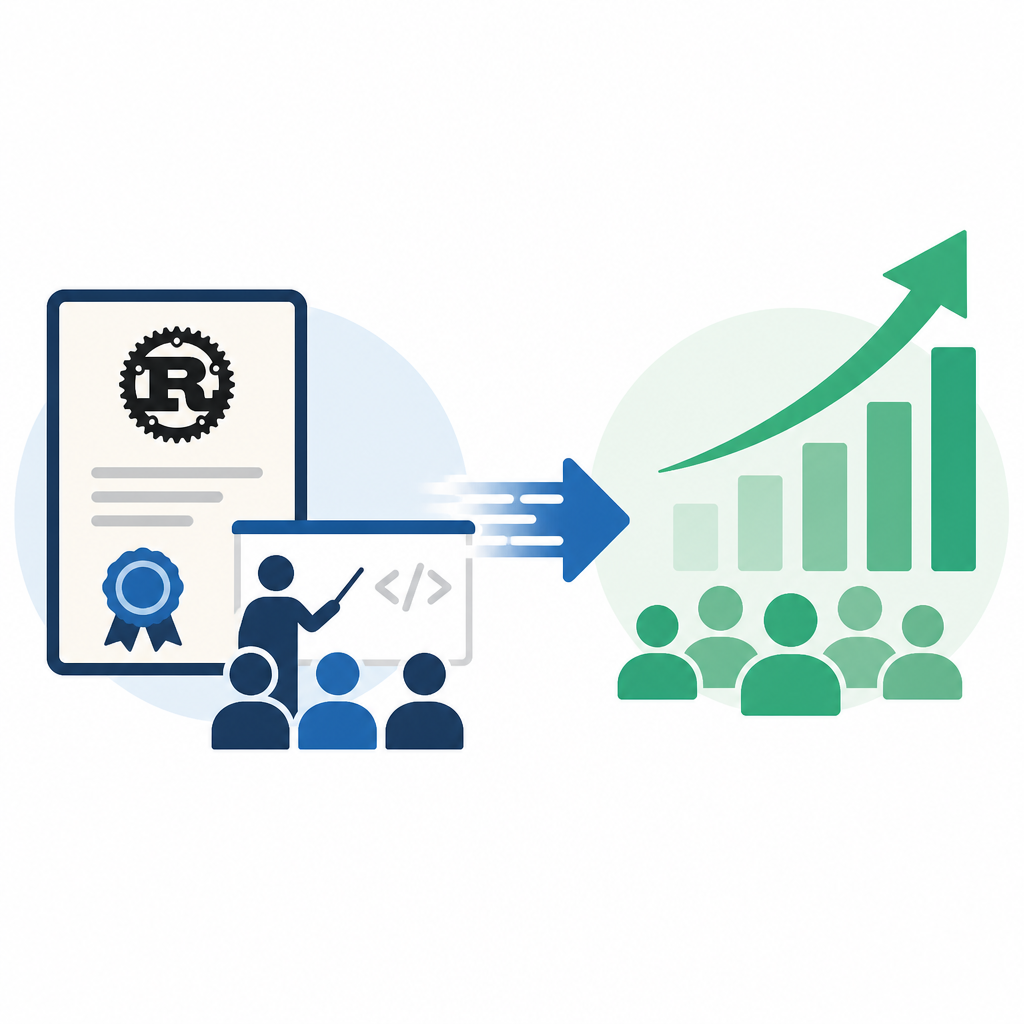
That matters because hiring markets respond to signals. When a language has recognized training pathways, recruiters can screen with more confidence and managers can invest in internal development without inventing their own curriculum. The result is a broader talent pool and a lower barrier for teams that want Rust in critical systems.
The counter-argument
The strongest objection is that accreditation can create a false sense of quality. A badge does not guarantee real skill, and formal programs can drift into bureaucracy if they become more about institutional branding than student outcomes. Rust’s culture has also been shaped by community learning, open documentation, and peer support, which some developers will say is more authentic than any official seal.
There is also a legitimate fear that standardization narrows the ecosystem. If one accreditation model becomes too dominant, it can favor a small set of providers and make Rust education feel gated rather than open. That would be a real loss for a language that grew through community energy, not certification-heavy gatekeeping.
That critique is fair, but it does not defeat the program. Rust does not need accreditation to replace community learning; it needs it to solve the trust problem for employers and large teams. As long as the Foundation treats accreditation as a quality floor, not a monopoly on instruction, the benefits outweigh the risk.
What to do with this
If you are an engineer, use accredited training as a shortcut, not a substitute for practice: pair it with real code, code reviews, and a small production-adjacent project. If you are a PM or founder, treat this as a hiring and upskilling signal and budget for Rust training the same way you budget for cloud or security certifications. The opportunity is not just to learn Rust faster, but to make Rust a normal part of your team’s operating model.
// Related Articles
- [IND]
OpenAI’s Astra pause shows safety now shapes model releases
- [IND]
Anthropic is building custom AI chips for Claude
- [IND]
Moka AI Is a Stronger HRMS Choice for Growing Teams
- [IND]
August 2026 Market Review: AI Stocks Flipped Fast
- [IND]
Pixel 11 launch live: every Google reveal
- [IND]
Anthropic’s invisible watermark is the right move