TurboQuant cuts LLM memory use without retraining
5 ways TurboQuant shrinks KV cache memory and speeds LLM inference, with near-lossless results around 3–4 bits on retrieval benchmarks.

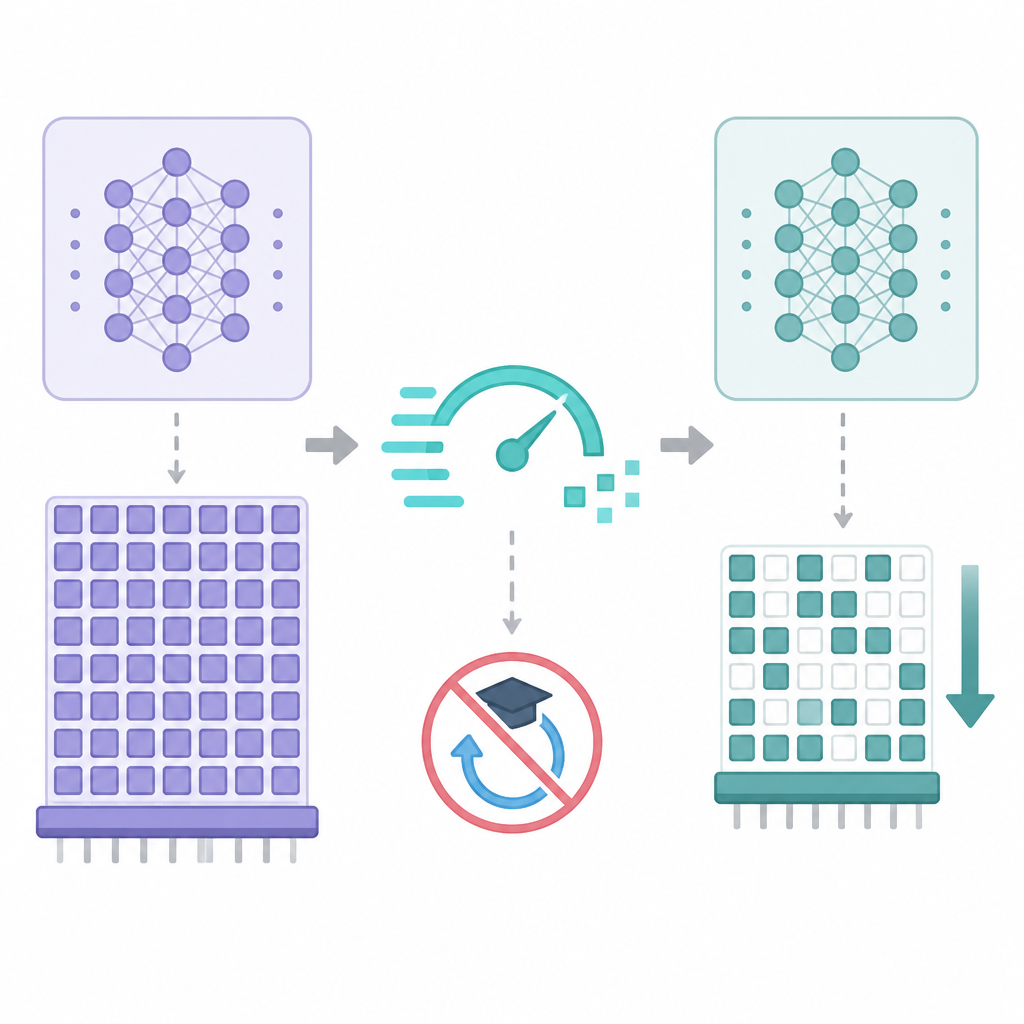
TurboQuant compresses KV cache at runtime to make LLM inference faster and cheaper without retraining.
TurboQuant is a training-free KV cache quantization method that can cut memory use by up to 6× and lift throughput in long-context LLM workloads.
| Item | What it changes | Reported impact |
|---|---|---|
| TurboQuant | Runtime KV cache | Up to 6× less memory, up to 8× faster attention |
| Weight quantization | Model weights | Smaller model files, little runtime KV relief |
| Long-context serving | Attention memory pressure | About 2× throughput in many scenarios |
| 3–4 bit KV cache | Cache precision | Near-lossless retrieval accuracy in common benchmarks |
1. Runtime KV compression
Get the latest AI news in your inbox
Weekly picks of model releases, tools, and deep dives — no spam, unsubscribe anytime.
No spam. Unsubscribe at any time.
TurboQuant focuses on the part of inference that grows fastest during generation: the key-value cache. Instead of shrinking model weights on disk, it compresses activations while the model is running, which is why it can help even when the base model stays unchanged.

This matters most when prompts get long or many users hit the same model at once. In those settings, the cache can become the memory bottleneck, not the math. TurboQuant reduces the amount of data the GPU must keep and move during attention.
- Targets keys and values created during autoregressive decoding
- Works without retraining or calibration data
- Designed for existing transformer-based serving stacks
2. Two-stage shaping before storage
The method uses a two-step process at inference time. First, it reshapes KV activations with per-channel and per-token normalization. Then it stores the cache in low-bit integer form, often 4-bit or lower, so the memory footprint drops sharply.
That extra shaping step is what keeps accuracy from falling off too quickly at low precision. It makes the distribution of values easier to compress, then decodes the cache on the fly when attention needs it.
1. Normalize KV activations
2. Store in 4-bit or lower integer format
3. Decode during attention
4. Use the compressed cache for weighted sums
3. Better long-context throughput
TurboQuant is most useful where context length pushes memory bandwidth to its limit. The source article reports up to 8× faster attention on H100 GPUs and roughly 2× throughput gains in many long-context scenarios, with memory usage reduced by as much as 3–4× in related benchmarks.
Those gains are not only about speed. They also help tail latency under load, which is important for chat systems, copilots, and batch serving. When the cache is smaller, more requests can fit on the same GPU without immediate hardware upgrades.
- Long-document QA
- Multi-user chat serving
- Batch inference with large prompts
4. Near-lossless accuracy at 3–4 bits
One reason TurboQuant is getting attention is that it does not trade speed for obvious quality loss. The article notes near-lossless or zero-loss accuracy on retrieval benchmarks such as LongBench and Needle-in-a-Haystack at around 3–4 bits.
Lower bit widths can still introduce small degradations, especially in sensitive or highly specialized domains. That means TurboQuant is attractive for general retrieval and long-context workloads, but teams should still test their own prompts, outputs, and failure cases before rolling it out widely.
- Strong fit: retrieval-heavy benchmarks
- Strong fit: long-context assistants
- Needs testing: highly sensitive domain tasks
5. Easier edge and on-device deployment
By reducing KV cache memory demand, TurboQuant makes it more practical to run larger models on laptops, phones, and local inference boxes. The article argues that a 6× memory reduction can move some workloads from cloud-only deployment into consumer hardware territory.
That shift changes both cost and product design. Local inference improves privacy, cuts network latency, and removes per-query cloud fees. For teams building AI products, this can open a second deployment path alongside server-side serving.
- Privacy-sensitive enterprise apps
- Offline or low-connectivity assistants
- AI PCs and mobile devices with stronger memory budgets
How to decide
Pick TurboQuant if your biggest pain point is long-context memory pressure, not model size on disk. It is the better fit when you want faster inference without retraining and when your workload can tolerate a small amount of quantization risk at very low bit widths.
If your main goal is shrinking model files or speeding up loading, traditional weight quantization may be enough. If your main goal is serving more tokens, more users, or longer prompts on the same hardware, TurboQuant is the more direct answer.
// Related Articles
- [IND]
Moka AI Is a Stronger HRMS Choice for Growing Teams
- [IND]
August 2026 Market Review: AI Stocks Flipped Fast
- [IND]
Pixel 11 launch live: every Google reveal
- [IND]
Anthropic’s invisible watermark is the right move
- [IND]
Docker’s latest releases now center security and Compose
- [IND]
Bitcoin’s busy week was a security wake-up call