Visa teams up with OpenAI on agent payments
Visa and OpenAI are building payment rails for AI agents, while Visa’s stablecoin pilots hit a $7 billion annualized run rate.

Visa and OpenAI are building payment rails for AI agents that can shop and pay.
Visa said it is working with OpenAI on a new payment setup for AI agents, and the company tied the announcement to its Visa Intelligent Commerce program. The timing matters because Visa also said its stablecoin settlement pilots are on track for a $7 billion annualized run rate, with activity spread across nine blockchain networks and more than 130 programs.
| Metric | Figure | What it means |
|---|---|---|
| Stablecoin settlement pilots | $7 billion annualized run rate | Visa is already testing real payment volume beyond cards |
| Blockchain networks | 9 | The pilots are not limited to one chain |
| Programs | 130+ | Visa is spreading the test across many use cases |
| Partner roster | OpenAI, Anthropic, Microsoft, Mistral AI, Perplexity, Stripe, Samsung | Visa is building for multiple AI platforms at once |
Visa is preparing for AI agents to shop on behalf of people
Get the latest AI news in your inbox
Weekly picks of model releases, tools, and deep dives — no spam, unsubscribe anytime.
No spam. Unsubscribe at any time.
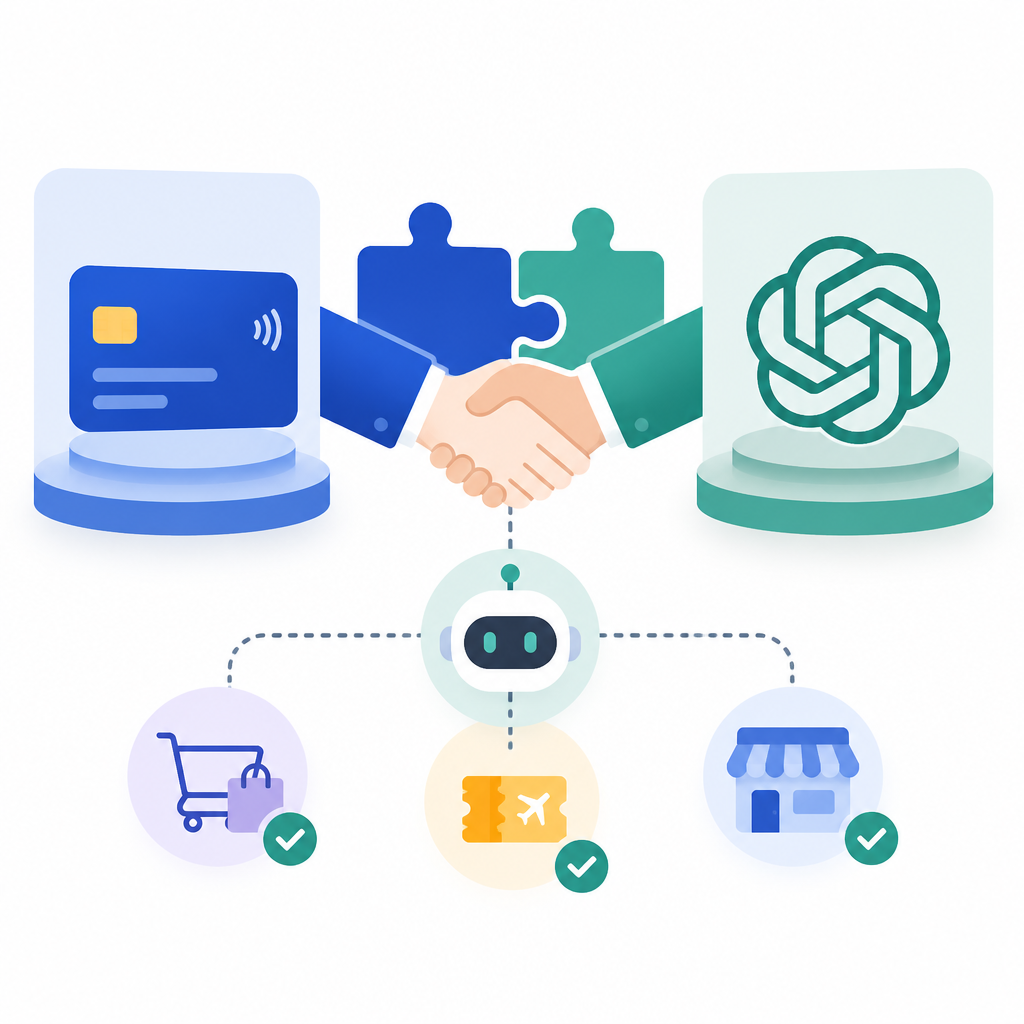
The core idea is simple: a consumer lets an AI agent find a product, decide to buy it, and complete the checkout. Visa wants the payment piece to happen inside its network, with tokenized credentials, authentication rules, and spending limits set by the human user.

That is a different model from the way most people buy online today. Instead of a person typing card details into a checkout page, the AI agent gets its own credential and uses it under strict controls. Visa says that setup is meant to close the gap between product research and actual payment.
The company framed the project as part of a broader push called “Find and Buy with AI.” Alongside OpenAI, the roster includes Anthropic, Microsoft, Mistral AI, Perplexity, Stripe, and Samsung.
- AI agents get tokenized payment credentials instead of raw card numbers
- Consumers set spending limits and authentication rules
- Visa says the same tokenization model already powers products like Apple Pay
- The system is meant to work across multiple AI platforms, not a single assistant
Visa is betting on infrastructure, not one AI winner
Visa’s strategy is interesting because it avoids picking sides in the current AI race. The company is building payment plumbing that can sit underneath OpenAI, Anthropic, and other assistants at the same time.
That matters for a network business. If a payment system works across competing AI products, merchants and platforms have less reason to build separate integrations for each assistant. Visa gets a shot at becoming the default payment layer for agent commerce, even if the AI apps themselves keep fighting for market share.
“We’re building the infrastructure to bridge that gap with security and control.”
The quote came from a Visa executive at the company’s Payments Forum in San Francisco, where the collaboration was announced. It captures the pitch well: consumer trust is the real bottleneck, not model quality or checkout speed.
There is also a strategic angle for OpenAI. A payments partnership gives the company a path beyond subscriptions and into commerce, where transaction volume can become its own business line. For Visa, the upside is even clearer: if AI agents become a real shopping channel, Visa wants to be the rail they use.
The stablecoin numbers are the part investors should watch
The OpenAI deal grabs attention, but Visa’s stablecoin work may be the more measurable signal. The company said those pilots are tracking toward a $7 billion annualized run rate, which is a meaningful number for a category that used to be treated as speculative infrastructure.
Visa said the pilots now span nine blockchain networks and more than 130 programs. That spread suggests the company is testing where stablecoins actually help, especially in transaction flows that are already heavy on cross-border settlement or treasury movement.
For comparison, the AI commerce announcement is still early and mostly architectural. The stablecoin program already has numbers attached to it, and those numbers point to real activity rather than a concept deck.
- AI agent commerce: early-stage partnership and product design
- Stablecoin pilots: $7 billion annualized run rate
- Network breadth: 9 blockchains versus a single AI integration
- Program count: 130+ pilots versus one headline collaboration
Visa shares have gained about 12% year to date, which suggests investors are already giving the company credit for expanding beyond the traditional card model. The market is also watching whether rivals like Mastercard and American Express move faster on similar AI payment deals.
What this means for the next phase of online checkout
If AI agents start making purchases at scale, the payments winners will be the companies that make trust easy without making checkout painful. Visa is trying to solve that problem before the first wave of agent shopping becomes normal.
The real test is whether consumers will let an assistant spend money with enough freedom to be useful, while still keeping the controls tight enough to feel safe. If Visa can make that tradeoff work across OpenAI, Anthropic, and Microsoft, it could turn AI commerce into another durable payment channel.
My read: the next 12 to 18 months will tell us whether this is a demo-friendly concept or a real transaction layer. Watch for merchant integrations, spending-limit controls, and any sign that AI assistants can complete purchases without breaking user trust.
// Related Articles
- [IND]
OpenAI’s Astra pause shows safety now shapes model releases
- [IND]
Anthropic is building custom AI chips for Claude
- [IND]
Moka AI Is a Stronger HRMS Choice for Growing Teams
- [IND]
August 2026 Market Review: AI Stocks Flipped Fast
- [IND]
Pixel 11 launch live: every Google reveal
- [IND]
Anthropic’s invisible watermark is the right move