Why small businesses should use AI for admin, not everything
Small businesses should use AI for administrative work, not core judgment or customer trust.

Small businesses should use AI for administrative work, not core judgment or customer trust.
Small businesses should use AI to clear administrative drag, not to replace the human judgment that makes them worth hiring.
That is the lesson from MIT Technology Review’s case study of London tutor Sam Finnegan-Dehn, who uses Notion AI as a second memory for notes, meeting summaries, invoicing, and goal-setting. He is not handing over lesson design or subject expertise. He is offloading the repetitive work that eats into evenings and weekends. That distinction matters because the real bottleneck for most small operators is not a lack of ideas. It is a lack of time.
AI is best at the boring work that steals hours
Get the latest AI news in your inbox
Weekly picks of model releases, tools, and deep dives — no spam, unsubscribe anytime.
No spam. Unsubscribe at any time.
For a solo operator, the promise of AI is not magic. It is capacity. Finnegan-Dehn has to plan lessons, find readings, send invoices, track student progress, and stay current in his field while also holding down a fundraising job. When Notion AI can summarize meetings, sync notes, and draft routine admin, it gives him back the hours that would otherwise disappear into clerical chores.

The same logic shows up in the article’s example of Grandma’s Quilt Shop, which uses a specialized AI tool to generate inventory descriptions and pricing. The owners say it cuts listing time by 60% to 80%. That is the kind of gain small businesses actually need: not abstract productivity theater, but a concrete reduction in the time spent on low-value tasks.
The right use of AI is to extend memory, not outsource expertise
Finnegan-Dehn says AI acts like a second memory across his notebooks, helping him connect ideas scattered across tabs and sessions. That is a strong use case because it supports recall and organization without deciding the substance of the work. He still chooses how to teach, what to emphasize, and when a student needs a different approach. The machine helps him see the record; the human makes the call.
That division is exactly why AI fits small businesses better when the work is informational rather than authoritative. A tutor, a shop owner, or a freelancer can let the model surface patterns, draft reminders, or organize goals. But the final judgment on quality, pricing, pedagogy, or client relationship has to stay with the person who bears the consequences. AI can assist a business owner’s mind. It cannot replace their responsibility.
The counter-argument
The strongest case against this view is that small businesses do not have spare margin for half-measures. If a tool costs $20 a month, requires setup, creates a new data ecosystem, and still produces clunky outputs, then the business owner may be better off doing the work manually or using a conventional service. The article is honest about that. It notes privacy concerns, AI mistakes, and Finnegan-Dehn’s own frustrations with the tool.
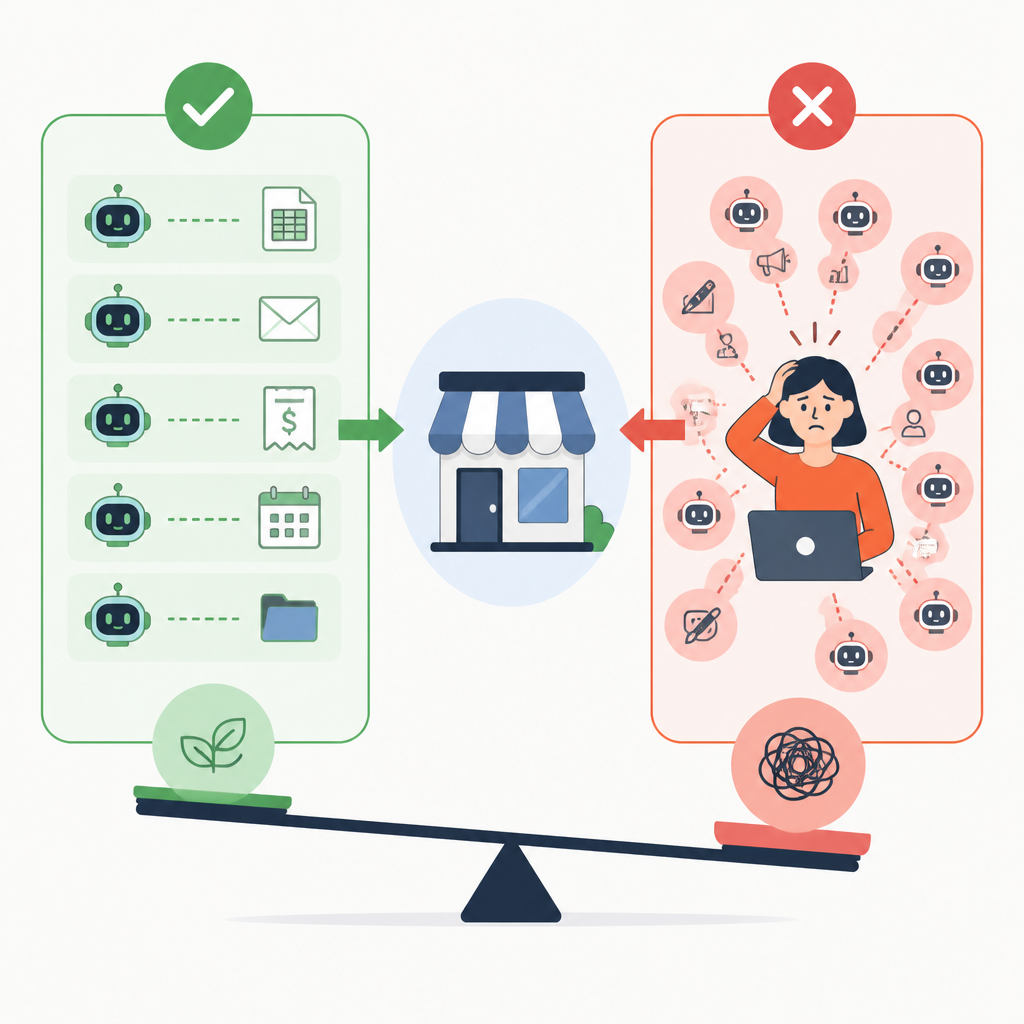
That objection is real, and it should stop anyone from treating AI as default infrastructure. But it does not defeat the argument for targeted adoption. It only sets the rule: use AI where the task is repetitive, reversible, and low-risk. Reject it where accuracy, privacy, or trust matter most. The question is not whether AI is perfect. It is whether it saves enough time on the right tasks to justify the cost and complexity.
What to do with this
If you run a small business, start by listing the jobs you hate, repeat often, and can verify quickly: note cleanup, meeting summaries, invoice drafts, basic research, and content organization. Test AI there first. Keep customer-facing decisions, financial approvals, and anything sensitive under human control. If your data is private, use local or self-hosted tools instead of sending it to a public chatbot. And if a plain old platform like Shopify, Square, or a spreadsheet does the job better, use that instead. AI is a leverage tool, not a religion.
// Related Articles
- [TOOLS]
Spark 4.2 turns AI search into SQL
- [TOOLS]
OpenAI's HF breach story turns into a security template
- [TOOLS]
SAP Design System adds AI and cross-platform UI kits
- [TOOLS]
ChatGPT Health turns general chat into a health layer
- [TOOLS]
Microsoft adds AMD chips to Azure AI and HPC
- [TOOLS]
Kimi K3 vs GLM-5.2: a one-endpoint test