World-action models are becoming robotics’ second bet
4 ways world-action models are changing robot policy design, from video priors to action prediction and hybrid control.

World-action models are emerging as a second route for robot policies, alongside VLM-based VLAs.
World-action models are no longer a side note in robot learning. This list breaks down four design choices that explain why the field is shifting, including a 1.2B-parameter Foundry-LLM checkpoint trained on 800B tokens.
| Item | Core idea | Why it matters |
|---|---|---|
| 1. Video-backbone WAMs | Pretrained video model as policy backbone | Strong prior for scene dynamics |
| 2. Inverse dynamics WAMs | Infer actions from state transitions | Useful when action labels are limited |
| 3. Joint prediction models | Predict future states and actions together | Tightens grounding between seeing and acting |
| 4. Hybrid VLA-WAM stacks | Mix language grounding with world prediction | Balances instruction following and dynamics |
1. Video-backbone WAMs
Get the latest AI news in your inbox
Weekly picks of model releases, tools, and deep dives — no spam, unsubscribe anytime.
No spam. Unsubscribe at any time.
The core WAM bet is simple: start with a pretrained video or world model, then adapt it for robot control. Instead of teaching a policy from scratch how scenes change, the model begins with a prior for motion, object persistence, and future frames. NVIDIA’s Cosmos family is one prominent example of this direction, and the blog also points to public efforts such as DreamZero, LingBot-VA, and Cortex 2.0.
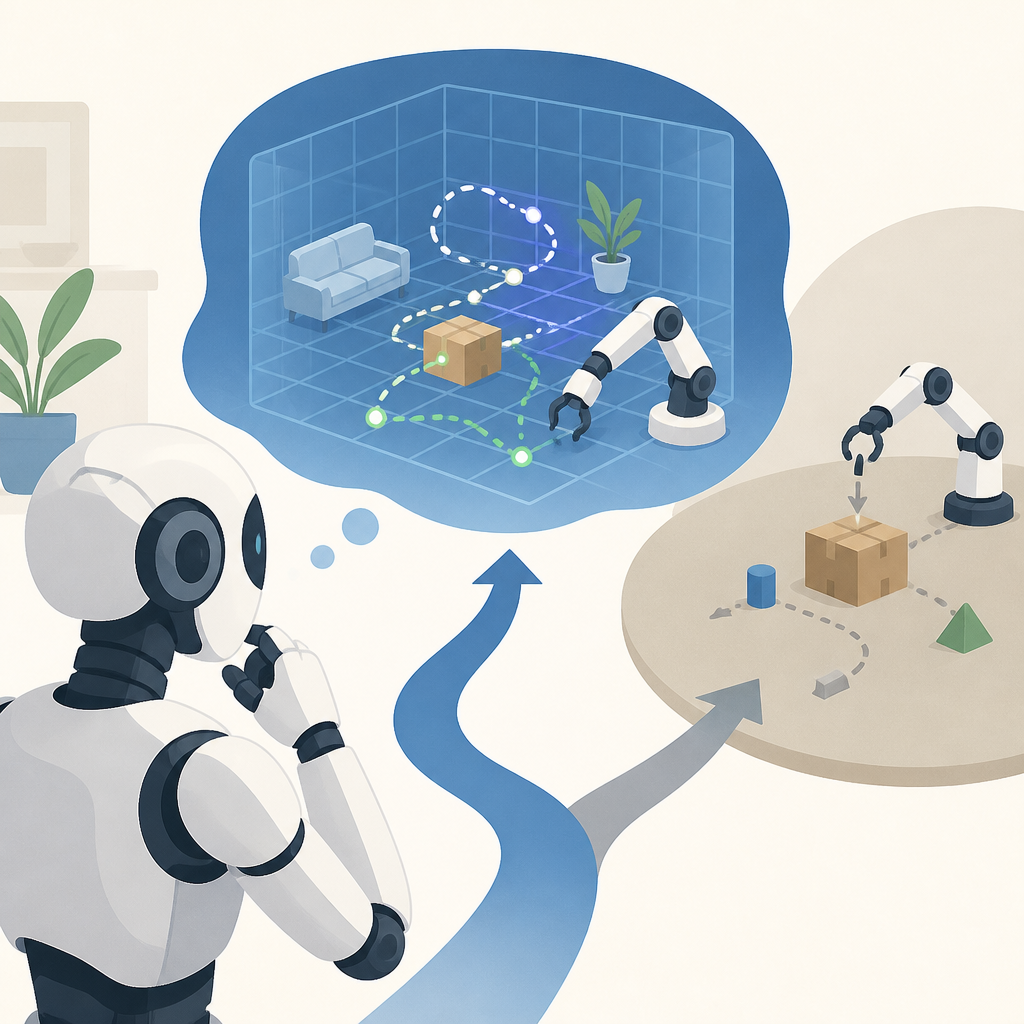
This matters because video pretraining may reduce the amount of robot data needed to learn behavior. The model is not only mapping text to action; it is learning how the world evolves under intent. That gives WAMs a different starting point from VLM-based VLAs, which often still need to learn the language-to-action bridge directly from robot demonstrations.
- Typical inputs: image, video, language, or latent state
- Typical outputs: future frames, latent features, or action chunks
- Common use case: manipulation tasks with visual change
2. Inverse dynamics WAMs
Inverse dynamics flips the learning problem. Rather than predicting what the world will look like after an action, the model looks at a current observation and a future observation, then infers the action sequence that likely caused the transition. In the post’s glossary, this is framed as recovering the most plausible action or action sequence from two states.
That formulation is attractive when action supervision is sparse or noisy. It gives the model a way to learn action structure from videos, not just from robot logs. In practice, this can be a bridge between passive internet video and active robot control, especially when paired with latent action spaces or discretized action tokens.
o_t + o_t+k -> a_t:t+k-1
3. Joint prediction models
Joint prediction tries to close the grounding gap by asking one policy to predict both future observations and actions from the same input. The post describes this as a single policy π(o_t, l_t) that outputs future states and robot commands together. The appeal is straightforward: if the model must explain what happens next and what to do next, its internal representation has to stay aligned with both perception and control.
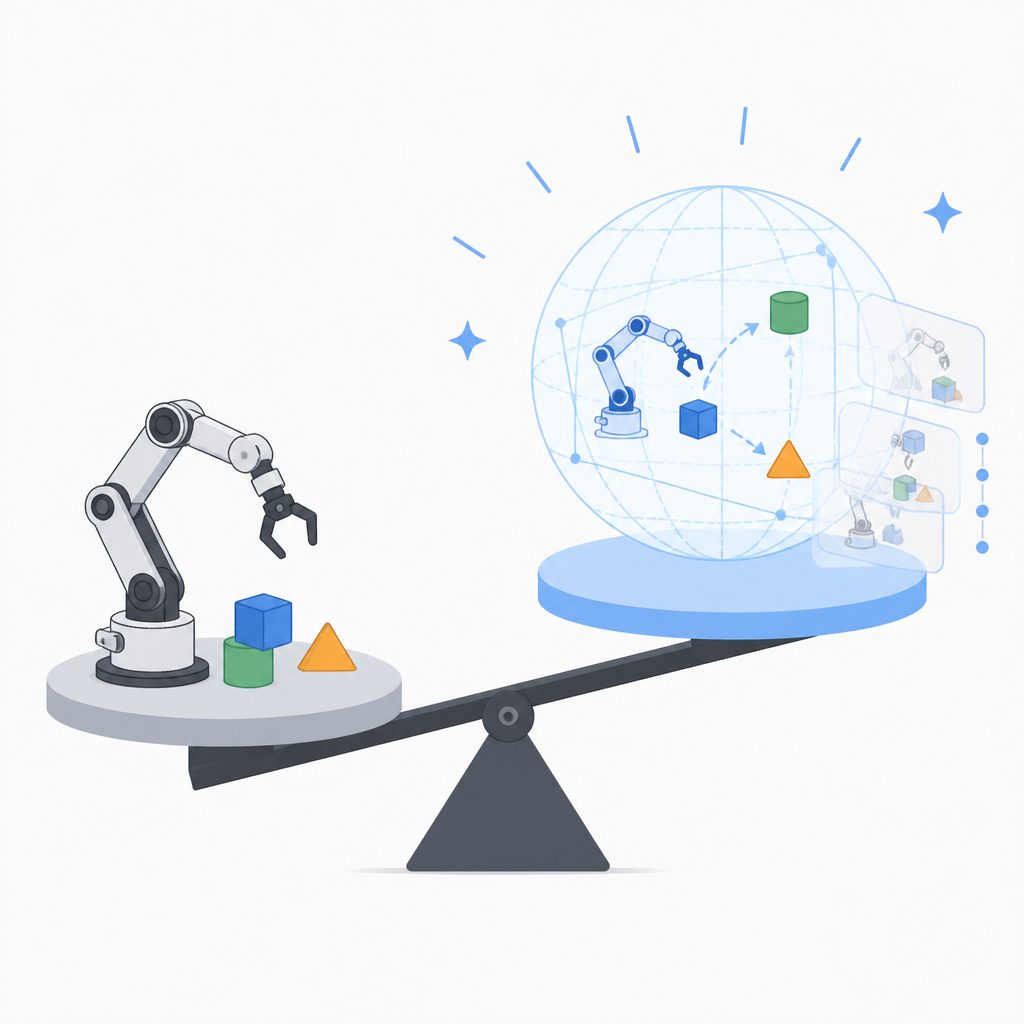
This approach is especially relevant for long-horizon tasks. A policy that only emits actions may drift, while a policy that also predicts future visual change gets a built-in consistency check. That makes joint prediction a strong candidate for tasks where planning, contact dynamics, and instruction following all matter at once.
- Can use action chunks instead of single-step control
- Works with latent predictions or explicit future frames
- Often pairs well with diffusion or transformer backbones
4. Hybrid VLA-WAM stacks
The article’s clearest conclusion is that the winner may not be a pure VLA or a pure WAM. A hybrid stack can use a language-heavy vision-language backbone for instruction understanding, then hand off to a world-model prior for scene evolution and action generation. That is likely to be attractive in robotics, where both semantic grounding and physical prediction matter.
Hybrids also fit the current state of the field. VLM-based VLAs still matter because they are strong at language alignment, while WAMs may be better at modeling dynamics. A combined system could keep the best of both: better instruction parsing, better anticipation of scene change, and better action generation under distribution shift.
- Best for teams that already have strong VLM and video infrastructure
- Useful when tasks require both instruction grounding and motion forecasting
- Likely path for generalist robot policies in production
5. Large-scale pretraining and data bets
One reason WAMs are accelerating now is that the pretraining stack is becoming more practical. The source highlights VLA Foundry’s Foundry-LLM checkpoint, which reports a 1.2B non-embedding-parameter model trained on 800B DCLM-Baseline-1.0 tokens. That kind of scale matters because it shows how much general-purpose pretraining is now available before robot adaptation begins.
For WAMs, the parallel lesson is that scale is no longer just about robot demonstrations. The field is pulling in video corpora, world-model objectives, and large foundation backbones from adjacent areas. The result is a stronger prior before fine-tuning, which may help explain why WAMs are moving from early research ideas into a mainstream recipe.
- Pretraining source can be text, video, or multimodal data
- Robot fine-tuning still matters for real-world control
- Data mix now shapes model behavior as much as architecture
How to decide
If you care most about instruction following and existing robot stacks, a VLM-based VLA is still the safer first bet. If you care most about scene dynamics, long-horizon prediction, or learning from video priors, a WAM is the more interesting route. If you are building for deployment, the hybrid option is the one to watch.
The practical takeaway from the NVIDIA post is not that one camp has won. It is that robot foundation models now have two serious starting points, and the best system may mix them. For teams choosing a roadmap today, the right answer depends on whether your bottleneck is language grounding, world prediction, or the gap between the two.
// Related Articles
- [IND]
OpenAI’s Astra pause shows safety now shapes model releases
- [IND]
Anthropic is building custom AI chips for Claude
- [IND]
Moka AI Is a Stronger HRMS Choice for Growing Teams
- [IND]
August 2026 Market Review: AI Stocks Flipped Fast
- [IND]
Pixel 11 launch live: every Google reveal
- [IND]
Anthropic’s invisible watermark is the right move