AI fraud is scaling faster than defenses
AI deepfakes are making fraud cheaper and faster, while blockchain tools may help banks and governments catch it.

AI deepfakes are making fraud cheaper and faster, while blockchain tools may help banks and governments catch it.
At the 2026 Reagan National Economic Forum in Simi Valley, Calif., fintech leaders described a finance system where AI and blockchain are pulling in opposite directions. On one side, criminals can fake voices, faces, and urgent requests in minutes; on the other, companies are building identity and ledger tools to spot the lie before money moves.
| Data point | What it shows |
|---|---|
| June 1, 2026 | Publication date of the Fortune piece |
| $25 million | Amount wired in a Hong Kong deepfake scam |
| $3 billion | Recent ETF outflows mentioned in the crypto market backdrop |
| 7,000 | U.S. stocks and ETFs Binance says it is offering |
| One week | How long before Zach Abrams got the fake CFO video call |
Fraud is getting cheaper to run
Get the latest AI news in your inbox
Weekly picks of model releases, tools, and deep dives — no spam, unsubscribe anytime.
No spam. Unsubscribe at any time.
The story Fortune’s Jeff John Roberts tells is simple: AI has lowered the cost of deception. Zach Abrams, cofounder of Bridge, said he got a video call from what looked and sounded like the CFO of Stripe. The fake executive pushed for an urgent transaction. Abrams was suspicious enough to ask for a follow-up by email, and that reply exposed the scam.

That kind of near miss matters because it shows how polished these attacks have become. A few years ago, phishing relied on sloppy grammar and obvious spoofing. Now attackers can clone a voice, match facial movement, and create enough pressure to make a finance leader act first and verify later.
The examples in the article point to a bigger problem than one-off social engineering hits. If criminals can automate this at scale, they can target payroll teams, vendors, school districts, county offices, and anyone else who still depends on email, phone calls, and human trust to move money.
- Deepfake scams can impersonate executives with voice and video.
- Public institutions often have weaker security processes than large fintech firms.
- AI lowers the cost of running fraud campaigns across many targets.
The same tools can also stop the damage
Fortune highlights a counterargument that matters: the technologies enabling fraud also help defend against it. Ribbit Capital partner Sigal Mandelker, who previously served as Under Secretary of the Treasury for Terrorism and Financial Intelligence, argued that blockchain ledgers are useful for tracking financial crime because they create a clearer record of transactions.
That point is more practical than ideological. A blockchain record does not magically make every transaction honest, but it can make suspicious flows easier to trace, especially when investigators need to connect wallets, exchanges, and counterparties across jurisdictions. In a world where AI can generate fake identities at scale, provenance becomes more valuable, not less.
“The solution to stopping the next era of fraud will not come from trying to halt the use of crypto and AI.” — Jeff John Roberts, Fortune
Roberts’ argument is that governments and legitimate businesses need to get better at using the same tools criminals are already adopting. That means better identity checks, better transaction monitoring, and better ways to prove that a person or organization is real before a payment clears.
There is also a policy angle here. If schools and local governments remain slow to adopt modern verification systems, they will keep being soft targets. If they modernize, they can make it much harder for a fake voice or fake face to trigger a wire transfer.
Crypto, AI, and the new fraud arms race
The article places this debate inside a broader finance story. Ramp CEO Eric Glyman talked about AI driving efficiency in corporate expense management. Kraken CEO Arjun Sethi and Bridge’s Abrams talked about stablecoins extending dollar usage globally. That is the upside case for these tools: faster payments, lower overhead, and wider access.
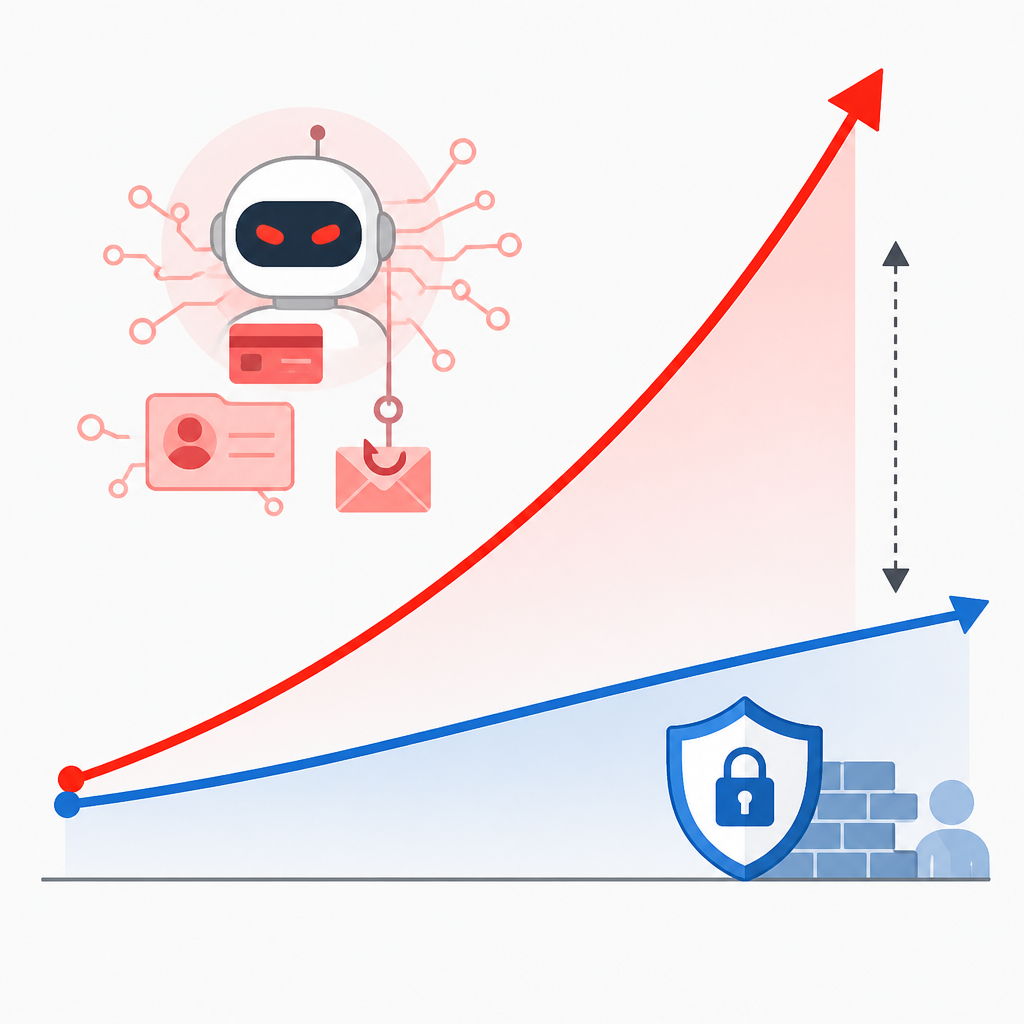
But the downside is now impossible to ignore. Criminals do not need perfect systems; they only need one person to believe a fake request for long enough to move money. The Hong Kong case, where a worker wired $25 million after a deepfake video meeting, shows how expensive that mistake can be.
- Kraken is pushing stablecoins as part of dollar-denominated crypto payments.
- Ramp is using AI to cut corporate finance friction.
- Coinbase and other firms are building identity and payments rails that can support verification.
- Binance said it offers 7,000 U.S. stocks and ETFs and plans tokenization on BNB Chain.
Those numbers matter because they show how quickly finance is becoming software-defined. The more transactions move through digital rails, the more room there is for both machine-speed fraud and machine-speed detection.
What companies should do next
The most useful takeaway from Fortune’s piece is not that AI fraud is coming someday. It is already here, and the gap between attackers and defenders is mostly about process. Companies need stronger out-of-band verification, tighter payment approvals, and identity systems that do more than trust a video call or caller ID.
For crypto firms, banks, and public agencies, the next step is obvious: treat identity as infrastructure, not an afterthought. If a CFO can be imitated in a video call, then voice and face alone are no longer proof of anything.
The real test over the next year is whether finance teams update their controls before attackers standardize these tricks. If they do not, the next headline may look less like a clever scam and more like a routine operating cost of doing business.
// Related Articles
- [IND]
Anthropic's IPO rumor turns into a market watch
- [IND]
Anthropic should not become dependent on Meta for compute
- [IND]
Mistral's robotics model cuts indoor navigation costs
- [IND]
Mistral missile: France’s short-range air defense workhorse
- [IND]
Apple Reclaims No. 1 by Market Cap as AI Costs Spike
- [IND]
Kimi K3 could pressure the middle tier of AI models