Apple’s Gemini deal turns cloud AI into local AI
Apple is using Google Gemini distillation and Nvidia confidential compute to push Siri toward local-first AI with cloud backup.
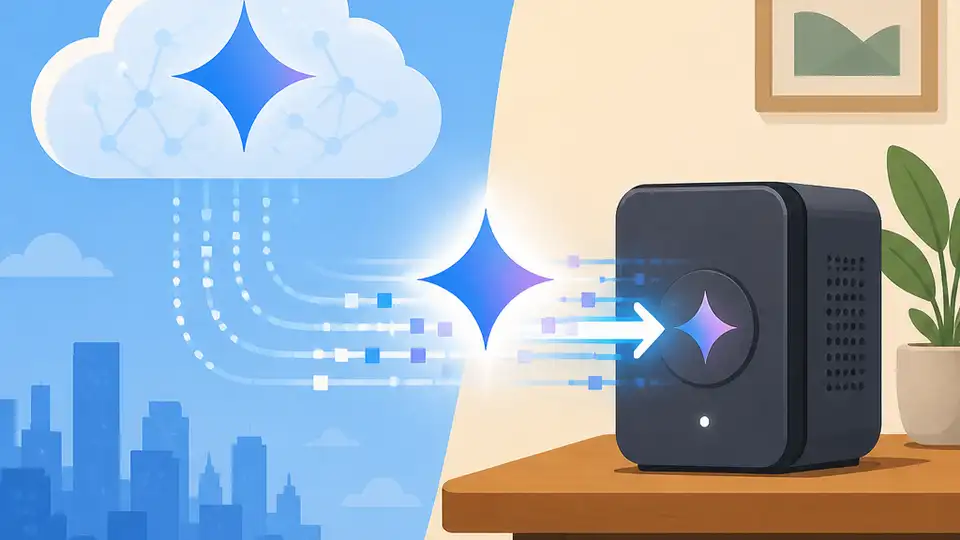
Apple is shrinking Gemini for local AI and using Nvidia-protected cloud backup.
I've been following Apple Intelligence long enough to know when the story starts sounding tidy and when the plumbing underneath is a mess. The marketing version is always neat: on-device privacy, personal context, smarter Siri, all that. But when I actually look at how these systems ship, it usually turns into a pile of compromises. Some requests run locally, some get punted to the cloud, some are delayed because the model is too big, and some are wrapped in privacy language so carefully that you can tell somebody in legal was sweating.
This 9to5Mac report made that tension obvious again. Apple wants to keep saying “on-device first,” but it’s apparently using Google’s Gemini model to distill a smaller model for local execution, while also leaning on Google Cloud and Nvidia’s confidential compute for the stuff that still needs serious horsepower. That’s not a clean architecture story. It’s a practical one. And honestly, that’s the interesting part.
I’ve seen enough AI product plans to know the real question is never “can it run?” It’s “where does it run, who controls the weights, and what privacy story can you still defend after the launch demo is over?”
Apple’s own public line on Apple Intelligence is here: Apple Intelligence. The report I’m breaking down is 9to5Mac’s write-up of Aaron Tilley’s reporting in The Information. The useful detail here isn’t a feature list. It’s the implementation pattern: distill a large external model, keep the local story alive, and use cloud infrastructure only where the device can’t carry the load.
Apple is not shipping one AI path, it’s shipping three
Get the latest AI news in your inbox
Weekly picks of model releases, tools, and deep dives — no spam, unsubscribe anytime.
No spam. Unsubscribe at any time.
“Apple is using a version of Google’s large Gemini model to train a smaller version of the model that can run locally on Apple devices, a process known as distillation.”
What this actually means is Apple is splitting the problem into layers. One layer is local inference on the device. Another is cloud inference for requests that are too heavy. A third is the model-training pipeline that turns a giant external model into something Apple can actually run on iPhone, iPad, or Mac hardware.
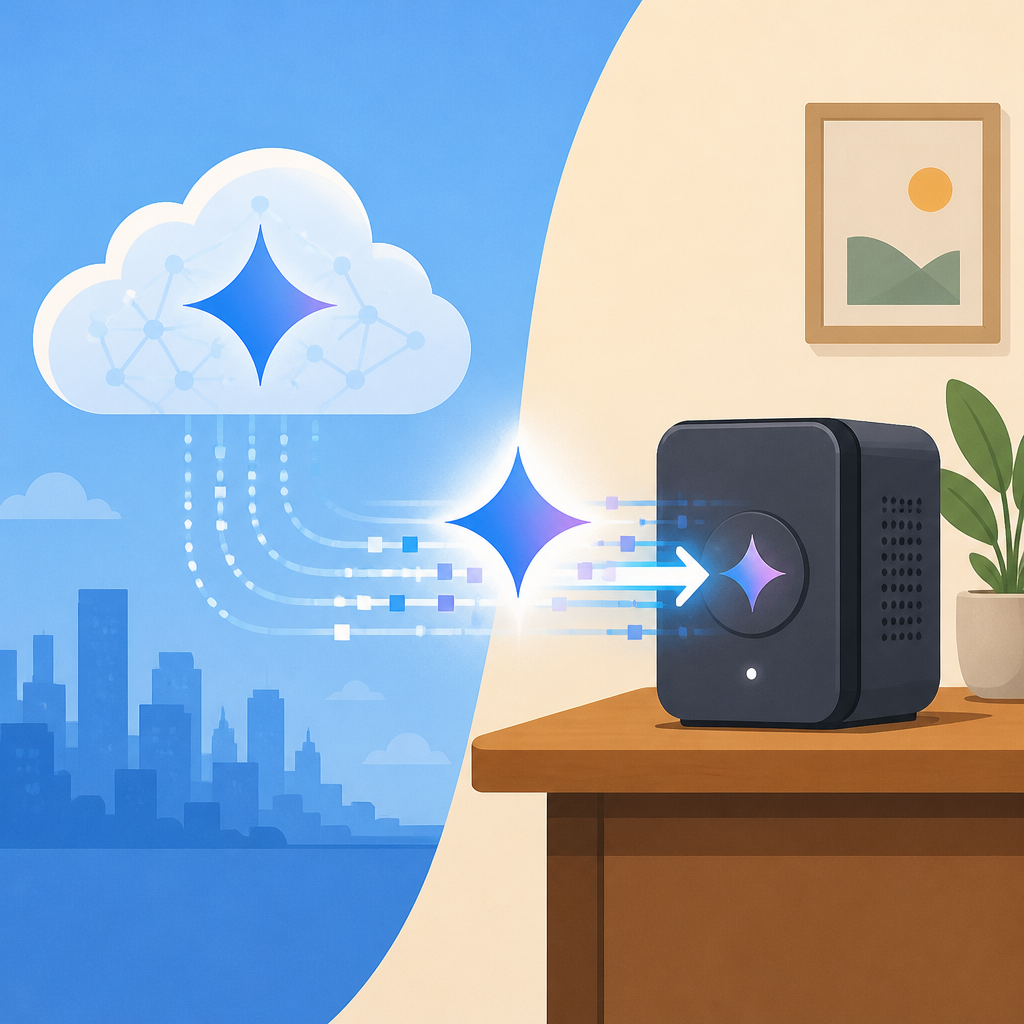
This is the part people miss when they talk about “Apple partnering with Google.” That phrase makes it sound like a simple API deal. It’s not. It’s a model transfer strategy. Apple is apparently treating Gemini as a teacher, not just a remote brain. That matters because it lets Apple preserve the on-device narrative while borrowing capability from a model it didn’t build from scratch.
I’ve built enough systems to know why this happens. If you want fast response times, lower per-request cost, and a privacy story you can defend in a keynote, local execution is the obvious goal. But if the model is too large, too expensive, or too slow, you need a smaller student model. Distillation is the compromise that keeps the product moving.
How to apply it: if you’re designing an AI feature, stop asking whether it’s “local or cloud.” Ask which tasks can be distilled into a small model, which tasks need a larger hosted model, and which tasks should never exist in the product at all. That’s the real architecture decision.
- Use local inference for short, repetitive, latency-sensitive tasks.
- Use cloud inference for broad reasoning, heavy context, or long outputs.
- Use distillation when you need the cloud model’s behavior without the full runtime cost.
There’s also a product angle here that Apple has been very careful about. If the local model is smaller and less capable, Apple can still claim it’s the primary path for common actions. Then the cloud steps in quietly when the request gets weird. That’s much easier to sell than admitting the assistant is cloud-first and only “privacy-aware” when convenient.
For developers, the lesson is boring but useful: your AI feature should probably be a routing system, not a single model endpoint. The more honest you are about that up front, the less embarrassing your roadmap becomes later.
Distillation is Apple’s way of buying time without admitting it
Distillation sounds elegant in slide decks. In practice, it usually means the original model is too big for the target device, so somebody has to squeeze behavior out of it until the smaller model is good enough. That squeezing can be expensive, slow, and annoyingly iterative.
Apple reportedly wants smaller companies that know how to shrink models for local devices, and the report names Liquid AI as one company Apple has considered acquiring. That tells me Apple knows model shrinking is not some side quest. It’s the core problem. If you want Siri to feel modern on-device, you need people who are obsessed with compression, quantization, and mobile inference tradeoffs.
I ran into this exact kind of pain when trying to move a capable model from server GPUs onto consumer hardware. The server version looked great. The device version fell apart under latency and memory pressure. The team kept trying to preserve too much of the original behavior, and the result was a bloated local model that was still not good enough. We only got anywhere once we stopped treating the local model like a mini server model and started treating it like a different product with different constraints.
That’s probably where Apple is right now. It doesn’t need a perfect local clone of Gemini. It needs a useful local assistant that feels native, fast, and private enough to keep the promise intact.
How to apply it: if you’re building your own AI stack, define the smallest useful version of the task. Then distill only that. Don’t try to preserve every capability from the large model. You’ll end up with a heavier local system that still isn’t trustworthy.
- Start with one narrow user job, not a general assistant.
- Measure latency and memory before you measure “quality.”
- Accept that the local model may need a different UX than the cloud model.
Apple’s advantage is that it can hide a lot of this complexity behind product language. Yours probably can’t. So if you’re working on a smaller product, be more explicit about what the local model is for and what it is not for. Users can handle boundaries. They hate surprises.
The cloud is still doing the ugly work
The report says many AI queries will still need cloud support because the full Gemini model has “trillions of parameters” and is too heavy for Apple’s own Private Cloud Compute infrastructure. That line matters because it punctures the fantasy that Apple can keep everything inside its own walls just by wanting it hard enough.
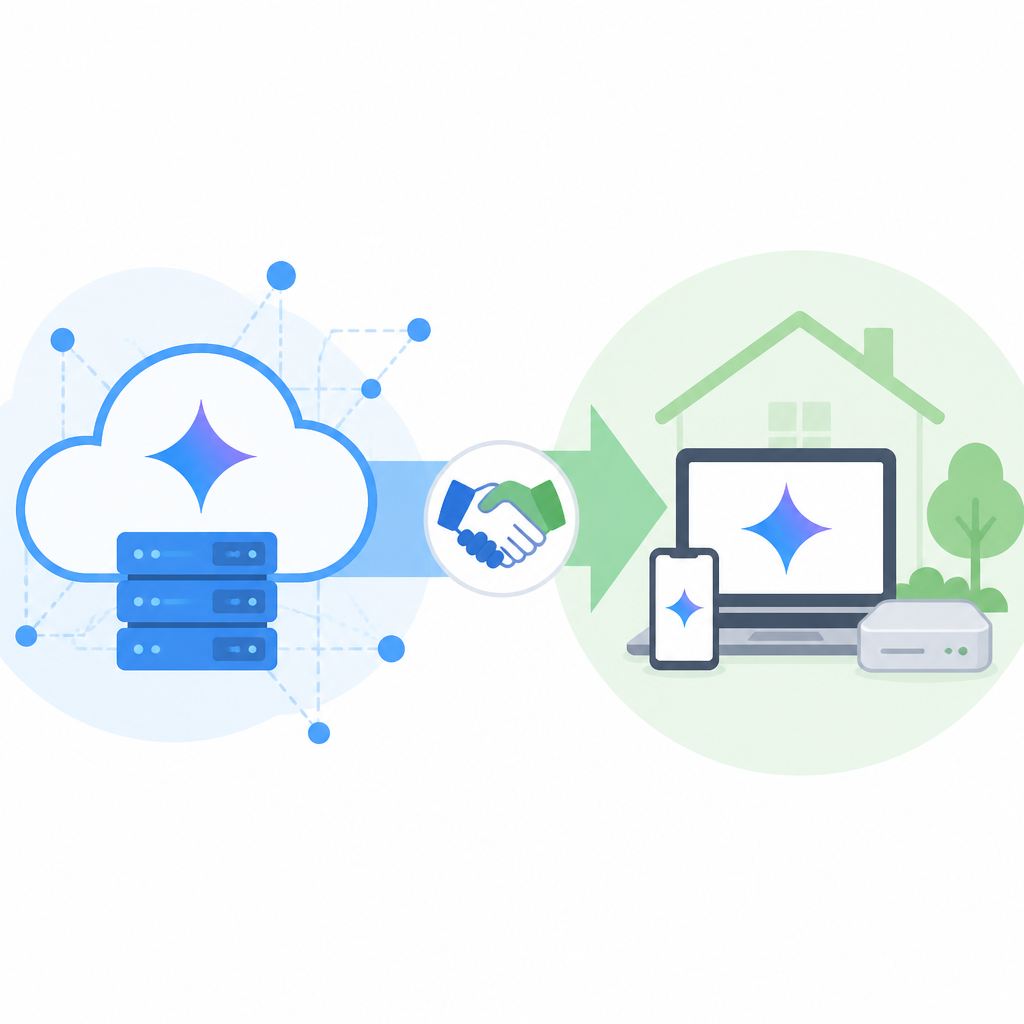
What this actually means is Apple still needs external compute for the hard stuff. The device can handle a smaller local model, but the bigger reasoning jobs, longer contexts, and more expensive requests still need somewhere else to go. In this case, that somewhere else is reportedly Google Cloud.
That’s not a betrayal of the on-device story. It’s the reality behind it. If your product promise is “private and fast,” you usually end up with a split architecture where the easy stuff stays local and the hard stuff gets routed elsewhere under strict guardrails.
The interesting part is that Apple is still expected to use the Private Cloud Compute branding. That’s a branding decision, sure, but it also tells me Apple wants users to think in terms of trust boundaries, not infrastructure vendors. If the cloud hop happens through a privacy-preserving layer, Apple can keep the narrative focused on security rather than dependency.
I’ve worked on systems where the cloud dependency was hidden so aggressively that nobody could explain failure modes later. That never ends well. Apple seems to be doing the opposite here: keep the cloud, but wrap it in privacy language and security tech so the product story still holds together.
How to apply it: if your AI feature uses cloud fallback, document the fallback plainly. What triggers it? What data is sent? How long is it retained? If you can’t answer those questions, you’re not done designing the system.
Also, don’t pretend the cloud path is a temporary hack unless you actually plan to remove it. In most real products, the cloud path becomes permanent. The honest move is to design for that from day one.
Nvidia confidential compute is the privacy patch Apple needed
The report says Apple recently approved Nvidia’s confidential compute technology for use with Google Cloud, which suggests Nvidia AI chips will handle at least some of Apple’s cloud-side processing. That’s a very specific detail, and it’s the kind of thing that tells you where the engineering pressure really is.
Confidential compute is basically a way to encrypt data and models while they’re being processed. The point is not to make the cloud disappear. The point is to make the cloud less scary. If Apple is going to send some Siri requests to Google Cloud, it needs a story that says the data is protected even while it’s moving through infrastructure it doesn’t own.
I’ve always liked confidential compute in theory because it acknowledges the obvious: once you leave the device, trust gets harder. You can’t just wave that away with a privacy slogan. You need technical controls. This is one of them.
How to apply it: if you’re sending sensitive workloads to a third-party cloud, ask whether your threat model includes the provider’s operators, the hypervisor, and the hardware layer. If it does, then confidential compute or a similar isolation mechanism is not optional. It’s part of the baseline.
There’s a tradeoff, of course. The report says confidential compute can slow processing a bit. That’s the price of the security envelope. Apple seems willing to pay it because the alternative is worse: a cloud-assisted Siri that looks fast but undermines the privacy story the company keeps repeating.
- Use confidential compute when the cloud must touch sensitive prompts or model weights.
- Accept some latency overhead if it preserves trust.
- Test the failure modes, not just the happy path.
The important thing here is that Apple is not choosing between “privacy” and “cloud.” It’s choosing between “cloud with controls” and “cloud with wishful thinking.” One of those is shippable. The other is a lawsuit waiting to happen.
Private Cloud Compute is becoming a label, not a location
The report says Apple is expected to keep using the Private Cloud Compute branding even though the next wave of Apple Intelligence features won’t run exclusively on Apple’s own servers. That’s a subtle but important shift.
What this actually means is the brand is moving from describing physical ownership to describing a privacy posture. Apple doesn’t seem to want users thinking, “Does this request run on Apple hardware or Google hardware?” It wants them thinking, “Is this request handled under Apple’s privacy rules?”
I get why Apple would do that. Most users do not care about vendor topology. They care about whether their data feels exposed. But from a developer perspective, this is where you have to be careful. Labels can hide architecture drift. If a term like Private Cloud Compute starts covering multiple backends, the implementation has to be consistent enough that the label still means something.
I’ve seen teams keep a strong product name long after the internals changed, and that usually creates confusion during incident response. Someone asks where the data went, and the answer becomes a maze of providers, regions, and policy exceptions. That’s exactly the kind of mess Apple needs to avoid if it wants the privacy brand to survive contact with real AI workloads.
How to apply it: if you have a privacy-forward feature name, write down what it guarantees technically. Not marketing-wise. Technically. Then make sure every backend path still satisfies that contract.
For example, if a feature says “private processing,” define whether that means:
- no human review,
- no long-term storage,
- encrypted in transit and at rest,
- isolated compute,
- or all of the above.
Apple can afford to keep the label and absorb the engineering complexity. Most teams can’t. So if you borrow the branding pattern, borrow the discipline too.
What this says about Siri, finally
This report doesn’t really tell us what Siri will say. It tells us how Apple is trying to make Siri viable without giving up the company’s privacy positioning. That’s a much more interesting story.
Apple appears to be accepting a simple truth: a useful assistant needs more than one model, more than one compute tier, and more than one vendor. The old dream of one giant model doing everything was always a bit naive for consumer hardware anyway. Apple is now building the less glamorous version that actually has a chance of shipping.
I think that’s the real takeaway for developers. The winning pattern here is not “put AI on the device” or “put AI in the cloud.” It’s “route the request to the cheapest place that can still satisfy the privacy and quality bar.” That’s not sexy. It’s just how products survive.
How to apply it: if you’re planning an AI assistant, draw the request flow before you write prompts. Mark the local path, the cloud path, the fallback path, and the privacy controls on each hop. If you can’t draw it clearly, you don’t understand the system well enough to ship it.
And if you’re wondering whether Apple’s approach is clean, no, it’s not. But clean is overrated. Working is better.
The template you can copy
# AI feature architecture template: local-first with cloud fallback

## Goal
Ship an AI feature that feels fast and private on-device, while using cloud compute only when the local model cannot handle the request.

## Model strategy
- Local model: distilled from a larger teacher model
- Cloud model: full-capability model for heavy requests
- Training method: distillation from teacher to student

## Routing rules
1. Keep short, repetitive, latency-sensitive tasks on-device.
2. Send complex reasoning, long-context, or high-cost requests to the cloud.
3. Use the local model by default, then escalate only when needed.

## Privacy controls
- Encrypt data in transit
- Use isolated or confidential compute for cloud processing
- Avoid long-term retention unless explicitly required
- Document exactly what data leaves the device

## Product language
- Use a privacy-forward label only if every backend path satisfies the same contract
- Define what “private” means in technical terms
- Do not let branding outrun infrastructure

## Engineering checklist
- [ ] Measure local latency on target devices
- [ ] Measure memory footprint of the distilled model
- [ ] Test cloud fallback triggers
- [ ] Verify confidential compute or equivalent isolation
- [ ] Write a failure-mode doc for local and cloud paths
- [ ] Confirm the UX explains when and why escalation happens

## Example request flow
1. User sends a prompt
2. Local model handles it if confidence is high
3. If confidence is low or context is too large, route to cloud
4. Cloud processing runs under privacy controls
5. Response returns to the device
6. Log only the minimum needed for debugging

## Distillation prompt for internal use
You are training a smaller on-device assistant from a larger teacher model.
Prioritize:
- fast response time
- low memory use
- predictable behavior
- privacy-preserving task completion

Deprioritize:
- verbose output
- broad generality
- expensive reasoning paths
- anything that requires always-on cloud access

## Decision rule
If a task can be done locally with acceptable quality, keep it local.
If it cannot, send it to the cloud with explicit privacy controls.
If neither path is acceptable, do not ship the feature yet.
The original reporting comes from 9to5Mac at this URL, with the implementation details attributed to Aaron Tilley’s reporting in The Information. My breakdown is original commentary built from that source, not a transcript or rewrite.
// Related Articles
- [IND]
Anthropic's IPO rumor turns into a market watch
- [IND]
Anthropic should not become dependent on Meta for compute
- [IND]
Mistral's robotics model cuts indoor navigation costs
- [IND]
Mistral missile: France’s short-range air defense workhorse
- [IND]
Apple Reclaims No. 1 by Market Cap as AI Costs Spike
- [IND]
Kimi K3 could pressure the middle tier of AI models