CSUB’s OpenAI deal turns AI into coursework
CSUB’s OpenAI partnership shows how to turn AI anxiety into three practical classes and a copyable campus-to-community program.
CSUB’s OpenAI partnership shows how to turn AI anxiety into three practical classes and a copyable campus-to-community program.
I’ve been watching universities fumble AI for a while now. Half the time, the message is “don’t worry, we’re exploring it,” which is code for nobody knows what to teach. The other half is a shiny lab announcement with no student workflow behind it. So when I read about California State University Bakersfield teaming up with OpenAI, I was skeptical in the exact way you should be skeptical of any campus AI rollout. But this one actually has shape: three courses, direct input from OpenAI engineers, and a path from classroom work into local nonprofit use. That’s not just “AI awareness.” That’s a curriculum with a destination.
The trigger was a KGET report by Connor Dore at KGET 17 News, published May 29, 2026. The article says CSUB and OpenAI are launching what the university is calling a first-in-the-nation partnership program, with three classes starting in the fall. I’m not going to pretend the article gives us a fully documented syllabus or implementation guide, because it doesn’t. But it does give us enough to dissect the structure, and that’s the useful part.
Stop treating AI like a campus emergency
Get the latest AI news in your inbox
Weekly picks of model releases, tools, and deep dives — no spam, unsubscribe anytime.
No spam. Unsubscribe at any time.
“The SPARKS program at CSUB is a collaboration between OpenAI and our campus in order to help our students better understand the power and the reach of artificial intelligence.”
What this actually means is CSUB is trying to move AI out of the fear bucket and into normal coursework. That matters because fear is a terrible curriculum designer. If students only hear “AI will replace jobs” or “AI is cheating,” they never get to the boring but important part: what the tools are good at, where they fail, and how to use them without making a mess.
President Vernon Harper frames the program around uncertainty in the job market, and that’s the right lens. Students do not need another campus slogan. They need a way to test AI in a controlled environment, with faculty, with real assignments, and with some accountability. I’ve seen too many schools toss a chatbot into a learning management system and call it innovation. That’s not education. That’s a demo with a budget code.
How to apply it: if you’re building an internal training program, start by naming the anxiety out loud. Don’t hide behind “digital transformation” nonsense. Say what people are worried about, then build a small set of courses or workshops that answer those worries with practice. If you want a reference point, look at OpenAI for the company side and CSU Bakersfield for the campus side, but keep your own program grounded in the actual work your students or employees do.
Three classes is better than one giant AI lecture
The article says the program includes three classes starting this fall: one in geological science focused on mapping groundwater contamination, one analyzing campaign finance reporting in politics, and one creating a community stakeholder AI lab on business. That spread is smart. It avoids the usual trap where AI gets taught as a single abstract concept instead of a tool that behaves differently in different domains.
What this actually means is the university is not asking every student to become an AI engineer. It’s asking them to see how AI changes specific workflows. Groundwater contamination mapping is a data problem. Campaign finance analysis is a pattern-recognition and reporting problem. A community stakeholder lab in business is a collaboration problem. Those are different muscles.
I like this because it mirrors how AI works in real life. The tool is never the point by itself. The point is whether it helps a geoscience student clean up messy field data, helps a politics student surface disclosure patterns faster, or helps business students prototype something a local organization can use. If you teach AI as one giant blob, students memorize buzzwords. If you teach it through actual tasks, they learn judgment.
- Pick one department problem, not one campus-wide slogan.
- Use one assignment where AI helps and one where it clearly should not.
- Require students to explain the output, not just submit it.
How to apply it: if you run a team or department, don’t launch “AI training” as a single webinar. Break it into use cases. For example, one session for research summarization, one for data cleanup, one for drafting or review, one for risk and policy. The more specific the use case, the less likely people are to either worship the tool or panic about it.
Bring the engineers into the room, but don’t let them own the whole class
Harper said students will learn directly from OpenAI engineers about prompts and how to build large language models. That part is useful, but I’d be careful here. Engineers are great at explaining how the system works. They are not automatically the best people to decide what students should learn first, or how a classroom should assess that learning.
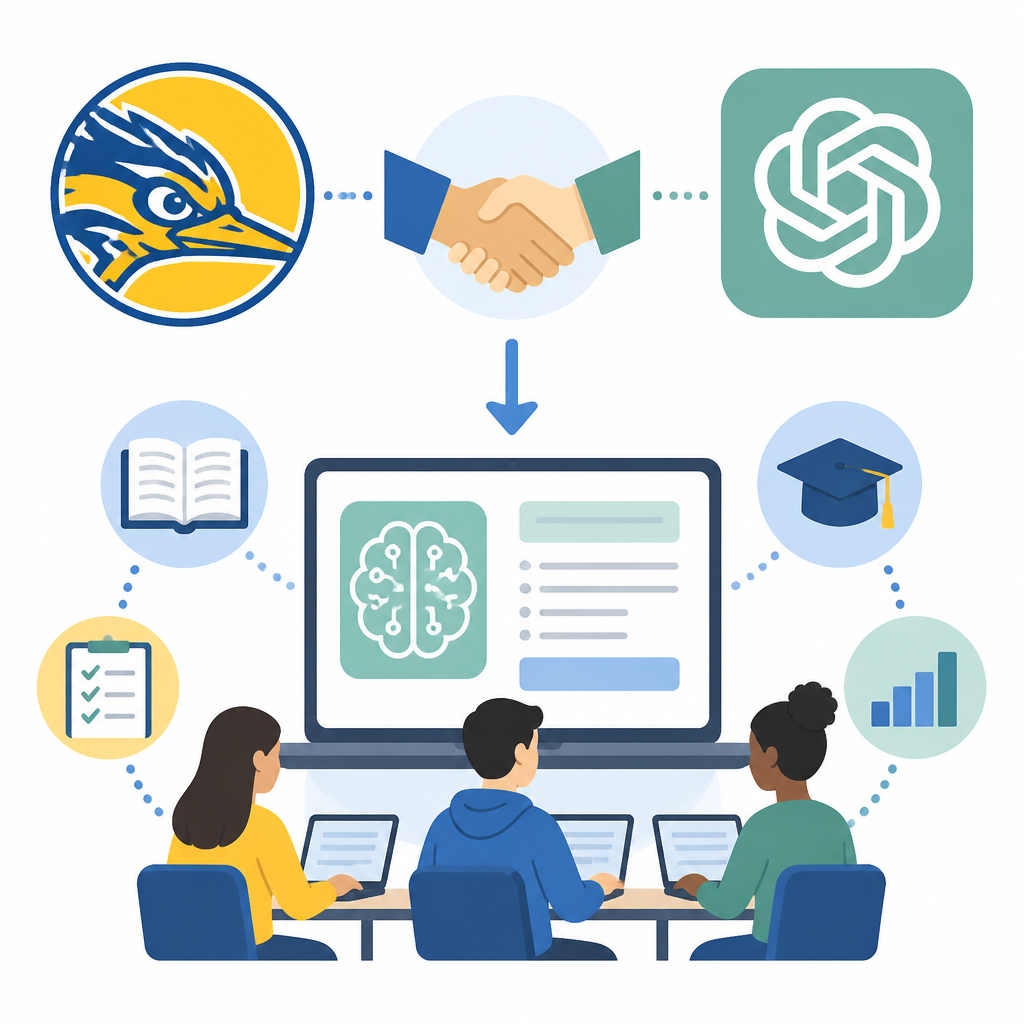
What this actually means is the partnership has a technical spine, which is good. Students should hear from people who build these systems. They should see what prompting looks like when it’s not just internet theater. They should understand model behavior, limitations, and failure modes. But if the course becomes a vendor demo, the whole thing gets flimsy fast.
I ran into this exact problem in a workplace training project. The vendor wanted to show off every feature. The employees wanted to know one thing: “Can I use this to save time without getting yelled at by legal?” Those are different questions. Universities have the same issue. Students need the practical version, not the sales version.
How to apply it: if you’re partnering with a tool company, split the responsibility. Let the vendor teach mechanics, examples, and product-specific workflows. Let the school or internal education team own the rubric, the ethics, the evaluation, and the actual assignment. That keeps the program from turning into a branded slideshow.
- Vendor teaches capabilities and limits.
- Institution teaches context, policy, and assessment.
- Students prove they can use the tool responsibly in a real task.
For a broader reference on AI education and model behavior, I’d point readers to the OpenAI API docs and the Google AI developer docs. Not because CSUB uses those exact resources in the article, but because anyone building curriculum around models needs to understand how these systems are documented in the real world.
The local nonprofit loop is the part I’d actually copy
The article says students will take their work to various local nonprofits after the classes, helping them with AI. That’s the strongest part of the whole setup. Too many university partnerships stop at the classroom door. Students do a project, get a grade, and the work disappears into a folder nobody opens again.
What this actually means is CSUB is trying to make the learning visible outside the university. That’s good pedagogy and good community design. Students learn faster when they know a real organization may use the output. Nonprofits get help they probably don’t have bandwidth to build themselves. And the university stops acting like its only job is to generate coursework that dies after finals week.
I’ve seen versions of this work in smaller settings too. The best ones are not fancy. A student team helps a nonprofit sort intake forms. Another team drafts a FAQ. Another maps a messy spreadsheet into something usable. None of that sounds glamorous, which is exactly why it works.
How to apply it: if you’re building a university, bootcamp, or internal academy program, create a post-class deployment path. Don’t stop at “students learned X.” Ask “who will use X next?” If you can’t answer that, your program is probably too abstract. Build a list of partner orgs, define the handoff, and make sure the student work ends in a real artifact.
For nonprofit collaboration and civic AI work, it helps to look at organizations like the Dolores Huerta Foundation, which the article says was part of the earlier workforce discussion, and to study local civic-tech examples rather than chasing abstract national trends.
The 70% stat is the part schools should stop ignoring
The article cites a 2025 Harvard Poll saying 70% of college students see AI as a threat to their job prospects. I’m glad the story included that because it explains why schools can’t just say “AI is here, get used to it.” Students are not being irrational. They are looking at a market that already feels unstable and then watching AI get inserted into every conversation about entry-level work.
What this actually means is the university has to do more than teach tool usage. It has to teach positioning. Students need to understand which tasks AI can accelerate, which tasks still need human judgment, and how to talk about that in interviews and portfolios. If a school skips that part, students will either overstate their skills or avoid the tools entirely.
I’m old enough to remember the internet panic Harper mentioned. He’s right that the pattern rhymes. New tech shows up, people assume it will flatten opportunity, then the market reorganizes around people who learned to work with it early. The difference now is that AI can also produce sloppy outputs at scale, which means the bar for judgment is higher, not lower.
How to apply it: if you teach or manage people, build a “what AI is for / what AI is not for” section into every program. Make students or staff write it down. Make them show examples. And for the love of sanity, include failure cases. People learn faster when they see where the tool breaks.
SPARKS works because it is narrow, local, and attached to outcomes
The CSUB program is called SPARKS, and that branding is fine, but the real value is not the name. It’s the structure. It’s narrow enough to be teachable, local enough to matter, and attached to outcomes that go beyond campus optics. That combination is rare, and it’s why this story is more interesting than a generic “university adopts AI” headline.
What this actually means is the program isn’t trying to solve everything at once. It’s not pretending to replace departments, faculty judgment, or student work. It’s building a pathway: learn the tools, apply them in class, extend the work into the community. That’s a model other schools can steal without needing a giant budget.
I’m not saying every campus should copy CSUB’s exact setup. I am saying the logic is sound. Start with one partnership. Tie it to a few real classes. Put students in contact with practitioners. End with a public-facing deliverable. That’s a lot better than another “AI task force” that produces a PDF nobody reads.
How to apply it: if you’re designing a similar program, use this checklist. Pick a domain. Pick three assignments. Pick one external partner type. Pick one post-class deployment path. Then define who owns each step. If you can’t answer those four things, you’re not ready to launch.
The template you can copy
# Campus AI partnership template

## Program name
[Your program name]

## One-line goal
Teach students how to use AI in a specific field, then apply that work with a real community partner.

## Core structure
- 1 external AI partner for technical input
- 1 campus lead for curriculum and assessment
- 3 courses or modules tied to real workflows
- 1 community partner network for post-class deployment

## Course design
### Course 1: Domain data cleanup
- Focus: messy datasets, classification, summarization, or mapping
- Student output: a cleaned dataset plus a short methods note
- AI use: assist with pattern detection and draft generation
- Human check: verify sources, labels, and assumptions

### Course 2: Domain analysis and reporting
- Focus: analysis of public records, field notes, or operational data
- Student output: a report with findings, limitations, and recommendations
- AI use: speed up first-pass analysis and outline creation
- Human check: fact-check every claim and cite every source

### Course 3: Community application lab
- Focus: building a usable artifact for a nonprofit, civic group, or local business
- Student output: FAQ, workflow guide, intake form, dashboard, or prototype
- AI use: drafting, structuring, and testing variations
- Human check: community review before handoff

## Guardrails
- Students must disclose AI use in every submission
- Students must explain what the model got wrong
- Students must show at least one non-AI baseline approach
- Faculty keeps grading criteria independent of vendor branding

## Partner handoff
1. Identify a local organization with a real workflow problem
2. Define one deliverable the organization can use immediately
3. Assign student teams to produce the deliverable
4. Review the output with the partner before final handoff
5. Document what worked, what failed, and what should change next term

## Prompting starter template
You are helping with a [domain] assignment.
Task: [specific task]
Audience: [who will use the output]
Constraints: [policy, style, length, citations]
Output format: [table, memo, checklist, draft, code]
Before answering, list the assumptions you made.
After answering, list the risks and what needs human review.

## Evaluation rubric
- Accuracy: Did the student verify the output?
- Judgment: Did the student catch model errors?
- Usefulness: Can the partner actually use the result?
- Transparency: Did the student disclose AI assistance?
- Reflection: Did the student explain what changed after review?

## Launch checklist
- [ ] Pick one department
- [ ] Pick one external partner
- [ ] Pick three assignments
- [ ] Write disclosure rules
- [ ] Write grading criteria
- [ ] Run one pilot section
- [ ] Collect feedback from students and partners
- [ ] Revise before scaling
If I were building this from scratch, I’d start with one pilot class, not three. But if the goal is to show how a university can make AI concrete instead of abstract, this template is the part I’d hand to another dean, program manager, or curriculum lead and say: take this, strip out the fluff, and adapt it to your own campus.
Source attribution: This breakdown is based on Connor Dore’s report for KGET 17 News at https://www.kget.com/news/local-news/csub-partners-with-ai-company-for-new-first-in-the-nation-program/. The template and commentary here are my own synthesis, not a reproduction of the article.
// Related Articles
- [TOOLS]
Docker Desktop on Windows in one clean install flow
- [TOOLS]
Grok 4.5 hits Cursor with $2/$6 pricing
- [TOOLS]
AGT turns agent calls into governed actions
- [TOOLS]
OpenClaw v2026.7.1 turns control UI into a workspace
- [TOOLS]
OpenAI’s screenless speaker turns ChatGPT into a companion
- [TOOLS]
SCALE turns CUDA code into portable GPU builds