Google OpenRL brings RL fine-tuning to Kubernetes
Google’s OpenRL lets teams run LLM post-training and fine-tuning on their own Kubernetes clusters.

Google OpenRL lets teams run LLM post-training and fine-tuning on their own Kubernetes clusters.
Google’s GKE Labs released OpenRL on June 24, 2026, and the pitch is simple: move reinforcement learning infrastructure off the researcher’s laptop and onto ordinary Kubernetes clusters. The project is experimental, but it already targets macOS, Nvidia GPUs, and Google Kubernetes Engine.
That matters because post-training LLM work gets messy fast. Google says a single RL loop can involve data prep, reward design, inference debugging, hardware provisioning, and cluster operations. OpenRL tries to split those concerns so researchers can focus on the recipe while platform teams handle execution and scale.
| Fact | Detail |
|---|---|
| Release date | June 24, 2026 |
| Target environments | macOS, Nvidia GPUs, GKE |
| Core use case | Self-hosted API for LLM post-training and fine-tuning |
| Example workflow | Parallel parameter sweeps for text-to-SQL on Gemma |
Why Google is splitting RL from the cluster
Get the latest AI news in your inbox
Weekly picks of model releases, tools, and deep dives — no spam, unsubscribe anytime.
No spam. Unsubscribe at any time.
OpenRL is built around a practical complaint: most RL tooling mixes research logic with infrastructure logic. In Google’s view, that makes every experiment harder to reproduce and every scaling decision more painful than it needs to be.
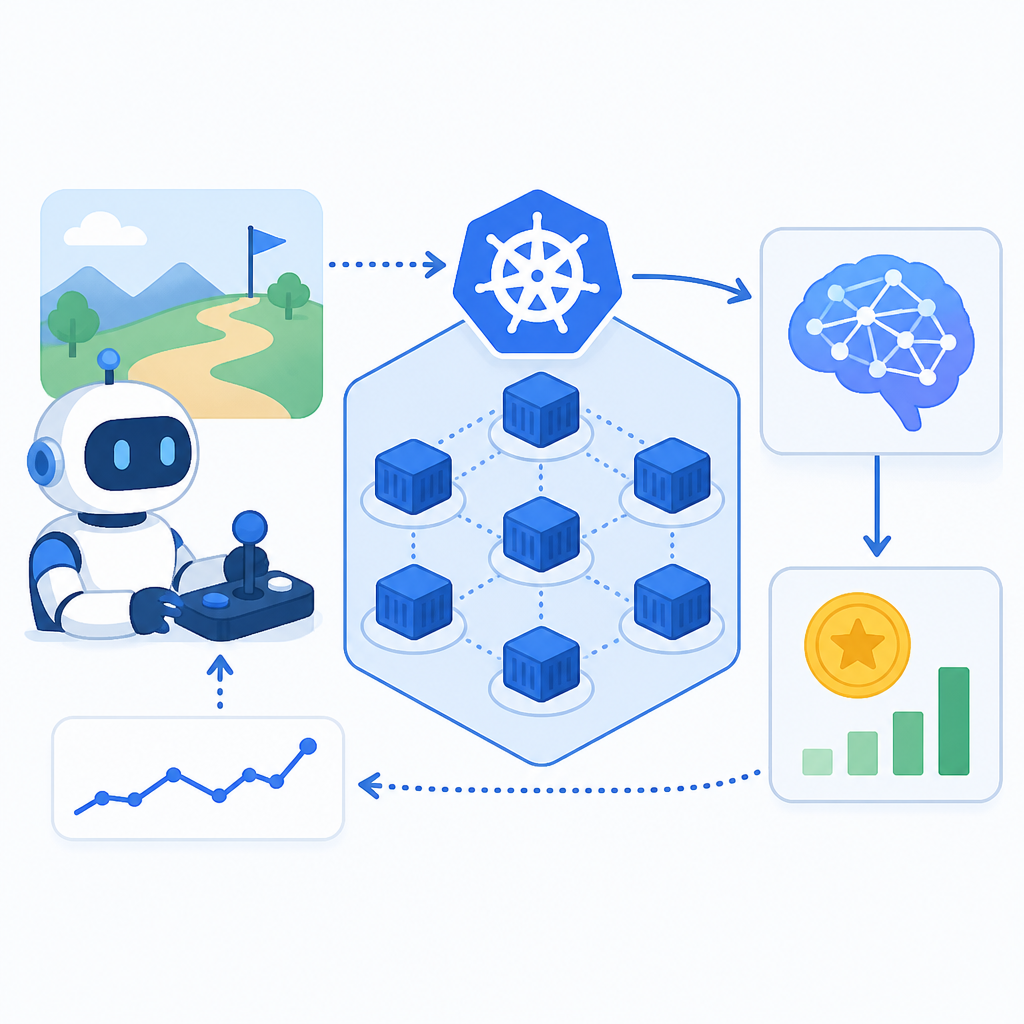
The project follows the same basic idea that made Kubernetes so influential in application infrastructure. Researchers should describe what they want to train; the platform should decide where it runs, how it scales, and how failures get handled.
Google engineers describe the benefit in plain terms. If the RL loop is separate from the machines doing the work, a researcher can run experiments from a Mac while the cluster handles the heavy lifting. That is a much cleaner setup than keeping the entire workflow tied to a single GPU box.
- Researchers can iterate on reward design without touching cluster internals.
- Platform teams can run multiple jobs on shared infrastructure.
- GPU time is less likely to sit idle while CPU-bound or network-bound steps finish.
- Teams get a clearer boundary between model logic and execution logic.
What OpenRL actually changes in practice
The biggest promise here is better GPU utilization. Google says traditional RL loops are often sequential, which means expensive accelerators wait around while other parts of the pipeline finish. OpenRL can run multiple jobs on the same infrastructure, which helps keep those GPUs busier.
That is a useful shift for teams doing post-training on large models, where hardware time is usually the bill that hurts first. It also gives teams room to test more variants in parallel, instead of serializing every change through one long-running loop.
OpenRL also ships with an autoresearch recipe that demonstrates parallel experiments for parameter sweeps and reward refinement in a text-to-SQL workflow for Gemma models. That example matters because it shows the project is aimed at real iteration speed, not just infrastructure elegance.
“It is incredibly easy to get bogged down in system complexity,” Google engineers wrote in the OpenRL announcement.
The quote gets to the heart of the project. RL for LLMs already asks teams to solve a hard model problem; adding infrastructure friction on top of that turns every experiment into a systems project. OpenRL tries to remove that extra tax.
How OpenRL compares with other post-training stacks
OpenRL is not the only project trying to separate fine-tuning recipes from execution details. FeynRL takes a similar approach by keeping the training recipe apart from system logic, while still allowing scale-out through tools like DeepSpeed, Ray, and vLLM.
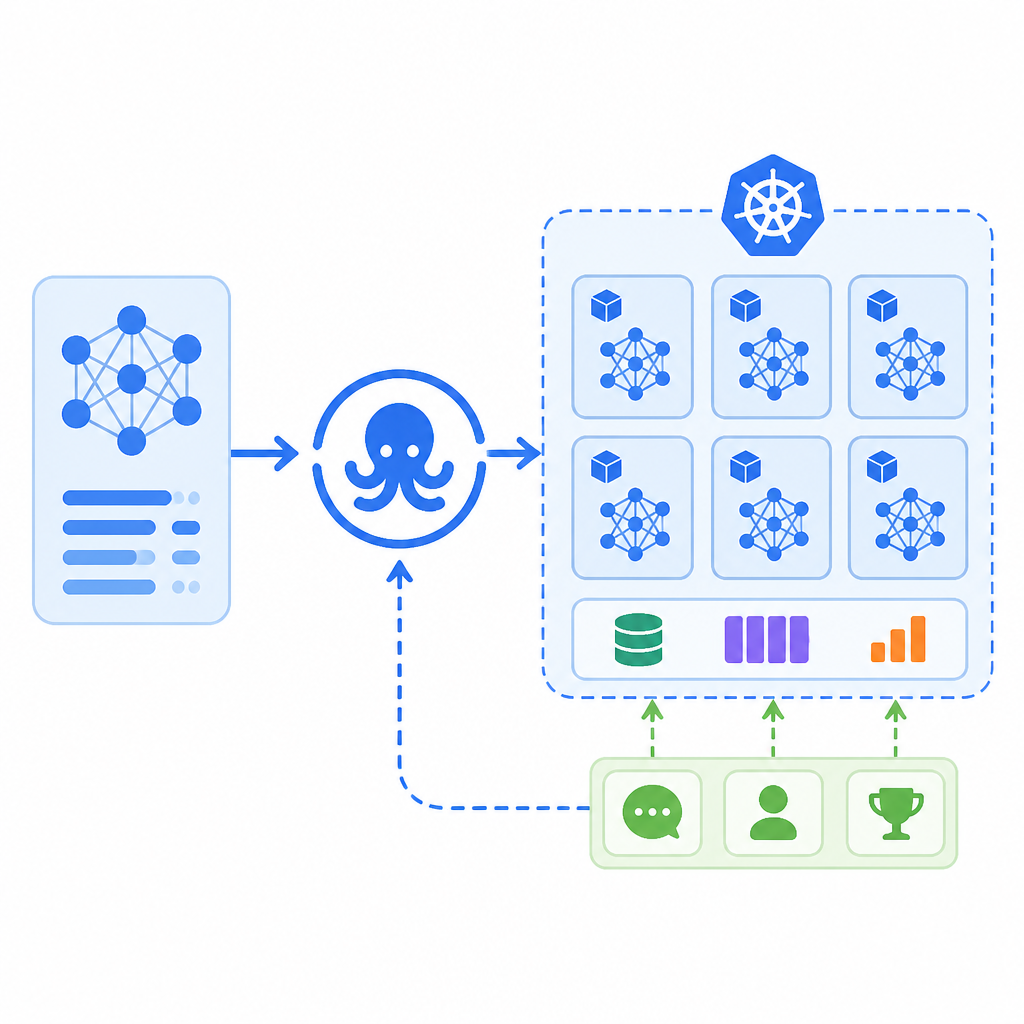
That comparison is useful because it shows where the market is heading. Teams do not want a monolithic training framework that hides everything. They want a thin API that lets researchers move quickly while giving operators enough control to keep the cluster predictable.
- OpenRL emphasizes a self-hosted API on standard Kubernetes clusters.
- FeynRL focuses on separating recipes from system logic.
- DeepSpeed, Ray, and vLLM solve scale and execution problems lower in the stack.
- Tinker-Cookbook compatibility gives OpenRL another integration path through a Tinker-style endpoint.
OpenRL is also a sign that the center of gravity for AI work is moving deeper into the post-training phase. Pretraining gets the headlines, but the teams shipping useful assistants and agents spend a lot of time on reward shaping, evaluation loops, and domain-specific tuning.
What this means for AI teams now
For engineering teams, the immediate takeaway is not that every RL workflow should move to Kubernetes tomorrow. It is that the old boundary between research code and infrastructure code is getting clearer, and that boundary matters if you want faster iteration and lower ops overhead.
If your team already runs model workloads on Kubernetes, OpenRL may be worth a close look once it matures beyond experimental status. If you are still treating RL fine-tuning as a one-off notebook exercise, this release is a reminder that the tooling is moving toward shared, repeatable, self-hosted workflows.
The more interesting question is whether OpenRL becomes a reference point for how post-training APIs are built. If Google keeps pushing this model, the next wave of LLM tooling may look less like a pile of scripts and more like a clean control plane for experiments, execution, and scale.
For now, the practical move is simple: if your team is spending more time wiring up RL infrastructure than improving the model, OpenRL is exactly the kind of project to watch.
// Related Articles
- [MODEL]
August 2026 model rankings: Claude leads text, Kimi coding
- [MODEL]
Qwen3.8-Max pushes Alibaba into the top tier
- [MODEL]
Qwen3.8-Max proves that agentic work is the real frontier
- [MODEL]
Google Earth Should Not Ship AI Image Generation
- [MODEL]
Try Claude Opus 4.7 and read its benchmarks
- [MODEL]
Opus 5 lets you cut cost without losing quality