Meta is replacing moderators with AI to cut costs
Meta is shifting content moderation to large language models, with human review set to drop sharply as AI spending climbs.

Meta is shifting most content moderation work from humans to large language models.
Meta has started handing a much larger share of content review to AI, and the scale is hard to miss. According to a Financial Times report cited by Business Upturn, the company has already moved about half of its moderation requests to large language models this year, with some categories expected to see human involvement fall by more than 90% before year-end.
| Metric | Reported figure | What it means |
|---|---|---|
| Moderation requests shifted to AI | About 50% | AI is already handling a major share of review work |
| Expected drop in human involvement | More than 90% in some categories | Humans may be limited to edge cases |
| Publication date | Jun. 25, 2026 | The change is happening now, not later |
Meta is betting that moderation can be automated
Get the latest AI news in your inbox
Weekly picks of model releases, tools, and deep dives — no spam, unsubscribe anytime.
No spam. Unsubscribe at any time.
The move fits into a much bigger push by Meta to pour money into AI infrastructure, talent, and model development. CEO Mark Zuckerberg has been talking up “personal superintelligence,” and that ambition comes with a very high bill. Cutting operating costs in older parts of the business helps make room for those investments.

Content moderation is one of the easiest places to look for savings because it is expensive, global, and constant. Every day, Meta has to review posts, videos, comments, ads, and appeal requests across Facebook, Instagram, Threads, and WhatsApp. That work has traditionally depended on a mix of software filters and human reviewers who make the final call when a post is borderline or an appeal gets messy.
Now Meta appears to be saying that a lot of those decisions are routine enough for an LLM to handle. That is a big statement, because moderation is one of the few AI use cases where the stakes are obvious to regular users. A mistake does not stay inside a test environment. It shows up as a post that disappears, a scam that stays up, or a creator who loses reach without a clear explanation.
- Meta has already moved roughly half of review requests to LLMs
- Some content categories may lose more than 90% of human review
- The company is trying to offset massive AI infrastructure spending
- Moderation touches Facebook, Instagram, Threads, and WhatsApp
The cost math explains the timing
The moderation shift makes sense when you look at Meta’s spending profile. AI infrastructure is expensive in a way that ordinary product updates are not. Data centers, advanced chips, research staff, and top-tier AI hires all add up fast, and Meta has been buying on all fronts.
That creates pressure to trim costs elsewhere. Human moderation has long been one of Meta’s biggest recurring expenses because the company operates at global scale and has to deal with local laws, languages, and politics. Replacing a large chunk of that work with software could save billions of dollars each year, which is exactly the kind of number that matters when a company is funding a multi-year AI race.
“The shift will allow us to reduce the amount of content that needs to be reviewed by people,” Mark Zuckerberg said during Meta’s 2024 earnings call.
Zuckerberg’s comment matters because it shows this is not a side project. Meta has been signaling for months that AI will touch more of the company’s core operations, and moderation is now one of the clearest examples of that strategy in action.
What makes this especially notable is that Meta is not just using AI to help moderators work faster. It is trying to make AI the primary reviewer for a growing slice of decisions. That is a much bigger bet, and it changes how the company thinks about trust and safety.
AI can process scale, but context is still the problem
Large language models are good at pattern recognition, fast classification, and handling huge volumes of text. Those strengths matter when millions of posts need to be screened every day. They are also cheaper than large human teams, and they do not need shifts, training breaks, or regional staffing plans.
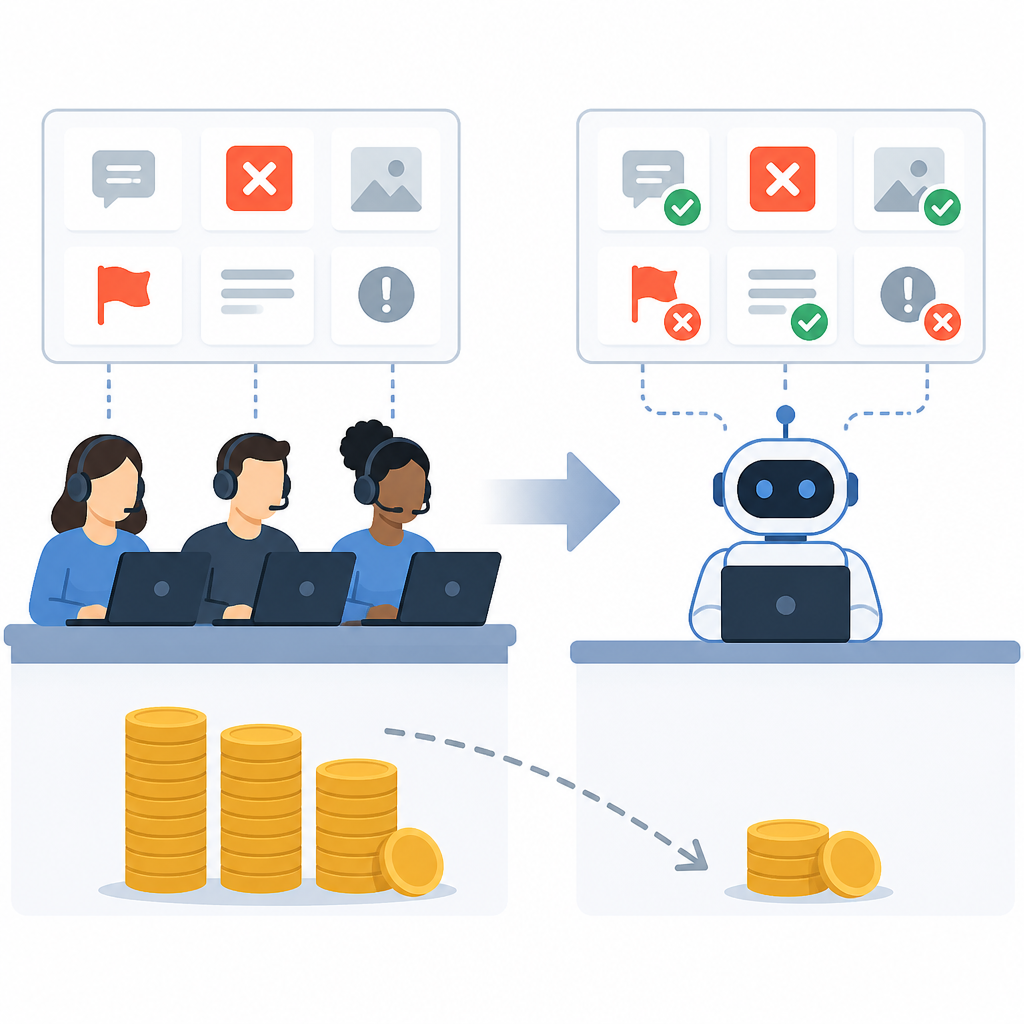
But moderation is full of edge cases. A joke can look like harassment. A political post can be misinformation in one country and protected speech in another. A slang term can mean one thing in the US and something very different in another market. That is where human judgment still matters.
- AI is fast and cheap, which helps with high-volume screening
- Humans are better at sarcasm, cultural nuance, and context-heavy appeals
- Bad calls can remove legitimate speech or leave harmful content online
- Appeals are often the hardest part to automate well
This is why Meta’s plan is more interesting than a simple cost-cutting story. It is also a live test of whether current AI systems can do a job that has always required judgment, policy knowledge, and a tolerance for ambiguity. If the company gets it wrong, users will notice quickly.
Other tech companies are watching closely
Meta is not the only company trying to use AI to shrink expensive human workflows. OpenAI, Anthropic, and Google are all pushing AI deeper into products and internal operations. But Meta’s moderation system is one of the most visible places where the economics of AI meet the realities of public platform governance.
If Meta can safely automate most routine moderation, the company will have a template that other large platforms may copy. If it cannot, then the limits of LLM-based review will be obvious, and human moderation will remain more important than the cost models suggest. Either way, the next few quarters will tell us whether AI moderation is a serious operating model or just a cheaper first pass.
The real question is whether Meta is building a better moderation stack or simply moving faster than its ability to explain mistakes. If human review drops by 90% in some categories, users should expect faster decisions and more automation, but also more disputes over what the system gets wrong. That tradeoff will be the story to watch, especially as Meta keeps spending heavily on AI and asks software to do work that used to require people.
// Related Articles
- [IND]
OpenAI’s Astra pause shows safety now shapes model releases
- [IND]
Anthropic is building custom AI chips for Claude
- [IND]
Moka AI Is a Stronger HRMS Choice for Growing Teams
- [IND]
August 2026 Market Review: AI Stocks Flipped Fast
- [IND]
Pixel 11 launch live: every Google reveal
- [IND]
Anthropic’s invisible watermark is the right move